The Modern Homeowner Guide to Aluminium Landscape Edging

Benefits of Aluminium Landscape Edging vs. Other Materials
When designing outdoor living spaces, picking the right edge restraint determines whether a garden maintains its defined shape or slowly bleeds into surrounding turf. Edging made from aluminium alloy (most commonly architectural grade 6063 or heavy-duty 6005A T6) provides a combination of structural rigidity and hand-formable flexibility.
One major reason homeowners and contractors choose aluminium is its natural oxide layer. Unlike raw carbon steel, aluminium produces a microscopic, self-repairing surface film that prevents deep structural corrosion. It never flakes, rusts, or stains adjacent light-colored concrete pavers. Furthermore, quality aluminium edging systems are 100% recyclable, often composed of at least 80% recycled metal, making them eligible for LEED green-building points.
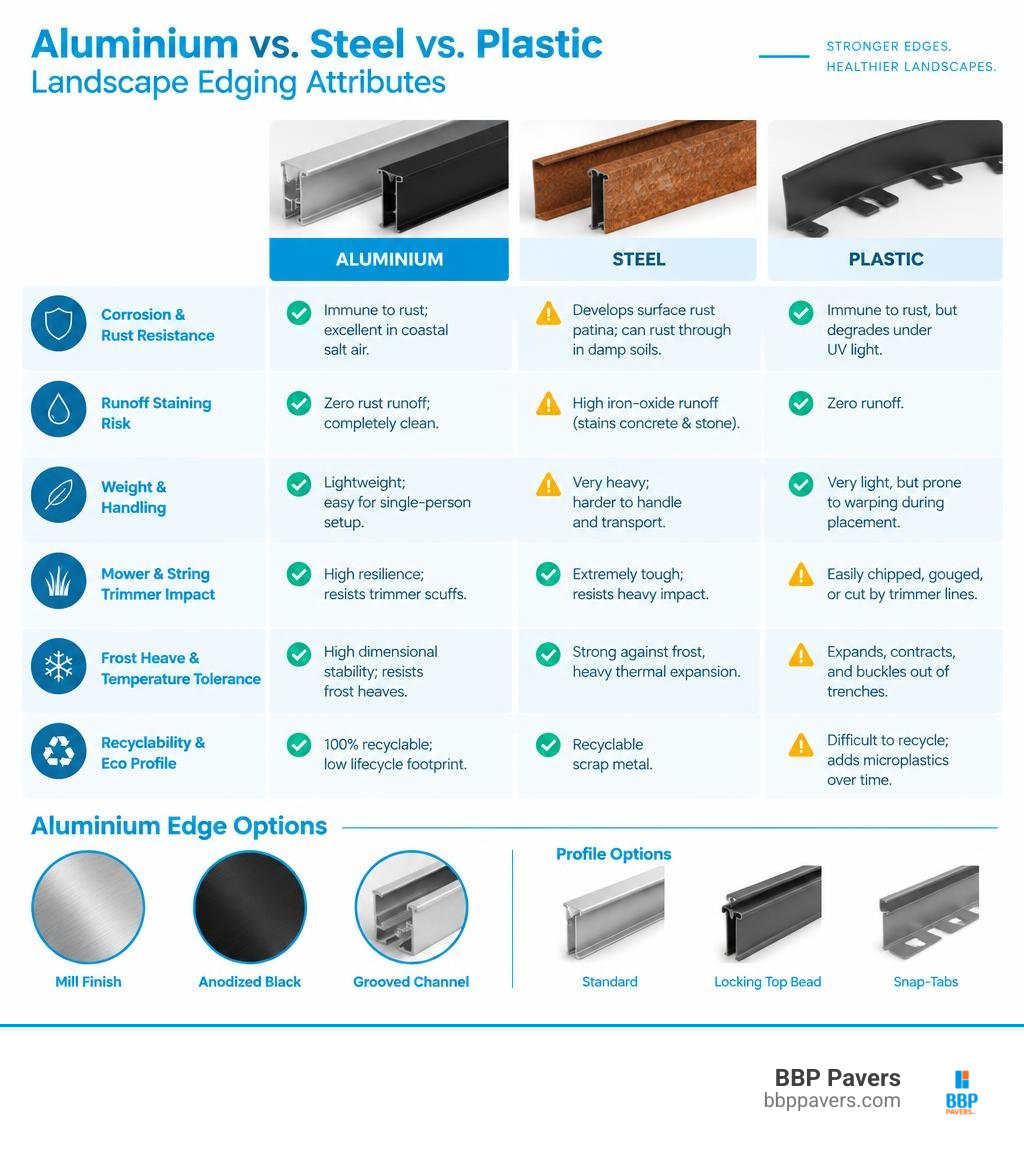
| Feature / Metric | Architectural Aluminium (6063/6005A) | Corten / Carbon Steel | Heavy-Duty Plastic / Poly |
|---|---|---|---|
| Corrosion & Rust Resistance | Immune to rust; excellent in coastal salt air | Develops surface rust patina; can rust through in damp soils | Immune to rust, but degrades under UV light |
| Runoff Staining Risk | Zero rust runoff; completely clean | High iron-oxide runoff (stains concrete & stone) | Zero runoff |
| Weight & Handling | Lightweight; easy for single-person setup | Very heavy; harder to handle and transport | Very light, but prone to warping during placement |
| Mower & String Trimmer Impact | High resilience; resists trimmer scuffs | Extremely tough; resists heavy impact | Easily chipped, gouged, or cut by trimmer lines |
| Frost Heave & Temperature Tolerance | High dimensional stability; resists frost heaves | Strong against frost, heavy thermal expansion | Expands, contracts, and buckles out of trenches |
| Recyclability & Eco Profile | 100% recyclable; low lifecycle footprint | Recyclable scrap metal | Difficult to recycle; adds microplastics over time |
Aluminium vs. Steel and Plastic Borders
Choosing between materials comes down to longevity, appearance, and maintenance. Steel delivers unmatched raw rigidity, but traditional carbon steel requires protective paint that eventually chips away. Even weathered Corten steel—popular for rustic outdoor spaces—sheds rust runoff during rainy seasons. If that runoff touches porous travertine, wet-cast concrete, or pale driveway pavers, it leaves permanent orange marks. Aluminium completely eliminates rust-bleed risks, which is vital when bordering light hardscapes.
Plastic edging is inexpensive at the hardware store, but sun exposure breaks down polymers over time. Within a few seasons, plastic strips become brittle, warp along straight runs, and pop out of the ground due to soil movement. Aluminium stays anchored below the grass line, maintaining clean lines year after year. For complex layouts requiring stone borders, exploring why landscape stone curbing outlasts flimsy yard borders shows why rigid materials are worth the upfront investment.
Material Types, Finishes, and Profile Options
Aluminium borders are manufactured through extrusion, allowing for precise structural features like grooved channels, locking top beads, and snap-tabs.
Depending on your aesthetic goals, three primary finishes dominate the landscape market:
- Mill Finish (Natural Silver): Raw extruded aluminium with a soft metallic sheen. It oxidizes naturally to a low-glare matte gray. It offers maximum value and blends invisibly against crushed stone or between lawn turf and gravel paths.
- Anodized Coatings: An electrochemical process that thickens the natural oxide layer, making it up to ten times harder than standard metal. Anodized coatings (common in satin black or deep bronze) are scratch-resistant and will not peel or flake.
- Architectural Powder Coating: Baked-on polymer powder offering broad color flexibility, including textured earth tones and Corten-mimicking patinas. It provides an extra layer of defense in high-salinity coastal areas.
Sizing and Profiles for Aluminium Landscape Edging
Profile depth determines whether an edge restraint serves merely as a visual separator or as an active root barrier. Standard manufactured heights range from 18 mm (approx. 0.75 inches) up to 200 mm (approx. 8 inches), with thickness profiles typically varying between 1/8-inch (3.2 mm) for residential borders and up to 8.5 mm for heavy commercial applications:
- 2-Inch to 4-Inch Heights: Ideal for demarcating flower beds, separating grass from decorative mulch, or restraining residential pathway gravel. For instance, commercial Pro Aluminum Landscape Edging – 60350 – 8′ x 1/8” x 4” Mill Finish – 1 — Longview Supply offers a balanced 4-inch profile that stops turf grass stolons while remaining discreet.
- 6-Inch Heights: The standard depth for vegetable patches, raised soil containment, and aggressive spreading grasses like Bermuda or Kikuyu.
- 8-Inch Heights: Deep containment profiles designed for sloped terrains, heavy crushed stone bases, or permeable pavement applications where sub-base stabilization is essential.
For heavy hardscapes, specialized angle profiles like AluExcel and AluExcel – Aluminium Edging | Kinley provide structural L-shaped footings designed to retain block pavers, wet-pour safety surfaces, and hot tarmacadam up to 180°C.
Modern Color Options and Aesthetic Finishes
Selecting the right color lets you blend borders into your surroundings or treat them as graphic design elements:
- Matte Black: Complements modern architectural properties, charcoal pavers, and dark organic mulches.
- Deep Bronze Patina: Pairs with warm flagstone, decomposed granite, and earthy brown tones.
- Brushed or Mill Silver: Creates crisp contrast against bright green sod, river rock, or dark basalt gravel.
For more design inspiration on pairing metal edges with masonry, take a look at these creative landscape stone border ideas to define your lawn.
Step-by-Step Installation Methods and Best Practices
Installing aluminium edging requires proper site preparation, consistent trench depth, and secure anchoring.
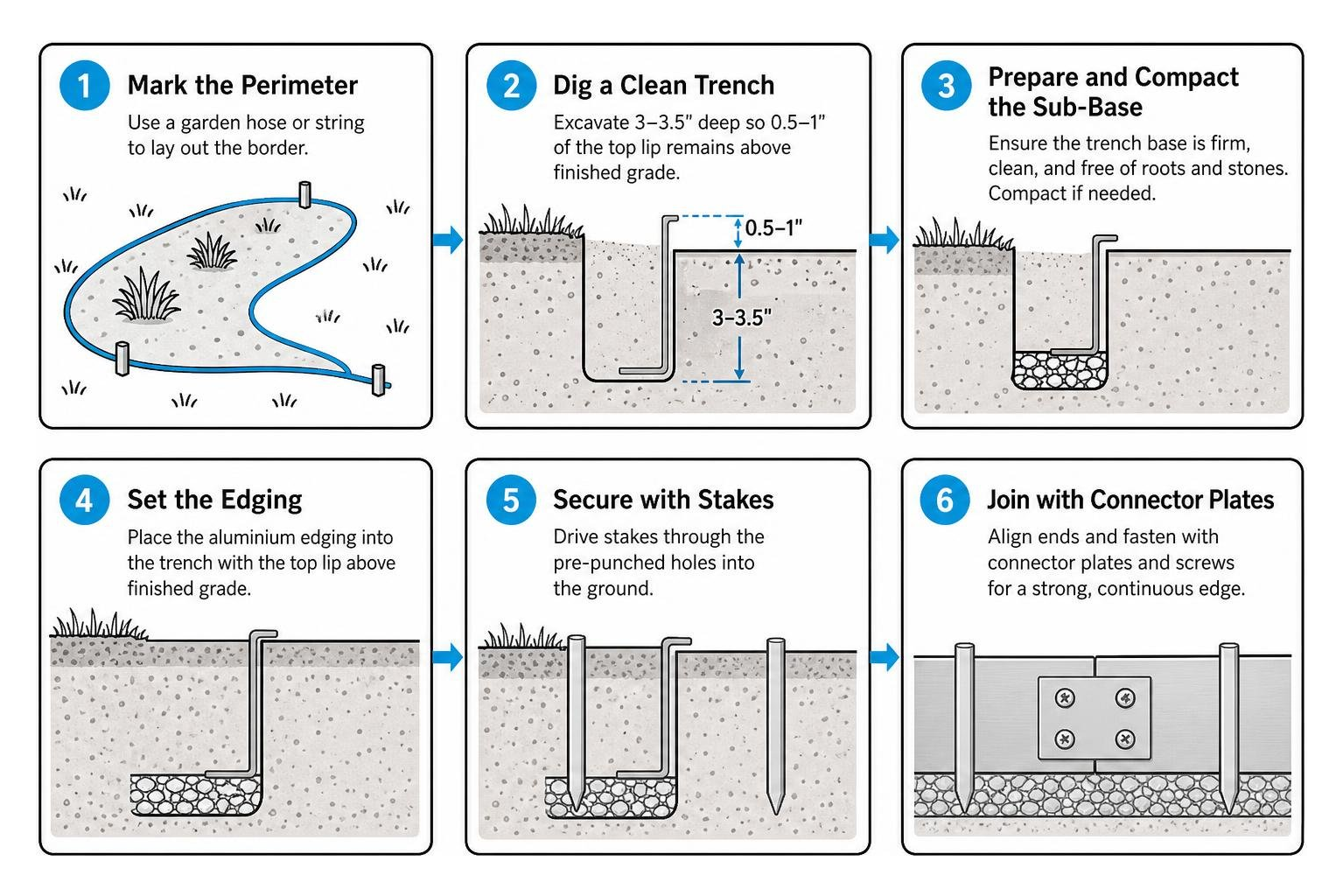
How to Install Aluminium Landscape Edging
- Mark the Perimeter: Lay out the border using a garden hose or rope for smooth curves, or survey string tied to stakes for crisp, straight runs.
- Dig a Clean Trench: Cut a vertical trench along your layout line using a flat spade or trenching tool. For a standard 4-inch profile, excavate roughly 3 to 3.5 inches deep so that approximately 0.5 to 1 inch of the top rounded lip stays above finished soil level. This keeps mower blades safely above the metal.
- Prepare and Compact the Sub-Base: Ensure the base of your trench is firm and free of buried stones or tree roots. For structural applications, a light, compacted crushed-rock base prevents settlement.
- Connect Section Joints: Join lengths end-to-end. Depending on the brand, you will use slide-in connector stakes, overlapping slide-and-groove joints, or patented telescoping systems that slide inside adjoining pieces to create seamless joints without joint gaps.
- Shape Curves or Straight Runs: Form curves gently by hand over your knee or around a smooth cylinder before pinning. For heavy structural profiles, using systems like Buy Pro Edge Aluminium Path Edging | Core LP or CORE PRO EDGE – Flexible Aluminium Landscape Edging by CORE Landscape Products allows you to snap out pre-cut tabs along the base with pliers to create smooth sweeping curves, while leaving tabs intact keeps straight runs rigid.
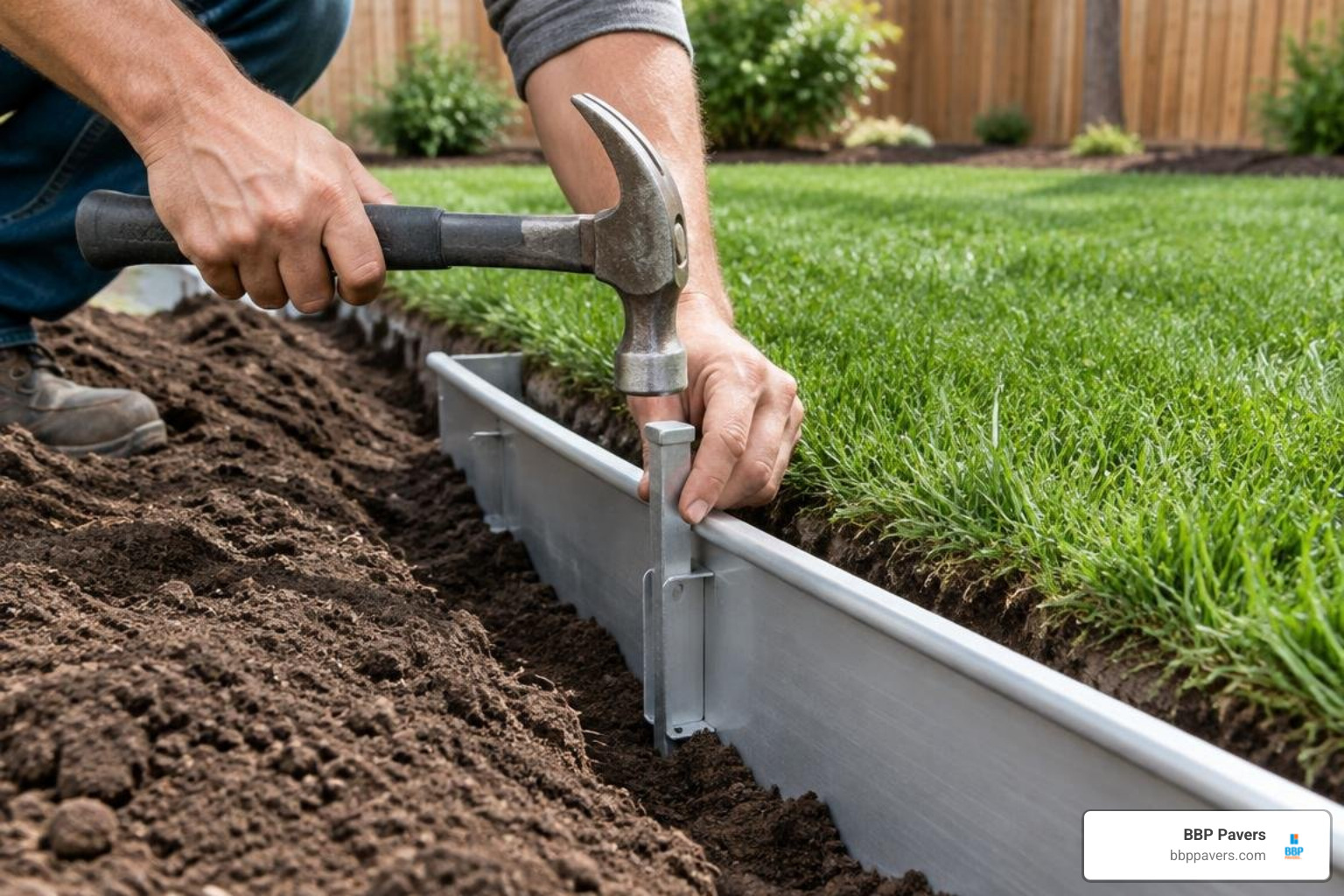
- Drive Anchor Stakes: Secure each strip by driving heavy-duty 10-inch to 12-inch aluminium stakes or spiral pins through the integrated stake pockets at an angle (usually 45 degrees into the undisturbed turf bed).
- Backfill and Tamp: Backfill both sides of the edging with soil, mulch, or gravel, tamping firmly along the strip to lock everything in place.
When integrating borders with custom hardscapes, learn how to master landscape edging with pavers for a flawless yard to keep your patio stones and planting beds aligned.
No-Dig vs. Traditional Hammer-In Systems
Homeowners often choose between traditional trench-set edging and surface-mounted “no-dig” kits:
- Hammer-In / In-Ground Trench Systems: These offer superior structural integrity and long-term durability. By seating 3 to 7 inches of metal underground, they act as true subterranean barriers against invading weed roots. They easily withstand lawn mower wheels, heavy foot traffic, and winter frost cycles.
- No-Dig Systems: These sit flat on cleared soil and secure via horizontal base tabs and heavy spikes driven through top-facing holes. While installation is faster, no-dig strips do not block subterranean grass runners as effectively. They work best on flat ground, over tree root zones where digging is impossible, or to contain aggregate paths.
For driveways and heavy traffic borders, explore our guide to concrete edging for driveways practical styles to boost curb appeal to evaluate whether metal or cast masonry suits your vehicle loads best.
Cost Breakdown and Planning Your Garden Perimeter
Aluminium edging is an economical mid-to-high-tier landscape border. While more expensive than flexible plastic rolls, its 25-plus-year lifespan makes the lifetime cost per year significantly lower.
- Residential DIY Kits (Amazon / Big Box Stores): Entry-level 24-foot kits typically range from $65 to $135 depending on gauge and finish. For example, the EasyFlex 48-foot Project Kit retails around $115 to $140, while premium kits like Dreamscape E-Z Edge (24-foot kits) run around $133 for heavy-gauge metal.
- Commercial Cartons & Contractor Bundles: High-grade 1/8-inch commercial edging (such as 112-linear-foot cartons containing 14 eight-foot sections) generally costs between $580 and $695 per carton ($5.20 to $6.20 per linear foot for materials alone).
- Accessories & Hardware: Extra 12-inch interlocking spiral stakes, 90-degree corner connectors, and end caps usually add $15 to $35 per 50 linear feet.
To estimate material needs for your yard, calculate the total perimeter of all garden beds, walkways, and tree rings, then add an extra 10% allowance to account for overlap joints, curve adjustments, and corner cuts.
Pairing your borders with the right plantings completes the design. Check out our recommendations for the best plants to border your paver walkway to find low-maintenance varieties that won’t spill past your new edging line. For regional projects, you can also see how we handle driveway edging Concord CA across challenging soil types.
Frequently Asked Questions About Landscape Borders
How long does aluminum landscape edging last?
Architectural aluminium landscape edging easily lasts 25 to 40 years or more. Because it does not contain iron, it cannot rust away in damp soil. Its surface oxidizes naturally to protect the underlying structural alloy, resisting degradation from soil microbes, lawn chemicals, irrigation water, and UV rays.
Can you bend aluminum edging for curves?
Yes. Residential and commercial grades of tempered aluminium bend smoothly by hand to follow garden curves, sweeping walks, and tree rings. For tight radii, bend the strip gradually around a fixed circular object (like a bucket or 5-gallon nursery pot). Systems like CORE PRO EDGE – Flexible Aluminium Landscape Edging by CORE Landscape Products feature built-in snap-out tabs along their base flange that can be removed with pliers to allow tight bends without buckling.
What depth of edging is best for garden beds?
For standard residential garden beds containing 2 to 3 inches of mulch, a 4-inch deep profile is ideal—with 3 inches buried in the soil and 1 inch exposed above grade. If you are dealing with aggressive, deep-rooting grasses, sloped retaining areas, or loose pea gravel, step up to a 6-inch or 8-inch depth to provide adequate underground root and stone containment.
To compare metal edging with traditional masonry approaches, browse our guides on top stone edging options every homeowner should know and concrete edging blocks simple strategies for long-lasting borders.
Conclusion
Aluminium landscape edging provides clean lines, reliable soil containment, and lasting durability without rust or warping. Whether you are framing winding flower beds, defining a gravel path, or establishing crisp separation along your lawn, choosing high-grade aluminium ensures a low-maintenance landscape that looks great year after year.
At BBP Pavers, we bring over 20 years of Bay Area hardscape expertise to every project, designing and installing custom paver driveways, patios, walkways, retaining walls, and complete landscape renovations. If you are ready to enhance your outdoor living space with premium materials, expert installation, and a 100% satisfaction guarantee, explore all our edging stone options landscaping resources and contact our team today for your free project consultation and quote!