Concrete Edging Blocks: Simple Strategies for Long-Lasting Borders

Concrete Edging Blocks: Simple Strategies for Long-Lasting Borders
Choose Concrete Edging Blocks for Strong, Clean Landscape Borders
Concrete edging blocks create a durable border between lawns, planting beds, patios, walkways, and driveways. Choose a style that matches your space, install it on a compacted base, and use proper drainage to help the border stay level through changing Bay Area weather.
For most homes, the best choice comes down to the look and job required:
- Wood-grain blocks add the warmth of timber without rot, termites, or regular staining.
- Brick-style blocks give garden beds and paver edges a traditional, structured appearance.
- Smooth or polished blocks suit modern patios, driveways, and minimalist outdoor designs.
Unlike untreated wood, concrete does not decay or attract wood-boring pests. It also holds a sharper line than flexible plastic edging. The tradeoff is weight: some large precast units are heavy enough to require two people, lifting equipment, or professional installation.
The right edging does more than make a yard look finished. It helps contain mulch and soil, limits gravel migration, protects paver edges, and creates intentional transitions between hardscape and planting areas.
Types and Styles of Concrete Edging Blocks
When selecting concrete edging blocks for your outdoor spaces, manufacturing methods and styling choices dictate both aesthetic performance and installation requirements. Concrete border units fall into two main fabrication styles: wet cast and dry cast.
Wet cast concrete uses a fluid mix poured into detailed molds, producing dense, high-strength units with intricate textures like natural timber grain or ultra-smooth architectural planes. Dry cast concrete relies on zero-slump mixes compacted under intense mechanical vibration and pressure, creating classic masonry textures, exceptional compressive strength, and uniform modular sizing.
Homeowners exploring top stone edging options every homeowner should know can tailor their design choices using these structural and stylistic categories:
Wood-Grain and Rustic Concrete Edging Blocks
For properties that benefit from a natural, organic vibe, wood-inspired concrete units capture the warmth and charm of authentic timber without the vulnerability to decay. High-definition molds duplicate deep bark grain, natural knots, and weathered growth rings on up to five visible sides.
Because concrete is naturally impervious to moisture and boring insects, you enjoy a rustic look without worrying about termites throwing an uninvited backyard party. Leading textured garden edging stone specifications highlight large single-unit sizes—often measuring 48 × 8 × 6 inches (1,219 × 203 × 150 mm) and weighing around 190 lbs each. These substantial wet-cast stones offer built-in UV resistance to minimize color fading under intense summer sun while providing enough physical mass to secure soil transitions and low planters.
For a traditional, weathered brick profile, modular dry-cast systems (such as Brandon Edge | Garden Edging Stones | Techo-Bloc) offer multi-length combinations—commonly 8 7/8 in, 12 13/16 in, and 16 3/4 in (225 mm, 325 mm, and 425 mm) with a consistent 7 1/16-inch (180 mm) height. Available in earth tones such as Chestnut Brown, Shale Grey, Champlain Grey, Onyx Black, and Caffè Crema, modular sizes allow flexible curves and structured patterns that coordinate with stone patios.
Sleek Architectural and Polished Finishes
Modern residential architecture demands clean lines, refined geometry, and minimal visual noise. Architectural smooth and polished concrete units deliver this sharp, contemporary aesthetic.
- Smooth Finishes: Double-sided, wet-cast units like those found in architectural smooth edging specifications provide a silky, uniform surface on all exposed faces. Available in 90 mm (3 9/16 in) and 180 mm (7 1/16 in) heights, they define modern walkways and crisp turf perimeters.
- Polished Finishes: For a granite-inspired look, Raffinato Edge Polished | Garden Edging Stones | Techo-Bloc units undergo surface polishing that reveals fine aggregate flecks beneath the surface. Available in sophisticated shades like Beige Cream, Greyed Nickel, and Onyx Black, these units create luxurious borders along modern driveways and terraces.
Key Applications Across Residential Landscapes
Concrete edging blocks do heavy-duty structural work in home landscapes. Whether establishing an uninterrupted border along driveway edging concord ca or stabilizing walkway pavers concord ca elegant paths, these sturdy masonry units protect underlying hardscape layers from lateral movement while maintaining pristine separation between landscape elements.
Garden Beds and Walkway Borders
In high-traffic garden zones, concrete borders create a physical barrier that keeps lawn turfgrass from invading planting beds and stops bark mulch from spilling over onto walking surfaces. Their durable flat surfaces also serve as a smooth mowing strip, letting mower wheels glide along the edge without chewing up plants or damaging the border.
When selecting the best plants to border your paver walkway, concrete units provide a clear structural transition that frames trailing groundcovers, ornamental grasses, and blooming perennials. Reviewing creative paver walkway ideas shows how contrasting concrete borders can outline natural flagstone, clay brick, or slate paths with crisp visual discipline.
Low Retaining Walls and Raised Planters
On sloped sites, multi-functional edging blocks pull double duty as grade transitions and low earth-retaining walls. Multi-height architectural units include hollow core channels that reduce handling weight, align block pins, and evacuate subsurface water.
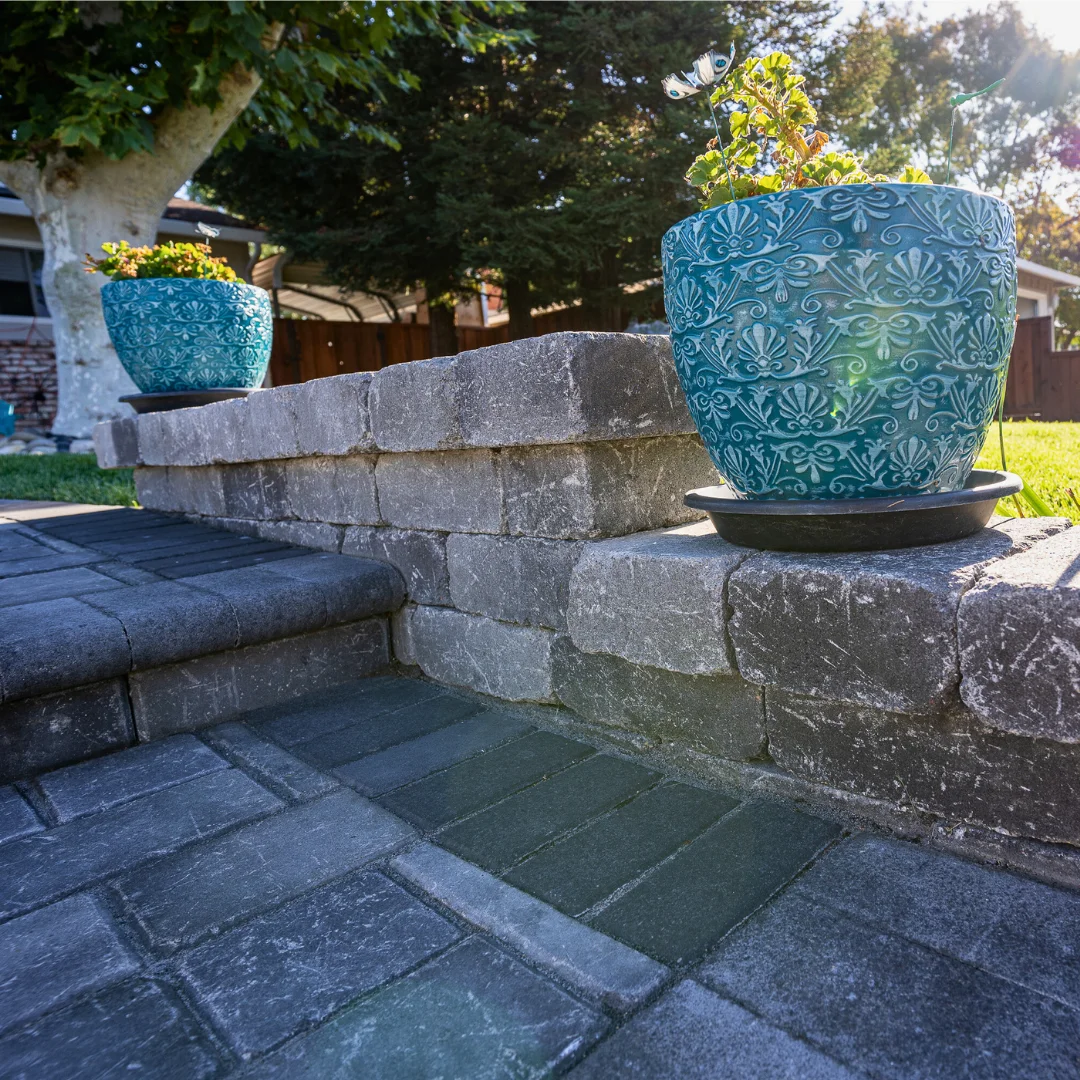
Double-sided blocks let you build freestanding seating walls, terrace borders, and raised garden beds that look completely finished from every vantage point. For front yard slope management, reviewing retaining wall ideas front yard blog illustrates how low terracing adds curb appeal. When building higher garden steps or terraces, standard smooth blocks can support gravity walls up to 24 inches unreinforced, or reach up to 10 feet when integrated with engineered geogrid reinforcement. Factoring in retaining wall installation cost early in your landscape planning ensures you choose the right block system and foundation setup for your property’s soil conditions.
Concrete vs. Alternative Edging Materials
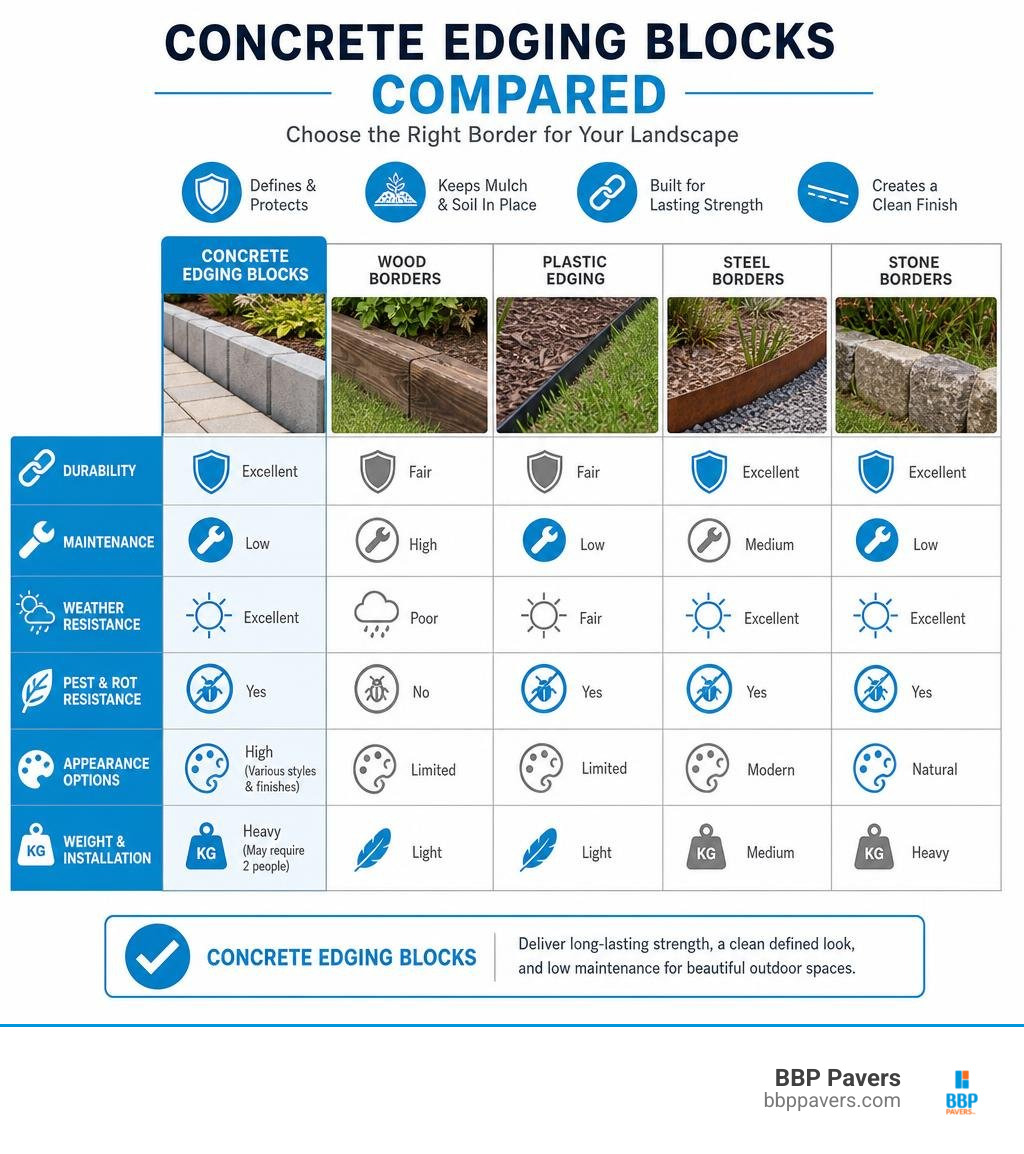
Choosing the ideal landscape edging involves weighing upfront cost, maintenance, longevity, and visual appeal across various materials.
| Edging Material | Average Lifespan | Weather & Pest Resistance | Maintenance Required | Installation Complexity | Relative Cost |
|---|---|---|---|---|---|
| Concrete Blocks | 30–50+ Years | Immune to rot/pests; high freeze-thaw resistance | Minimal (occasional rinsing) | Moderate to High (due to unit weight) | Moderate to High |
| Treated Timber | 7–12 Years | Prone to rot, warping, fungal decay, and termites | High (sealing, staining, eventual replacement) | Low to Moderate | Low to Moderate |
| Corten / Carbon Steel | 15–25 Years | High strength; subject to rusting over time | Low to Moderate | Moderate (requires anchoring stakes) | Moderate |
| Plastic / Poly Bumper | 3–7 Years | Degrades with UV exposure; prone to frost heaving | High (re-anchoring, string trimmer damage) | Low | Low |
| Natural Cut Stone | 40–50+ Years | Highly weather-resistant; variable shape tolerances | Low | High (requires skilled masonry shaping) | High |
Durability and Maintenance Advantages of Concrete Edging Blocks
Unlike timber that cracks under sun exposure or thin plastic edging that buckles when bumped by a lawn mower, concrete border blocks maintain their structural integrity decade after decade. Wet-cast and dry-cast manufacturing processes produce dense mixes that withstand freeze-thaw cycles, winter rains, and de-icing salts without surface spalling.
Maintenance is straightforward: you never need to apply chemical wood preservatives, scrape flaking paint, or hammer dislodged plastic spikes back into the ground every spring. A quick rinse with a garden hose and mild soap clears away seasonal dust and soil splashback. Following simple retaining wall concord ca fall maintenance tips—such as clearing drainage weep channels and checking cap adhesives—keeps your concrete borders looking clean year after year.
Step-by-Step Installation and Base Preparation
A durable, level concrete border relies on the foundation underneath it. Skipping proper base preparation leads to shifting blocks, uneven joints, and settled edges.
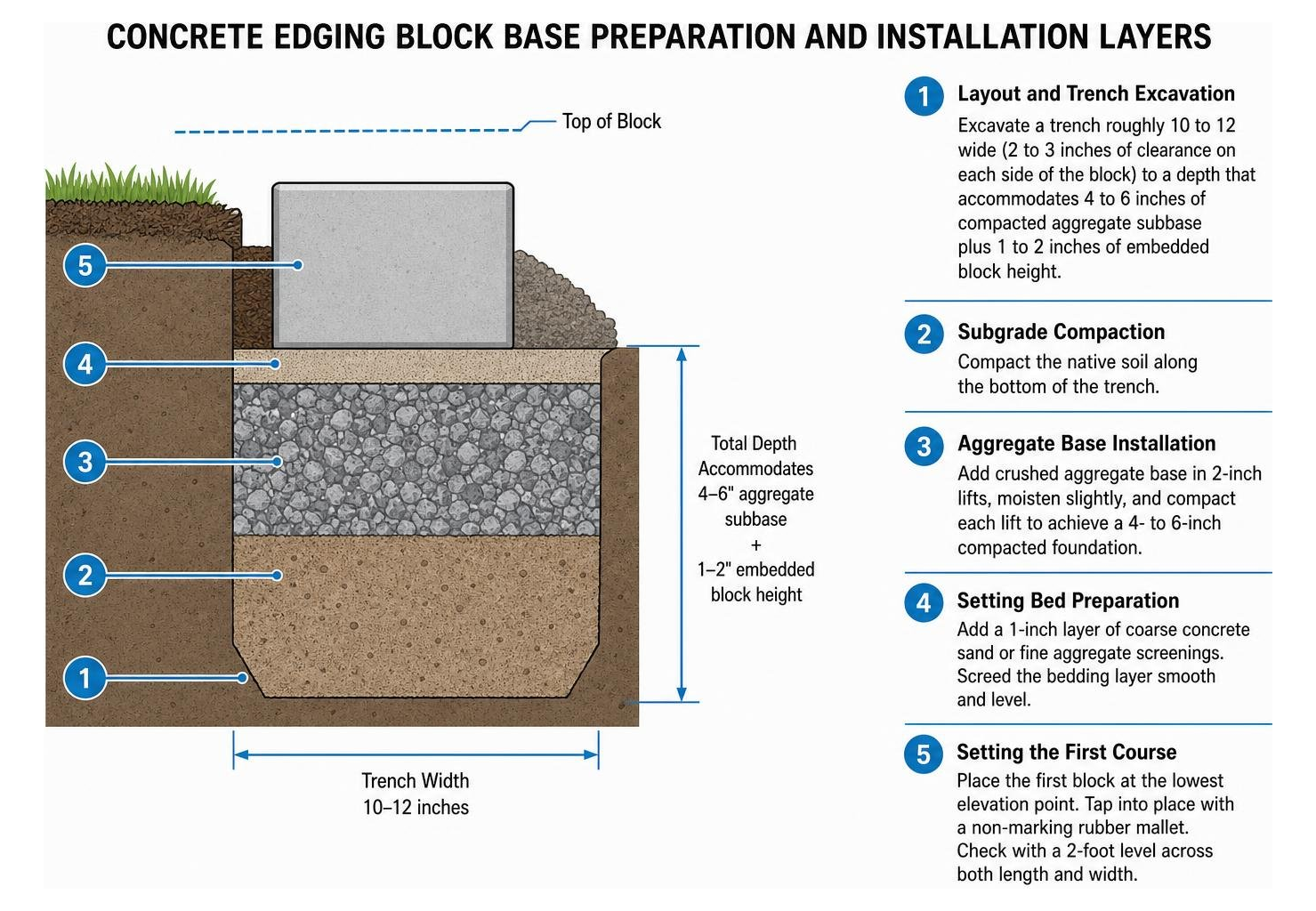
- Layout and Trench Excavation: Mark your border run with marking paint and an alignment string. Excavate a trench roughly 10 to 12 inches wide (leaving 2 to 3 inches of clearance on either side of your block) to a depth that accommodates 4 to 6 inches of compacted aggregate subbase plus 1 to 2 inches of embedded block height.
- Subgrade Compaction: Compact the native soil along the bottom of the trench with a hand tamper or vibratory plate compactor.
- Aggregate Base Installation: Following proper paver installation preparation protocols, add crushed aggregate base (Class 2 permeable or 3/4-inch minus crushed rock) in 2-inch lifts. Moisten slightly and compact each lift until you have a solid, 4- to 6-inch foundation.
- Setting Bed Preparation: Add a 1-inch layer of coarse concrete sand or fine aggregate screenings over the compacted gravel. Screed this bedding layer smooth and level.
- Setting the First Course: Place your initial concrete block at the lowest elevation point of your run. Tap the block into place using a non-marking rubber mallet. Check with a 2-foot level across both length and width.
- Securing Alignment: Continue setting adjacent blocks tightly along your stringline. For multi-tier raised borders or caps, apply exterior-grade masonry adhesive along contact surfaces.
- Backfilling and Joint Stabilization: Backfill behind garden-facing edges with drainage gravel or soil, and anchor the turf-facing edge with clean topsoil or compacted crushed stone to keep the run firmly locked in place.
Tools, Adhesives, and Cutting Techniques
To achieve clean joints and accurate corners, assemble the right gear before beginning:
- Handling & Leveling: Heavy-duty work gloves, a 48-inch spirit level, a torpedo level, a mason line with line blocks, and a deadblow rubber mallet.
- Cutting Equipment: A gas-powered masonry cutoff saw or a continuous-rim diamond blade mounted on an angle grinder. Always wear a NIOSH-approved respirator (N95 or higher), ANSI-rated eye protection, and hearing protection to guard against silica dust.
- Bonding Agents: High-strength polyurethane concrete adhesive (such as Flexlock or Prosoco masonry adhesives) designed for all-weather outdoor bonding.
When cutting blocks to turn 90-degree corners or complete a run, double-check your angles and mark cut lines around all exposed sides for clean breaks. Reviewing how to lay pavers provides practical guidance on setting lines and executing clean masonry cuts.

DIY Installation vs. Professional Hardscape Contracting
Small garden bed borders using lightweight modular units (under 25 lbs each) make rewarding weekend DIY projects for homeowners with basic masonry tools. However, complex layouts present real challenges:
- Heavy Lifting: Large timber-style slabs weighing 190 lbs per block require specialized lifting clamps, mechanical equipment, or multi-person crews to prevent back injuries and dropped stones.
- Grade Management: Sloped driveways and multi-level terraced beds require cut-and-fill grading, stepped base trenches, and precise geogrid integration to prevent lateral blowouts.
- Structural Integrity: When tying borders into interlocking pavers or vehicle-rated driveways, edges must be anchored with reinforced concrete haunching or heavy edge restraints.
Working with an experienced hardscape specialist ensures accurate excavations, proper sub-base compaction, laser-straight sightlines, and comprehensive warranty protection on both materials and labor.
Frequently Asked Questions About Concrete Edging
How long do concrete garden borders typically last?
High-density wet cast and dry cast concrete edging blocks routinely last 30 to 50 years or longer. Because high-strength concrete resists freeze-thaw cycles, pest infestations, and rot, it outlasts wood or plastic alternatives by decades. Premium manufacturers back their blocks with limited lifetime warranties covering structural integrity when installed according to engineering guidelines.
Can concrete borders be installed directly over lawn or soil?
No. Setting heavy concrete edging directly on top of turfgrass or loose topsoil leads to uneven settling, tilting blocks, and joint separation after seasonal rains. You should always dig out the organic sod layer and establish a compacted crushed aggregate subbase before laying the blocks. For an in-depth breakdown of soil preparation over turf areas, refer to how to lay pavers on grass.
How do you prevent edging blocks from shifting over time?
Prevent shifting by combining a firm foundation with secure edge locking:
- Compact a 4- to 6-inch subbase of crushed rock beneath the blocks.
- Bury the bottom 1 to 2 inches of the first course below the finished ground grade.
- Apply structural concrete adhesive along stacked layers and capping stones.
- Firmly backfill both sides with compacted soil, turf sod, or a concrete edge haunch to resist soil pressure and heavy lawn equipment.
Conclusion
Upgrading your landscape with durable concrete border blocks is one of the most effective ways to boost curb appeal, eliminate tedious edge maintenance, and create crisp transitions across your property. Whether you prefer the rustic warmth of timber-style borders, classic brick detailing, or modern polished stone, high-density concrete provides a lasting architectural framework for your gardens, paths, and driveways.
At BBP Pavers, our team brings more than 20 years of local Bay Area hardscape expertise to every project. We combine premium materials, a safety-first installation process, and a 100% satisfaction guarantee to design and build outdoor living spaces that stand the test of time.
Ready to transform your landscape borders? Explore our comprehensive guide to edging stone options landscaping or reach out to our team today to claim your free consultation and quote!