Paver vs Concrete Patio Cost Breakdown for Materials and Long-Term Care

Paver vs Concrete Patio Cost Breakdown for Materials and Long-Term Care
Paver vs Concrete Patio Cost: The Upfront Price Is Only Part of the Decision
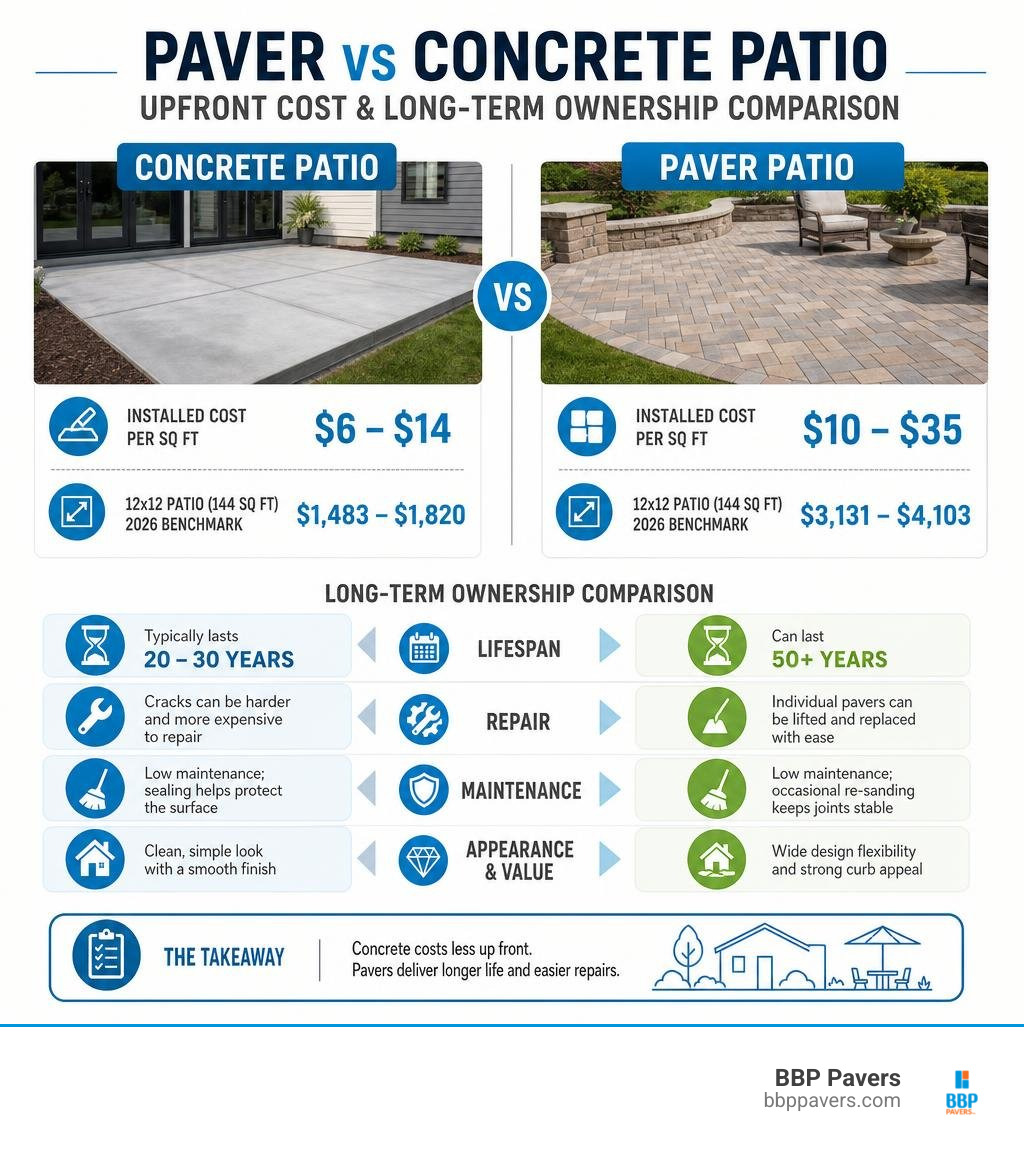
For a basic patio, poured concrete is usually cheaper up front. Installed concrete commonly costs about $6 to $14 per square foot, while a professionally installed paver patio often costs $10 to $35 per square foot.
For a 12×12 patio (144 square feet), 2026 benchmarks place plain concrete around $1,483 to $1,820, compared with roughly $3,131 to $4,103 for pavers. The paver vs concrete patio cost gap is real, but it is not the whole budget story.
Pavers can last 50 years or more and allow targeted repairs when soil shifts or a unit gets damaged. Concrete typically lasts 20 to 30 years, costs less at installation, and provides a smooth, simple surface, but cracks can be harder and more expensive to hide or repair.
The right choice depends on more than the quote total. Base preparation, drainage, Bay Area site access, design complexity, maintenance, and how long you plan to own the home can all change the better-value option.
This guide breaks down the initial price, hidden installation expenses, long-term care, and resale considerations so you can compare equivalent patio scopes before choosing.
Paver vs Concrete Patio Cost: Upfront Price Breakdown by Size
When evaluating contractor bids, comparing numbers per square foot without normalizing the total project size can distort your budget expectations. Larger surfaces benefit from economies of scale for delivery and machinery mobilization, but the fundamental labor differences between poured slabs and hand-placed units remain distinct.
Current 2026 patio cost benchmarks highlight how dimensions directly influence your initial investment:
| Patio Size (Dimensions) | Square Footage | Poured Plain Concrete ($6–$14/sq ft) | Standard Concrete Pavers ($10–$25/sq ft) | Premium Pavers / Natural Stone ($20–$35+/sq ft) |
|---|---|---|---|---|
| 10×10 Small Bistro | 100 sq ft | $600 – $1,400 | $1,000 – $2,500 | $2,000 – $3,500+ |
| 12×12 Standard Patio | 144 sq ft | $864 – $2,016 | $1,440 – $3,600 | $2,880 – $5,040+ |
| 12×16 Dining Space | 192 sq ft | $1,152 – $2,688 | $1,920 – $4,800 | $3,840 – $6,720+ |
| 16×16 Family Patio | 256 sq ft | $1,536 – $3,584 | $2,560 – $6,400 | $5,120 – $8,960+ |
| 20×20 Outdoor Living | 400 sq ft | $2,400 – $5,600 | $4,000 – $10,000 | $8,000 – $14,000+ |
| 20×30 Multi-Zone Patio | 600 sq ft | $3,600 – $8,400 | $6,000 – $15,000 | $12,000 – $21,000+ |
12×12 Paver vs Concrete Patio Cost Comparison
A 12×12 patio (144 sq ft) is the classic footprint for a compact suburban backyard dining area.
- Poured Concrete: For a plain broom-finished slab, professional installation typically totals $1,483 to $1,820. Concrete delivery trucks have minimum load fees, meaning smaller slabs carry a slightly higher cost per cubic yard of placed material.
- Interlocking Pavers: A professional build runs between $3,131 and $4,103. The comprehensive paver patio installation cost reflects deeper excavation, a multi-layered aggregate subbase, bedding sand, commercial-grade edge restraints, and manual stone setting.
While concrete offers an attractive entry price for this scale, pavers provide a modular footprint that can be easily expanded later without leaving an ugly cold joint.
20×20 Paver vs Concrete Patio Cost and Material Differences
Expanding to a 20×20 patio (400 sq ft) creates a true multi-zone outdoor living space suitable for an outdoor kitchen, fire feature, and large seating area.
- Poured Concrete: Expect to invest $4,000 to $5,600 for standard concrete. At 400 square feet, the crew can pour and screed the entire space in a single day, maximizing labor efficiency.
- Standard Concrete Pavers: A 400 sq ft patio built with interlocking concrete pavers typically costs $5,000 to $10,000 installed.
- High-End Paver Materials: Opting for natural bluestone, travertine, or architectural porcelain pushes the total to $8,000 to $14,000+.
The price gap widens on larger footprints due to the physical hours required to place, cut, compact, and sand individual pieces. However, expansive concrete slabs are significantly more vulnerable to visible thermal cracking over time than segmented stone fields.
Comparing Stamped Concrete as a Middle Ground
Homeowners often ask about stamped concrete as an aesthetic compromise. Stamped concrete involves pouring a standard slab, adding integral color or surface hardeners, and pressing textured rubber mats into the wet surface to mimic stone, slate, or brick.
- Installed Cost: Stamped concrete costs $9 to $18 per square foot, placing it squarely between basic poured concrete and high-end pavers.
- The Reality: While it eliminates the individual placement labor of pavers, it retains all the structural downsides of a concrete slab. It still cracks when the ground settles, cannot be repaired in localized spots without noticeable patches, and requires dedicated acrylic resealing every 2 to 3 years to prevent fading and surface spalling.
Material Breakdown, Subbase Preparation, and Hidden Installation Expenses
The surface material you walk on accounts for only 20% to 35% of your total project invoice. The unseen foundation work beneath the surface dictates both the quote total and how long the structure survives.
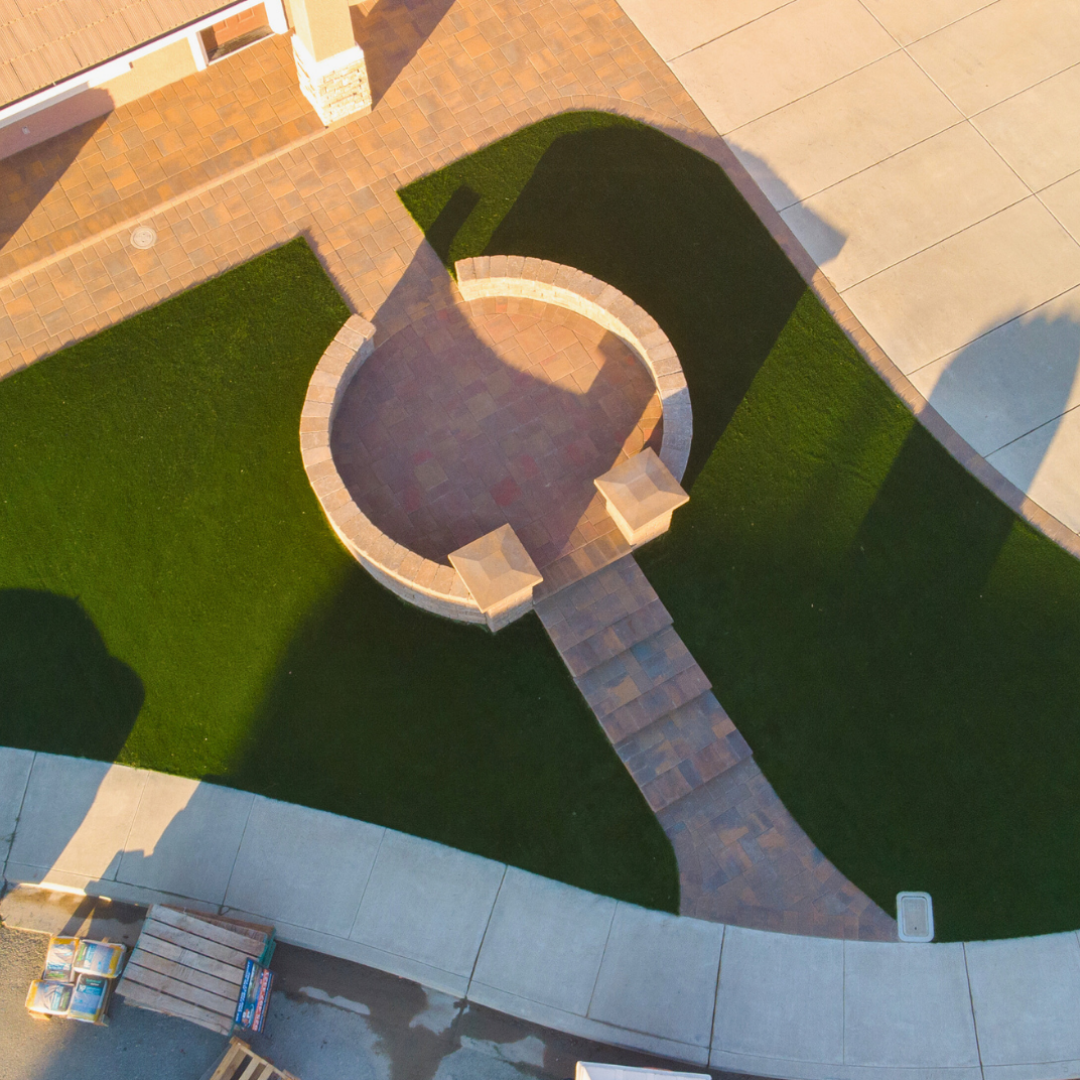
When reviewing itemized estimates, watch for these common project variables:
- Demolition and Hauling: Removing an old 4-inch concrete slab costs $3 to $6 per square foot, plus dumpster and disposal fees.
- Site Access Constraints: If machinery cannot enter your yard through a standard gate, manual wheelbarrow labor can add $500 to $1,500 in handling costs.
- Edge Restraints and Spikes: High-grade paver installations require heavy-duty composite or aluminum edging anchored with 10-inch steel spikes to stop outer stones from drifting.
- Weed Barriers and Geotextiles: Heavy-duty woven geotextile fabric separates native subsoil from gravel, preventing foundation sinkage.
- Permit Fees: Local building codes may require grading or hardscape permits depending on lot coverage limits and setback rules.
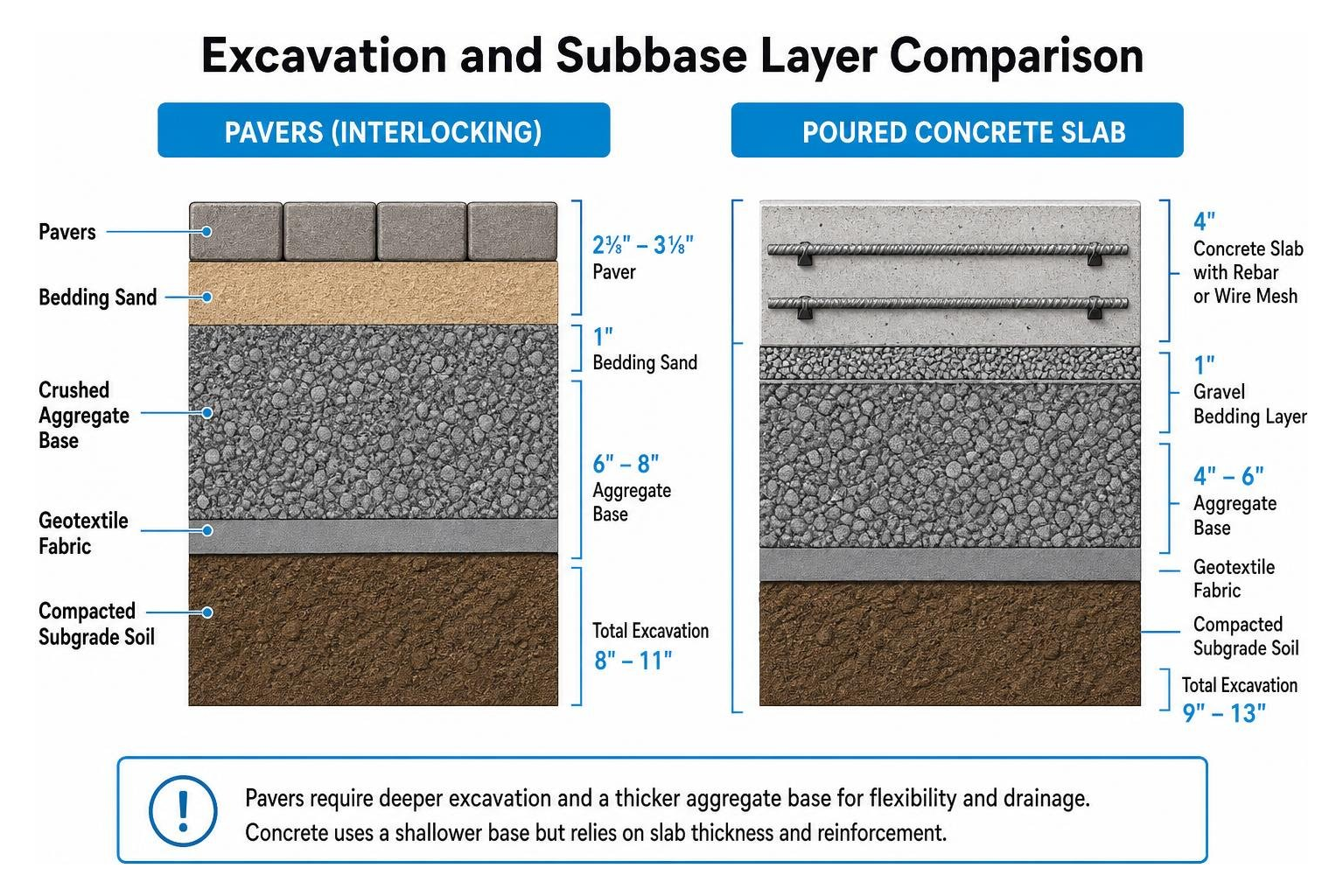
Proper paver installation preparation requires excavating deeper than a concrete pour to establish a stable structural aggregate bed.
Excavation, Soil Type, and Drainage Prep
Soil conditions dictate subbase depth. In areas with expansive clay soil—such as many neighborhoods across Northern California—the ground swells when saturated and shrinks when dry.
- For Concrete: Crews excavate 4 to 6 inches, lay a thin gravel bedding layer, and pour a 4-inch slab with rebar or wire mesh. If the clay underneath shifts unevenly, the rigid slab is forced to bridge the gap, leading to stress cracks.
- For Pavers: Excavation must reach 7 to 9 inches to fit a 4- to 6-inch compacted class-2 road base, a 1-inch bedding sand layer, and the pavers themselves. Proper pitch (typically a 1-inch drop per 8 to 10 linear feet) directs water away from your home foundation. Complex drainage solutions, such as integrated French drains or catch basins, add $1,000 to $3,000 to the total site prep.
Geocell Stabilization vs Traditional Aggregate Base
An increasingly popular engineering solution for difficult access yards or deep clay deposits is geocell base stabilization (such as BaseCore). Geocells are expandable three-dimensional honeycomb grids made of high-density polyethylene.
By confining aggregate within cellular pockets, a 2-inch geocell grid provides load distribution equal to 6 to 8 inches of compacted crushed stone.
- Cost Impact: While the geocell material adds upfront product cost, it cuts required soil excavation depth by more than half.
- Labor Savings: Crews haul away less native soil and import significantly less aggregate, reducing dump fees and wheelbarrow labor in tight backyards.
DIY vs Professional Installation Labor
Can you save money by tackling the installation yourself? The answer depends heavily on which material you choose.
- DIY Concrete Patio ($3–$6/sq ft for materials and tool rentals): Concrete is unforgiving. Once the ready-mix truck arrives, you have roughly 60 to 90 minutes to place, screed, float, edge, and broom-finish the slab before it cures. A mistake in timing leads to a ruined finish that requires hydraulic breakers to fix. Most homeowners find concrete DIY stressful and technically risky.
- DIY Paver Patio ($4–$10/sq ft for materials and plate compactor rental): Pavers are labor-intensive but forgiving. You can lay stones at your own pace, step back to check your lines, and pull up uneven units to adjust the sand layer beneath.
- When to Hire a Professional: Professional crews bring heavy excavators, laser levels, mechanical plate compactors, and wet masonry saws. A professional team completes in two days what takes an unassisted homeowner four weekends of backbreaking work.
10-Year and 30-Year Lifecycle Ownership Costs
Evaluating a patio solely by its installation invoice is what economists call optimizing for the wrong number. Over a 30-year horizon, maintenance, repairs, and replacement cycles significantly shift the financial equation.
According to long-term hardscape studies and lifecycle cost data, a 400 sq ft concrete patio costs roughly $6,300 total over 30 years ($0.52/sq ft/year), while a paver patio of the same size totals $9,400 ($0.78/sq ft/year). The cost difference closes dramatically when you account for localized repairs versus full slab replacements.
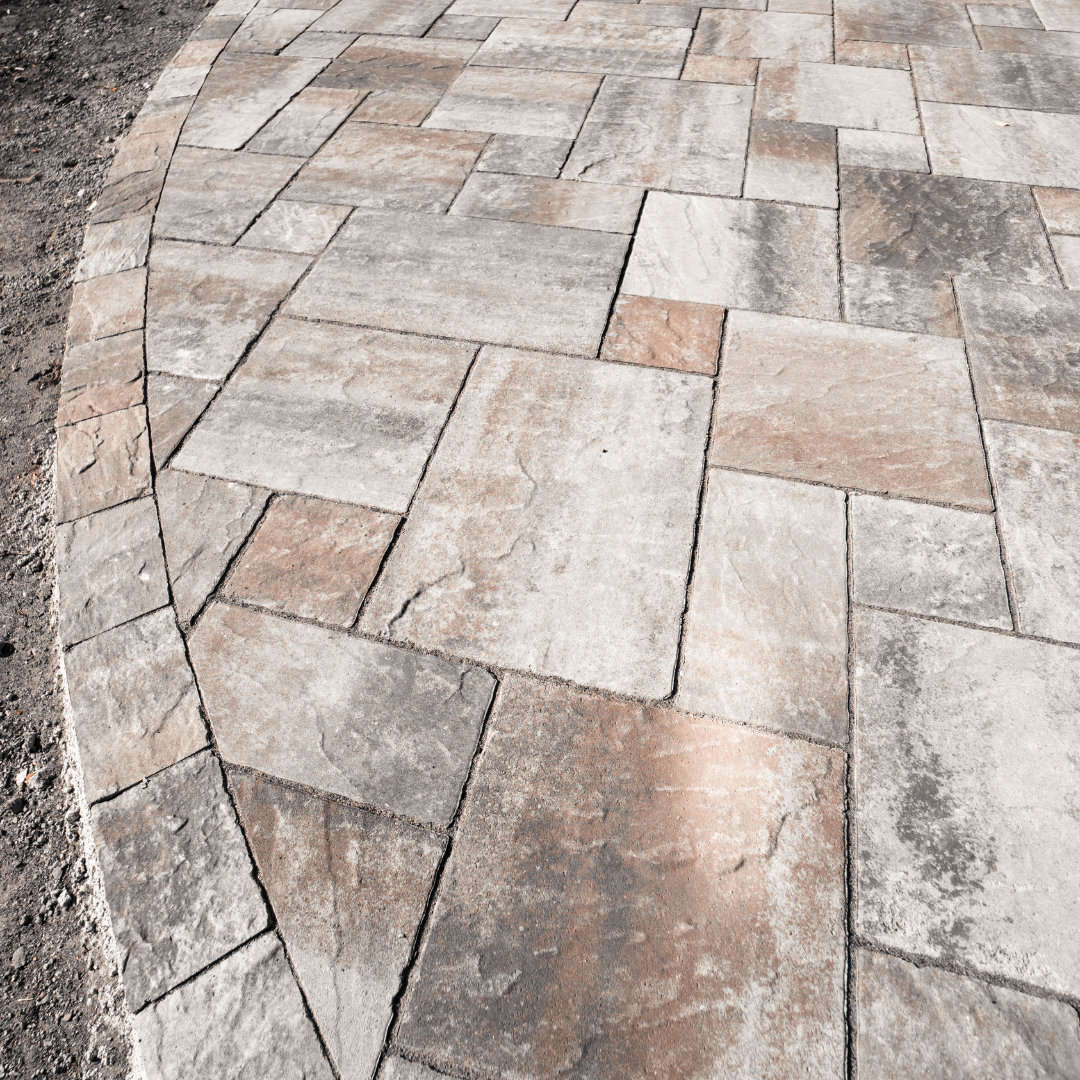
Understanding the balance between pavers vs concrete durability and aesthetics helps clarify where your maintenance dollars go over time.
Maintenance Realities: Re-Sanding vs Crack Sealing
Every hardscape requires maintenance to stay functional and attractive.
- Concrete Maintenance Needs:
- Sealing: Applying a penetrating silane-siloxane or acrylic sealer every 2 to 3 years ($0.50–$1.50/sq ft DIY; $2.00–$3.50/sq ft hired) prevents moisture intrusion and surface spalling.
- Crack Patching: Flexible polyurethane crack injection is required every few years as joints shift ($50–$200 per repair kit).
- Resurfacing: When surface pitting or extensive cracking occurs, concrete resurfacing coats the slab for $3 to $5 per square foot.
- Paver Maintenance Needs:
- Polymeric Sanding: Joint sand locks the stones together and prevents weed growth. Re-sanding is typically needed every 3 to 5 years at $1 to $3 per square foot.
- Washing and Sealing: Learning how to seal pavers with an elastomeric joint-stabilizing sealer keeps the color vibrant and locks the sand in place, requiring reapplication every 3 to 5 years.
Freeze-Thaw Durability, Settling, and Spot Repairs
Ground movement is the ultimate test of any outdoor surface. Whether caused by freeze-thaw cycles or moisture variations in heavy clay, the ground beneath your patio will shift over decades.
- Rigid Concrete Failure: Because concrete is a single monolithic slab, it cannot flex. Tensile stress creates diagonal surface cracks. When a section settles or lifts due to root growth or soil erosion, repairing it requires cutting out entire slabs, pouring new concrete, and accepting permanently mismatched patch colors.
- Modular Paver Resilience: Interlocking pavers form a flexible pavement system with thousands of individual expansion joints. The system flexes with soil movement without cracking.
- The 10-Minute Spot Repair: If a tree root pushes up three pavers or an oil spill stains a section under the barbecue, you simply pry out the affected stones, adjust the sand bedding, and reinsert them (or replace them with matching spares). The repair is invisible and costs virtually nothing.
ROI, Home Resale Value, and Long-Term Property Impact
Hardscape improvements consistently rank among the highest-return residential remodeling projects, but prospective buyers perceive poured concrete and interlocking pavers very differently.
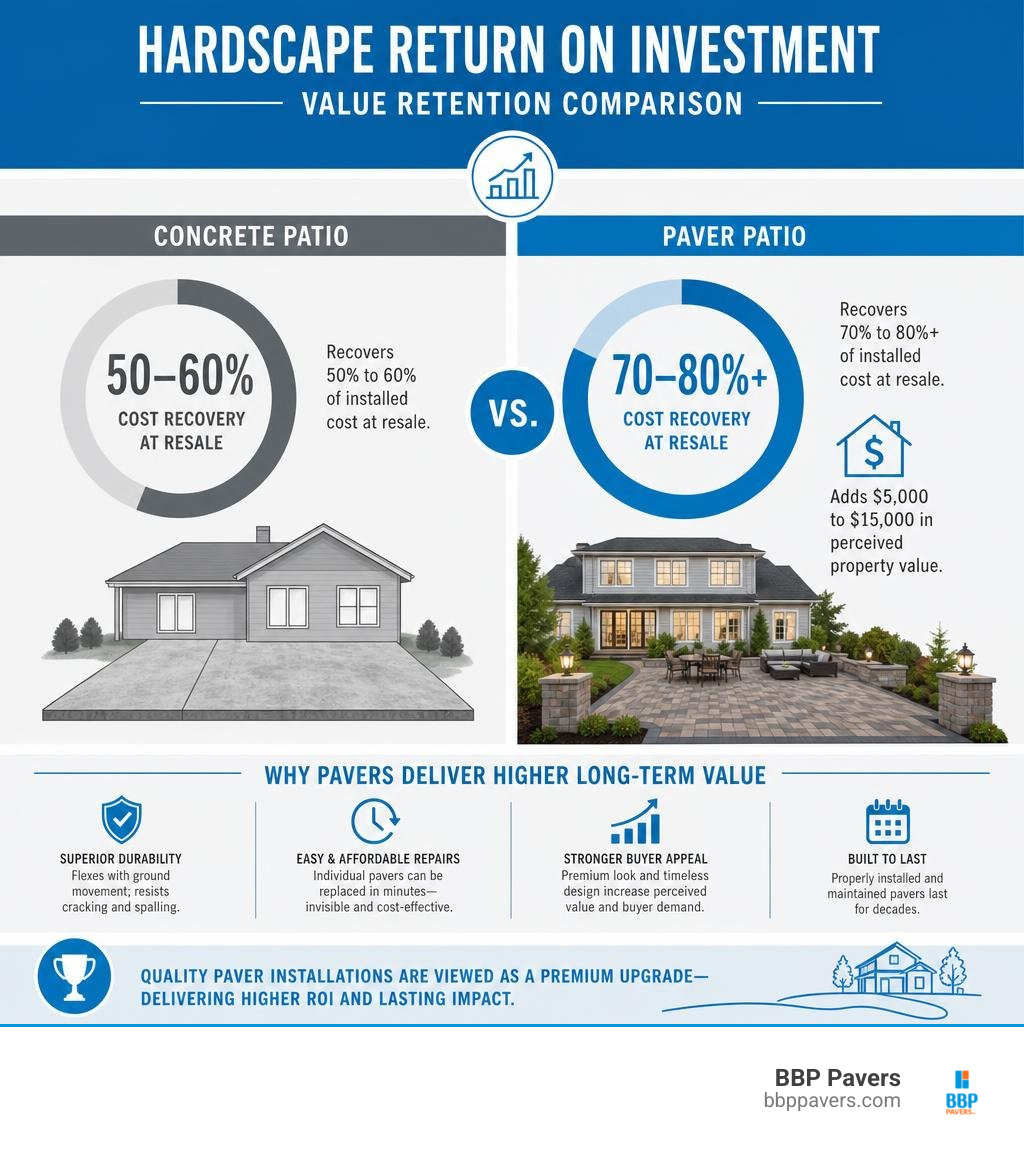
- Concrete Resale Value: A clean concrete patio is functional and expected in standard starter homes. The National Association of Realtors indicates basic concrete installations recover roughly 50% to 60% of their upfront cost at the time of sale.
- Paver Resale Value: Premium paver hardscapes function as an architectural extension of the home’s interior living space. Appraisers and real estate professionals note that quality paver installations can add $5,000 to $15,000 in perceived property value, frequently recovering 70% to 80%+ of their installed cost.
Examining industry market data on whether do pavers increase home value confirms that prospective buyers in upscale neighborhoods view interlocking stone as a premium upgrade, whereas plain concrete is often viewed as builder-grade infrastructure that may eventually need replacement.
Frequently Asked Questions About Paver and Concrete Patios
How much cheaper is poured concrete than pavers up front?
Poured concrete is roughly 40% to 60% cheaper to install initially. Standard broom-finish concrete runs $6 to $14 per square foot, whereas professional paver installations range from $10 to $35 per square foot. The cost difference comes down to manual labor: concrete is placed quickly in liquid form, while pavers require individual excavation layers, hand setting, mechanical edge anchoring, and joint sand compaction.
Do paver patios add more home value than concrete slabs?
Yes. High-end hardscaping delivers superior curb appeal and buyer appeal compared to flat concrete. While a concrete slab recovers approximately 50% to 60% of its initial cost at resale, a professionally designed paver patio recovers 70% to 80% or more, often adding $5,000 to $15,000 directly to the home’s market valuation in competitive markets.
What are the long-term maintenance costs over 10 years?
Over a 10-year window, maintaining a 400 sq ft paver patio typically costs $800 to $1,800, which covers power washing, polymeric joint sand replenishment, and protective sealant. Maintaining a poured concrete patio costs $600 to $1,500 for regular sealing and crack caulking; however, if the concrete slab suffers severe structural cracking and requires decorative resurfacing, that single event can add $1,200 to $2,000 to the decade’s total upkeep.
Conclusion: Making the Right Long-Term Investment
Choosing between poured concrete and interlocking pavers comes down to balancing your immediate budget against your long-term vision for your home:
- Choose poured concrete if your primary goal is maximizing square footage on a strict initial budget, you need a smooth utilitarian surface, or you plan to sell the home within the next 2 to 3 years.
- Choose interlocking pavers if you want an elevated outdoor living space, plan to stay in your home long-term, desire zero visible cracking, and want the ability to perform easy spot repairs or expansions down the road.
If you are exploring decorative alternatives to plain slabs, read our pavers vs stamped concrete definitive comparison to see how textured concrete stacks up against individual stone installations.
At BBP Pavers, we bring over 20 years of local Bay Area hardscape expertise to every project. From comprehensive excavation and soil-stabilized base preparation to precision paver laying, our safety-first process and 100% satisfaction guarantee ensure your new outdoor living space lasts for decades.
Ready to transform your backyard? Contact BBP Pavers today for a free, detailed on-site consultation and estimate.