Why 1 Inch Thick Brick Pavers Are the Best Choice for Overlays

Why 1 Inch Thick Brick Pavers Work So Well for Concrete Overlays
1 inch thick brick pavers are a smart option for resurfacing a sound concrete patio, walkway, porch, or pool deck without tearing out the slab first. Their low profile helps limit changes to door thresholds, steps, and drainage while giving an old surface the look of real brick, concrete pavers, or natural stone.
For most overlay projects, success depends on three things:
- Confirm the existing concrete is stable, clean, and sloped to drain water away.
- Choose an exterior-rated paver and installation system, such as mortar-set or a manufacturer-approved overlay method.
- Use durable joint material and account for expansion joints, especially in larger outdoor areas.
Thin pavers are best for pedestrian spaces. They are generally not a substitute for full-thickness, vehicle-rated pavers in a residential driveway. Standard patios and walkways commonly use pavers around 2 inches thick or more when installed over a compacted aggregate base.
For Bay Area homeowners, a thin brick overlay can refresh a worn concrete surface with less demolition, less mess, and fewer disruptions to the surrounding landscape. The key is treating the existing slab as part of the paving system, not simply covering it.
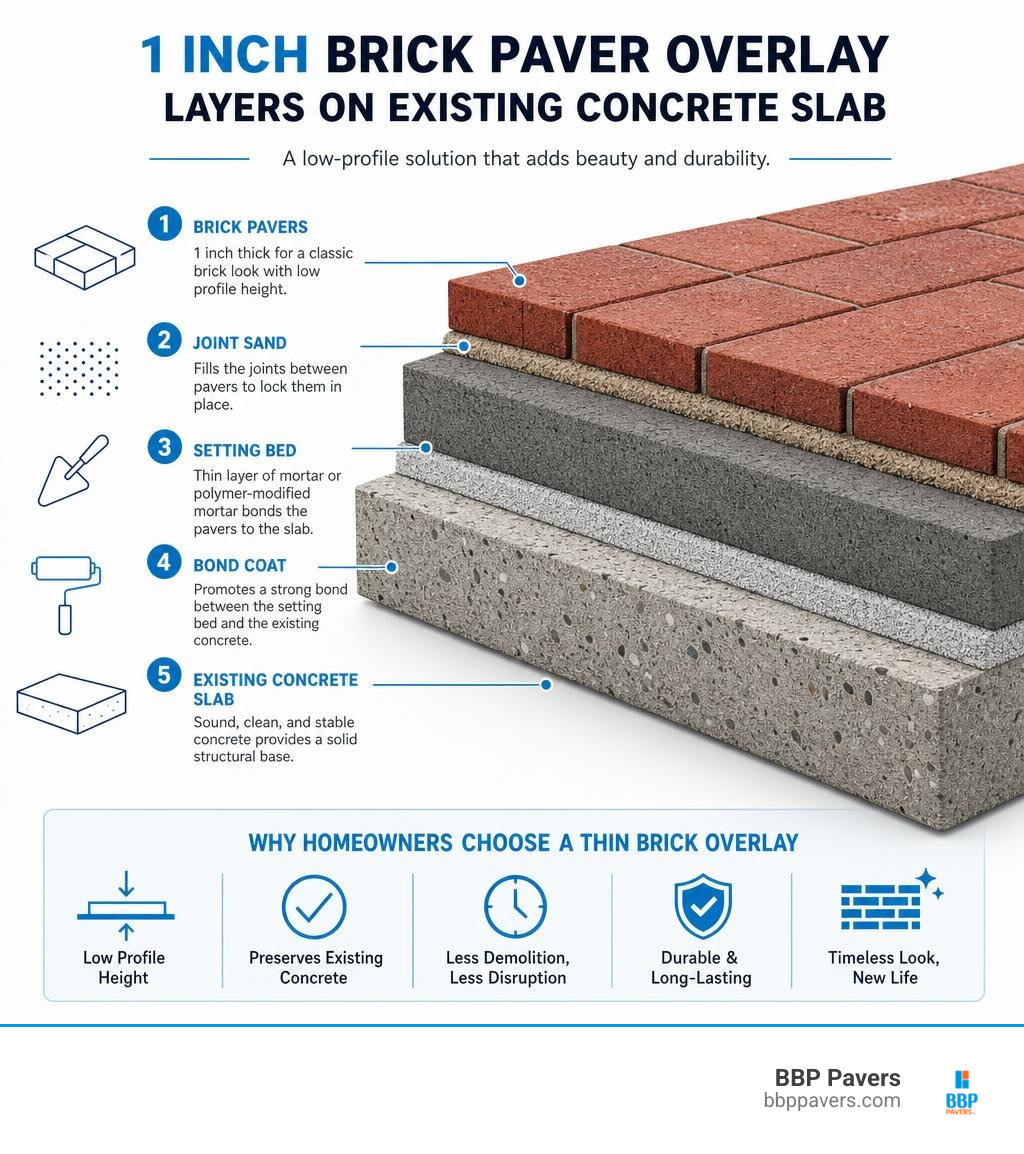
What Are 1 Inch Thick Brick Pavers and Where Are They Used?
Thin brick pavers are precision-cut or molded paving units that typically measure between 1/2 inch and 1-3/8 inches in nominal height. While standard full-depth units rely on substantial mass and thickness to transfer loads down into a deep gravel subbase, thin units leverage the structural strength of an existing solid subsurface—most commonly a poured concrete pad.
We routinely specify these low-profile units for pedestrian zones where space, vertical clearance, or access limitations make full excavation impractical. Thin units deliver the rich, historic texture of fired clay or the crisp, architectural lines of modern masonry without requiring a major site overhaul.
Common applications include:
- Patios and Terraces: Upgrading tired, stained concrete slabs into elegant dining and entertaining areas with patio pavers.
- Front Porches and Walkways: Bringing historic charm to entryways while keeping step rises within uniform building code tolerances.
- Pool Deck Resurfacing: Giving sun-baked or slippery pool surrounds a fresh, textured, slip-resistant finish.
- Interior Living Spaces: Creating seamless indoor-outdoor transitions in sunrooms, mudrooms, wine cellars, and rustic kitchen floors using thin brick flats or Chicago common 1/2″ paver tiles.
| Paver Type | Nominal Thickness | Weight per Sq. Ft. | Ideal Base Substrate | Best Applications |
|---|---|---|---|---|
| Thin Brick / Paver Tiles | 1/2″ to 3/4″ | 5 – 7 lbs | Mortared concrete, cement backer | Indoor floors, vertical accents, low-clearance steps |
| 1-Inch Brick Pavers | 1″ to 1-3/8″ | 9 – 12 lbs | Concrete slab, bonded bedding | Exterior patios, pool surrounds, garden walkways |
| Standard Pedestrian Pavers | 2″ to 2-3/8″ | 22 – 28 lbs | 4″–6″ compacted crushed stone | Traditional sand-set patios, heavy pedestrian plazas |
| Heavy-Duty / Driveway Pavers | 2-3/8″ to 3-1/8″ | 28 – 35+ lbs | 8″–12″ compacted road base | Residential driveways, commercial loading zones |
Comparing Thin Overlays to Standard Paver Thickness
The fundamental engineering difference between thin pavers and full-size units comes down to load distribution and vertical elevation. Standard 2-3/8 inch (60 mm) interlocking units are designed for flexible pavement systems. When installed over compacted aggregate and bedding sand, their deep vertical faces generate friction, distributing pedestrian and vehicle weight laterally across adjacent units.
Thin pavers do not provide the vertical surface area needed for standard interlocking friction. Instead, they act as a masonry veneer, relying entirely on the compressive strength of the concrete underneath. Because they sit low, you avoid blocking exterior doors, covering weep screeds, or distorting stair riser heights. When learning how to choose the best pavers for your patio, checking your available vertical clearance is always step number one.
Clay, Concrete, and Natural Stone Material Options
Thin pavers come in a variety of materials to match different architectural styles, load requirements, and design budgets:
- Extruded and Molded Clay: Fired at high temperatures, authentic clay pavers feature permanent, rich earth tones that never fade from UV exposure. High-density products like 1-3⁄8″ Flat Top Thin Clay Pavers by Pine Hall Brick offer extreme durability, low absorption, and classic visual warmth.
- Wet-Cast Concrete: Concrete units provide great dimensional accuracy, diverse textures, and lower initial material costs. They are widely available in varied rectangular and modern modular shapes.
- Reclaimed Historic Brick: Sliced from genuine antique brickwork, options like vintage Chicago commons bring weathered patina and distinct maker’s stamps to interior mudrooms or covered outdoor loggias.
- Natural Stone Veneers: Thin-cut granite, bluestone, slate, or 1″ thick natural stone pavers provide cool surface temperatures and sophisticated, one-of-a-kind veining.
If you are torn between traditional brick and cement compositions, review our breakdown of brick pavers vs concrete pavers to see how each material handles weather, foot traffic, and long-term care.
The Strategic Benefits of Concrete Overlays with Thin Pavers
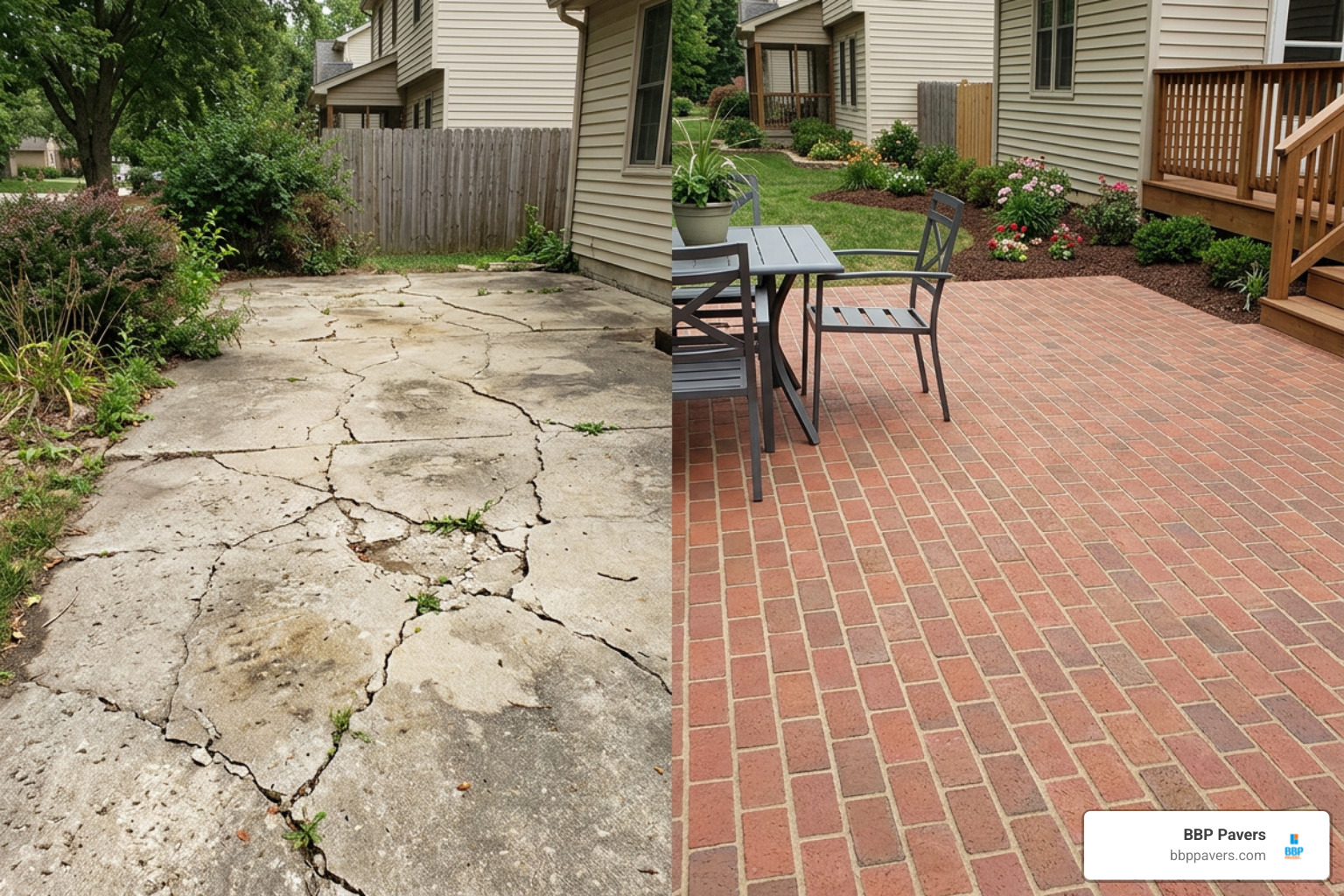
Choosing an overlay system over a complete tear-out turns an old concrete slab from a liability into a stable foundation. Homeowners often weigh pavers vs stamped concrete when planning a renovation. While stamped concrete can crack, fade, and require frequent resealing, a thin paver overlay provides the authentic texture of real masonry without the high price tag of full site demolition.
Eliminating Demolition and Excavation Costs
Jackhammering and hauling away a 400-square-foot concrete patio can easily add thousands of dollars to a project before new construction even begins. Demolition requires mini-excavators, dump trucks, and heavy disposal fees at local landfills.
An overlay system bypasses this entire destructive phase:
- Saves Money: Cuts out machinery rentals, dump fees, and extensive labor hours.
- Protects Your Yard: Keeps heavy equipment off your turf, irrigation lines, and mature garden beds.
- Saves Time: What would take a week of demolition, excavation, and aggregate compaction can often be completed in just a few days of direct masonry installation.
- Eco-Friendly: Reusing a sound concrete pad keeps tons of masonry waste out of municipal landfills.
Preserving Threshold Clearances and Step Heights
One of the biggest headaches in outdoor remodeling is managing elevation changes around existing doorways and staircases. Adding a standard 2-3/8 inch paver plus a 1-inch sand bedding layer raises the grade by nearly 3.5 inches. This build-up often blocks sliding door tracks, covers foundation siding, and violates residential building codes by creating uneven stair riser heights.
Thin pavers solve this problem cleanly:
- Door Thresholds: A 1-inch profile slides neatly under low-clearance French doors, screen doors, and entry sills.
- Stairway Geometry: Preserves uniform step heights, preventing dangerous trip hazards that violate safety codes.
- Coping Alignment: Integrates smoothly against existing pool coping stones, creating flush transitions on renovated pool decks.
How to Install 1 Inch Thick Brick Pavers on Existing Slabs
Proper base preparation is just as vital for thin overlays as it is for ground-up installations. Mastering how to install pavers over an existing concrete slab requires careful surface prep, reliable bonding methods, and tight joint construction to prevent shifting over time.
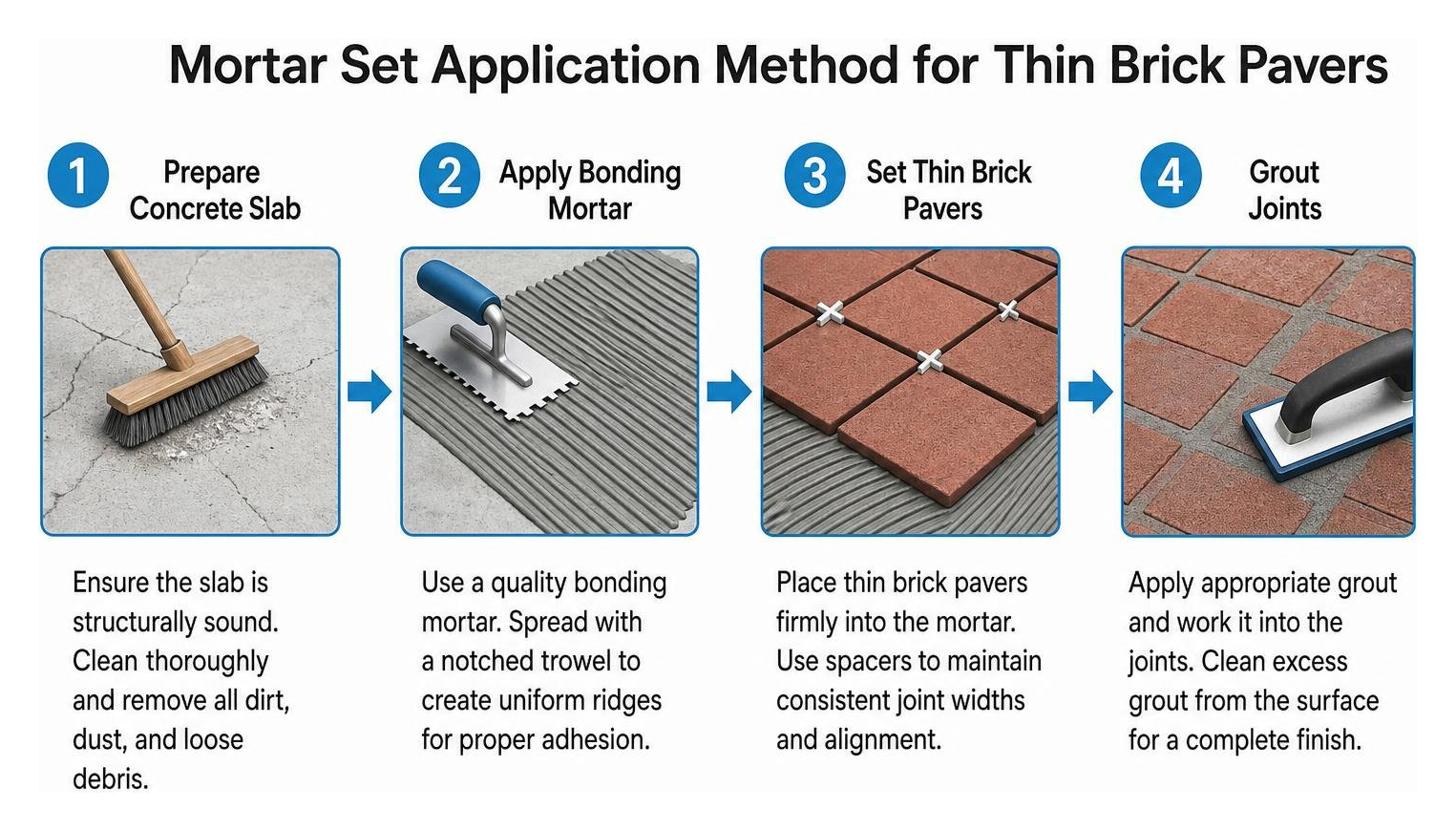
Substrate Evaluation and Base Preparation
Before opening a single bag of mortar, you must inspect the existing concrete slab thoroughly:
- Check Structural Soundness: The slab must be structurally stable. Hairline shrinkage cracks are normal and easily treated, but shifting slabs, severe frost heaves, or crumbling concrete cannot support an overlay.
- Repair Surface Flaws: Fill spalling patches and patch static cracks using a polymer-modified repair mortar. For hairline surface cracks, apply an elastomeric crack-isolation membrane over the fissure to stop movement from transferring up into your pavers.
- Confirm Drainage Slope: Verify the concrete slopes away from your home’s foundation at a minimum rate of 1/4 inch per linear foot (approx. 1–2%).
- Deep Surface Cleaning: Pressure wash the concrete to remove dirt, grease, moss, paint, and curing compounds that could prevent mortar or adhesive from sticking.
Reviewing typical paver installation mistakes to avoid will help you spot tricky substrate issues before laying your first course.
Mortar-Set, Sand-Set, and Adhesive Methods
Depending on your project’s exposure to moisture, freeze-thaw cycles, and vertical tolerances, you can choose from three main installation methods:
1. Mortar-Set System (Recommended for Exterior Applications)
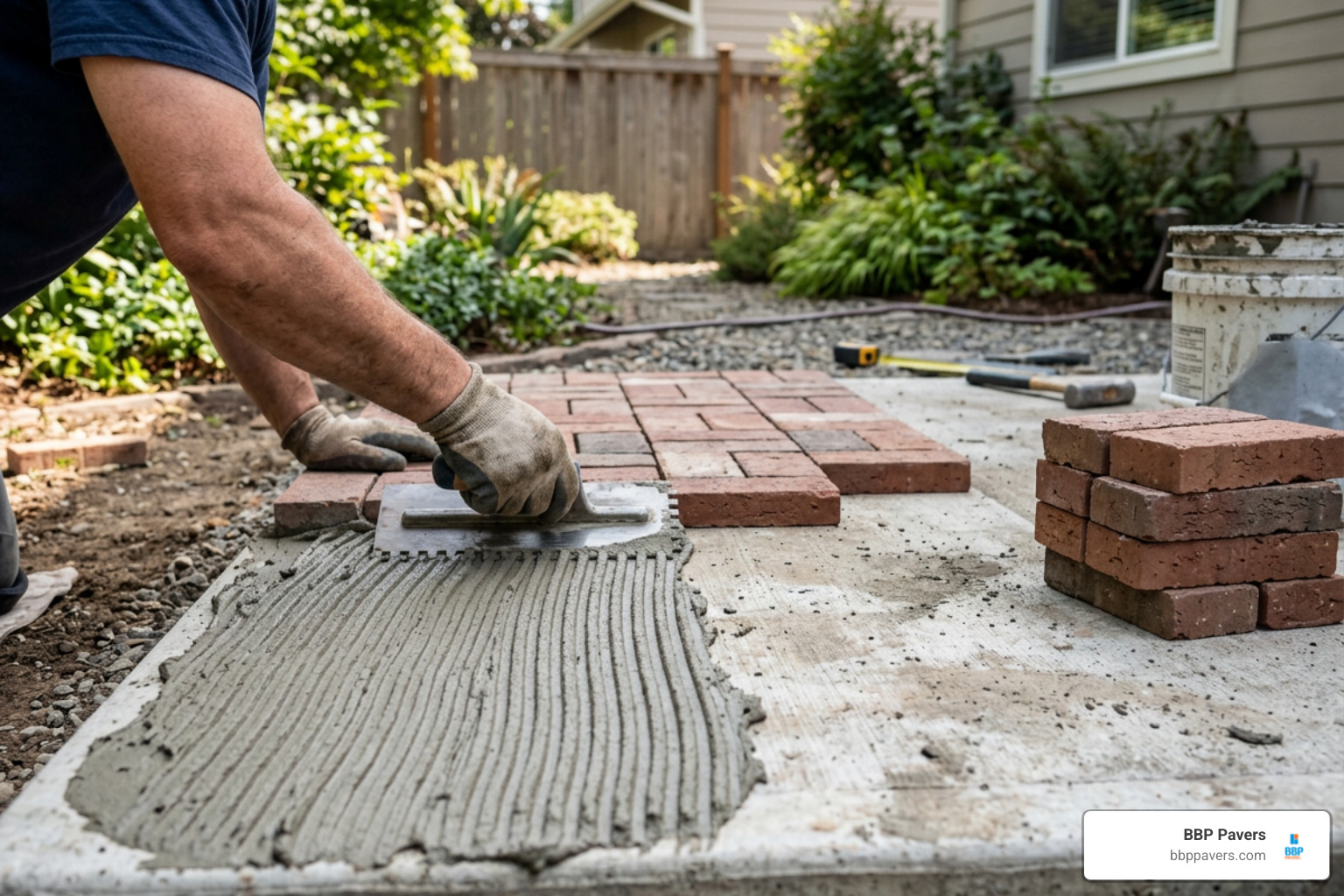
- Process: Apply a 1/4-inch to 3/8-inch bed of polymer-modified exterior thinset mortar directly to the cleaned concrete using a notched trowel. Butter the back of each brick paver and press it firmly into position.
- Joints: Fill joints with exterior-grade masonry grout or high-performance polymeric sand once the mortar bed has fully cured (typically 24 to 48 hours).
- Best For: Uncovered exterior patios, walkways, pool decks, and regions with occasional freeze-thaw cycles.
2. Sand-Joint / Thin-Bed Overlay
- Process: Place a thin, uniform 1/4-inch bedding layer of coarse sand or concrete sand over the slab, held in place by a mortared border or mechanical perimeter edge restraints.
- Joints: Lay 1-3/8 inch pavers in tight interlocking patterns (such as 45-degree or 90-degree herringbone) and sweep polymeric sand into the joints, compacting gently with a rubber-faced roller.
- Best For: Covered porches, breezeways, and sheltered residential courtyards.
3. Polyurethane Construction Adhesive
- Process: Apply exterior-grade hardscape polyurethane adhesive directly to the underside of the pavers in serpentine beads, bonding them directly to clean, dry concrete.
- Best For: Small landings, step treads, paver border edges, and decorative interior focal points.
Durability, Climate Resistance, and Long-Term Care
High-quality thin pavers are built to handle tough weather and everyday foot traffic. However, because these units have less mass than full-sized paving stones, their long-term performance depends directly on the quality of their manufacturing and proper joint sealing.
Freeze-Thaw Performance and ASTM Standards
In cold climates or higher-elevation areas, winter moisture is a paver’s biggest enemy. If water seeps into a porous brick and freezes, the expanding ice can cause the face of the paver to flake off or crack—a failure known as spalling.
When shopping for exterior clay pavers, always look for products that meet strict masonry manufacturing guidelines:
- ASTM C902 Standard: Look for compliance with ASTM C902 standards and modular specifications, which covers pedestrian and light-traffic paving brick.
- Class SX Weathering: This rating certifies that the paver can handle severe freeze-thaw cycles and direct contact with deicing chemicals without breaking down.
- Vitrification: High-firing kiln processes melt the clay minerals into a dense, glass-like body, keeping water absorption low (typically under 6%) and stopping efflorescence salt deposits before they start.
Maintenance, Polymeric Sand, and Sealing Requirements
Keeping your thin brick overlay looking brand new requires minimal effort when you use the right joint materials and protective coatings:
- Polymeric Sand Jointing: Modern polymeric sands blend fine aggregate with water-activated polymers. Once set, the sand hardens like flexible mortar, locking the pavers in place, keeping joint lines intact, and preventing ants and weeds from moving in.
- Joint Maintenance: Wash away surface dust with a standard garden hose. If you ever need to lift deep grease or organic stains, follow proven techniques for how to remove paver stains using pH-neutral, breathable cleaners.
- Protective Sealing: Apply a penetrating, breathable silane-siloxane or water-based acrylic sealer every 3 to 5 years. Sealing enriches natural brick colors, locks in joint sand, and shields against BBQ grease, wine spills, and leaf stains. Read our step-by-step guide on how to seal pavers for the best application techniques.
Cost Analysis and Budgeting for 1 Inch Thick Brick Pavers
Thin brick overlays are one of the most cost-effective ways to update your hardscape because they let you bypass expensive excavation and hauling work. However, material grades, site conditions, and your chosen layout all influence final project costs.
When planning your budget, keep these key factors in mind:
- Paver Material Selection: Standard concrete units are the most affordable, premium architectural clay runs in the middle, and hand-cut natural stone or reclaimed antique brick sits at the high end.
- Substrate Repair Needs: Fixing old concrete cracks, applying waterproof membranes, or grinding down uneven sections will add some upfront prep costs.
- Laying Patterns: Simple running bond patterns go down quickly, while intricate herringbone, basketweave, or circular designs require more border cuts and careful layout work.
- Edge Restraint Work: Mortaring perimeter soldier courses or installing low-profile mechanical restraints ensures your borders stay locked in place.
- Joint and Sealer Upgrades: Investing in high-grade polymeric sand and professional sealers pays for itself through lower maintenance down the road.
Material and Labor Expenses per Square Foot
Material prices for thin pavers generally fall into predictable ranges:
- Thin Concrete Pavers: $2.00 – $5.00 per sq. ft.
- Extruded Thin Clay Pavers: $3.50 – $7.00 per sq. ft.
- Reclaimed Antique & Specialty Clay: $8.00 – $16.00 per sq. ft.
- Thin Natural Stone Veneers: $7.00 – $15.00+ per sq. ft.
Professional installation for a fully mortared or adhesive overlay system typically ranges from $12 to $22 per square foot, covering concrete prep, mortar beds, cutting, paver setting, and polymeric jointing. By eliminating demolition, homeowners frequently save $3 to $8 per square foot compared to a full excavation and base rebuild.
Indoor vs Outdoor Project Value
Thin brick is uniquely versatile because it works just as well inside your home as it does outside on the patio. In interior settings like entryways, mudrooms, and sunrooms, thin brick flats create a warm, rustic aesthetic that pairs beautifully with hardwood and tile. They handle heavy foot traffic, muddy boots, and pet claws without showing wear.
Outside, a clean brick overlay instantly boosts curb appeal and backyard usability. Upgraded outdoor living spaces consistently deliver strong returns on investment by expanding functional square footage and making a great impression on future home buyers.
Frequently Asked Questions About 1-Inch Pavers
Can 1-inch pavers be used on residential driveways?
No, 1-inch thick pavers should not be used for residential driveways or areas with vehicle traffic. Passenger cars, trucks, and SUVs create heavy point loads and dynamic braking forces that will crack thin pavers and break their mortar bonds. Driveways require full-depth pavers (at least 2-3/8 inches or 60 mm thick, and often 3-1/8 inches or 80 mm for heavier vehicles) set over an 8-to-12-inch compacted aggregate base to properly distribute vehicle weight.
Do you need to remove cracked concrete before laying thin pavers?
You do not need to tear out the entire slab if the cracks are minor, stable, and sitting on a solid subgrade. Hairline shrinkage cracks and static surface fissures can be cleaned out, filled with structural epoxy or polymer-modified repair mortar, and bridged using an elastomeric crack-isolation membrane.
However, if your concrete slab is sinking, heaving unevenly, or breaking apart from tree roots or subgrade erosion, it has lost its structural integrity. In those situations, overlaying thin pavers will only lead to cracked bricks down the road, and the old concrete must be removed.
How do you prevent weeds between thin brick joints?
Weeds take root when airborne seeds settle into damp, open dirt between pavers—they rarely grow up from underneath a solid concrete slab. The most effective way to keep joints weed-free is to sweep high-performance polymeric sand into the gaps and activate it with water during installation.
Polymeric sand cures into a firm, cohesive barrier that blocks windblown seeds, stops burrowing insects, and resists water erosion. Applying a breathable paver sealer over the surface adds an extra layer of protection, keeping moisture out and maintaining a crisp, weed-free finish for years.
Conclusion
Renovating an aging concrete patio, walkway, or porch does not require days of loud jackhammering, piles of demolition debris, or blown budgets. By choosing high-quality thin brick pavers, you can reuse your stable concrete slab as a solid foundation, preserve critical door and stair clearances, and give your home the timeless charm of real masonry.
At BBP Pavers, we bring more than 20 years of local Bay Area hardscape expertise to every project. From comprehensive concrete slab evaluations to custom herringbone and running bond patterns, our crew focuses on clean prep, quality materials, and a safety-first process backed by a 100% satisfaction guarantee.
Ready to upgrade your outdoor space? Connect with our experienced team to explore our brick pavers collection and schedule your free on-site design consultation today.