
Pavers vs Stamped Concrete: The Definitive Comparison

Did you know that most homeowners who choose the wrong outdoor surface material end up spending 40% more on repairs within the first decade? If you are currently deciding between pavers vs stamped concrete, this guide was written specifically for you.
This pavers vs stamped concrete definitive comparison covers every factor that matters before you invest: upfront cost, long-term durability, maintenance demands, repair difficulty, design flexibility, environmental impact, and resale value. By the end of this article, you will know exactly which material is right for your home, your climate, and your budget.
At BBP Pavers, we have completed hundreds of projects across the Bay Area and helped homeowners make this exact decision with confidence. Keep reading to make yours.
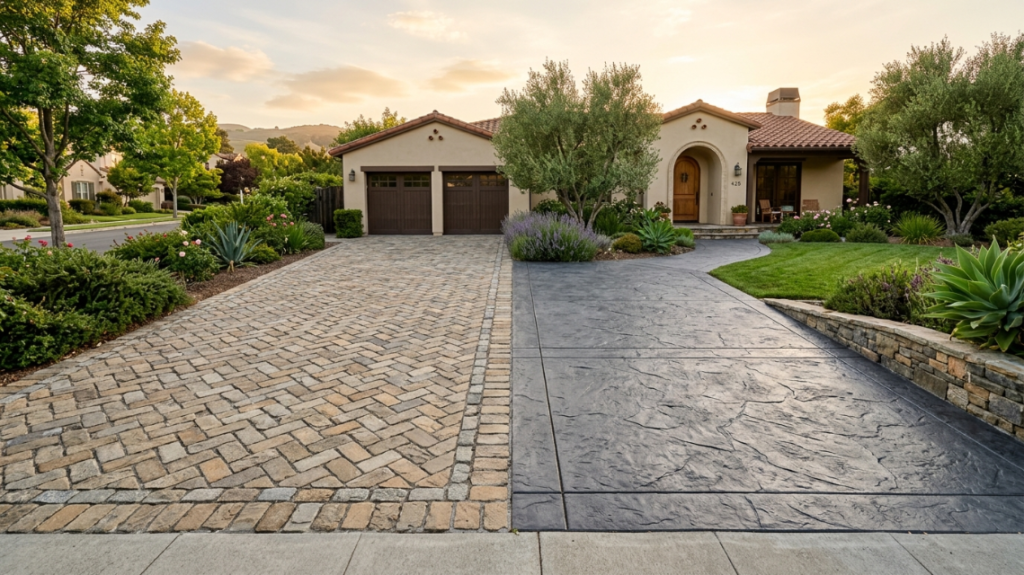
What Are Pavers vs Stamped Concrete? Understanding Both Materials
Before comparing them directly, it is important to understand what each material actually is and how it is installed — because the construction method explains most of the performance differences in this pavers vs stamped concrete definitive comparison.
What Are Pavers?
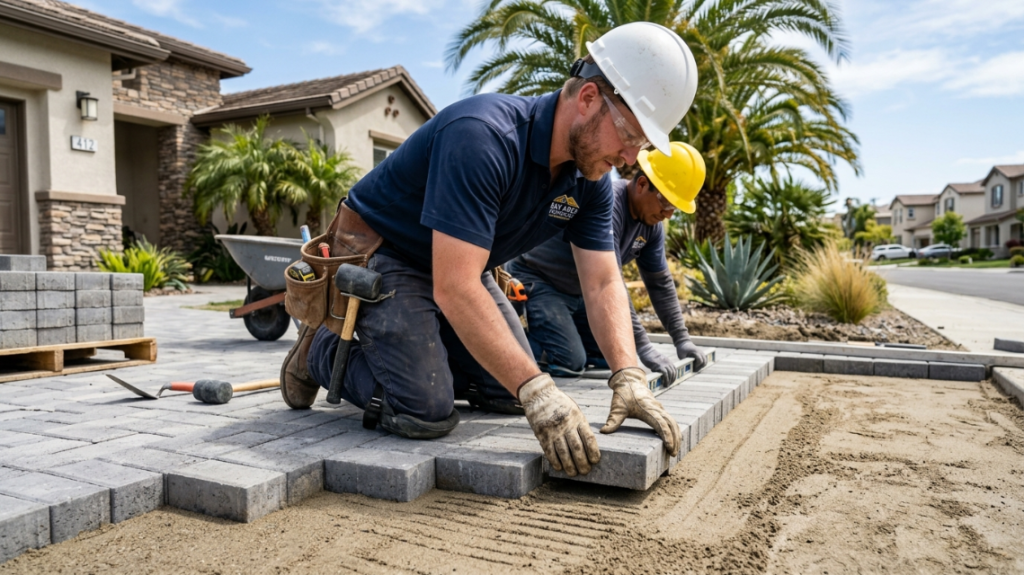
Pavers are individual units — made from concrete, brick, clay, or natural stone — installed in an interlocking or mortared pattern over a compacted base of gravel and sand. Because each unit is independent, the surface can flex with ground movement without cracking.
BBP Pavers installs premium interlocking and natural stone options for patio pavers, driveway pavers, and walkway pavers throughout the Bay Area.
What Is Stamped Concrete?
Stamped concrete is a poured concrete slab that has patterns and textures pressed into its surface before curing, mimicking the look of stone, brick, or wood. Colorants and sealers are applied afterward to enhance the visual effect.
Unlike pavers, stamped concrete behaves as a single rigid slab — making it far more vulnerable to cracking when the ground beneath it shifts.
Pavers vs Stamped Concrete Comparison: Full Cost Breakdown
Cost is the first factor most homeowners consider, and in any honest pavers vs stamped concrete comparison, stamped concrete appears cheaper at first glance. But the full picture changes significantly over time.
Long-Term Cost of Ownership
Stamped concrete requires resealing every 2–3 years at $1–$3 per square foot. A single crack repair runs $500–$2,500. Full slab replacement — which many homeowners face within 10–15 years — can exceed the original installation cost entirely.
Pavers, by contrast, rarely require full replacement. Individual units can be lifted, reset, or replaced for under $200 in most cases. Over a 15–20 year horizon, pavers vs stamped concrete long-term costs consistently favor pavers.
Pavers vs Stamped Concrete Durability: Which One Lasts Longer?
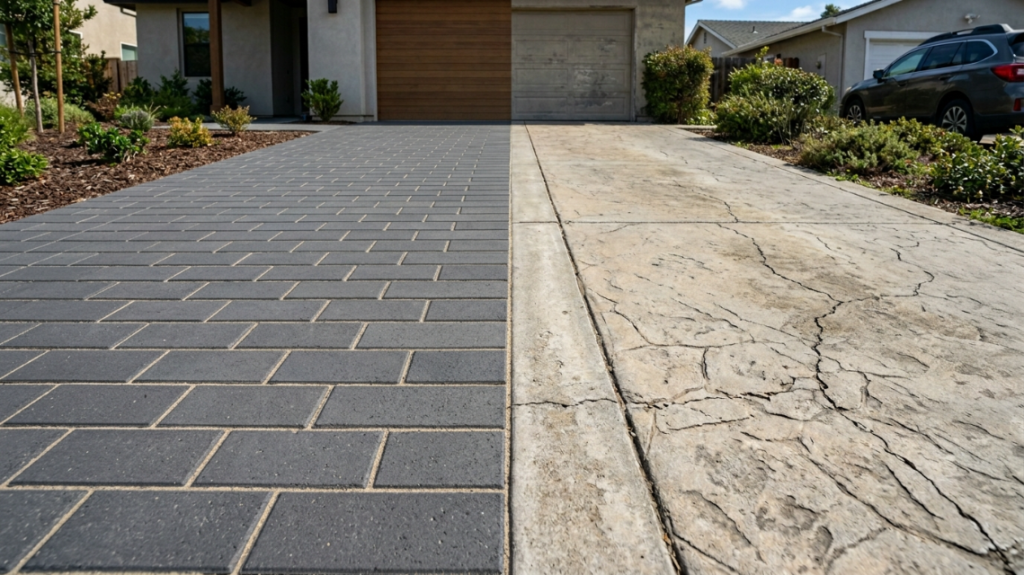
In the pavers vs stamped concrete definitive comparison for durability, pavers win — and the reason comes down to how each surface handles ground movement.
How Pavers Handle Ground Movement
Each paver unit is independent. The surface distributes stress across dozens or hundreds of joints. When soil expands, contracts, or settles — which happens in virtually every climate, including the Bay Area — individual pavers shift slightly without cracking.
How Stamped Concrete Handles Ground Movement
Stamped concrete is a monolithic slab. When the ground moves beneath it, tension builds across the entire surface until something gives — and that something is a crack. In regions with clay soil or tree roots, common throughout Concord, Walnut Creek, and Lafayette, stamped concrete cracking is not a question of if, but when.
Expected Lifespan
- Pavers: 25–50+ years with basic maintenance
- Stamped Concrete: 10–20 years before significant deterioration
Our customers in Concord and Walnut Creek regularly report that their BBP Paver installations look as good at year 10 as they did on day one.
Pavers vs Stamped Concrete: Aesthetics and Design Flexibility
When evaluating pavers vs stamped concrete from a purely visual standpoint, opinions are more divided — and both options have genuine strengths.
Design Options with Pavers
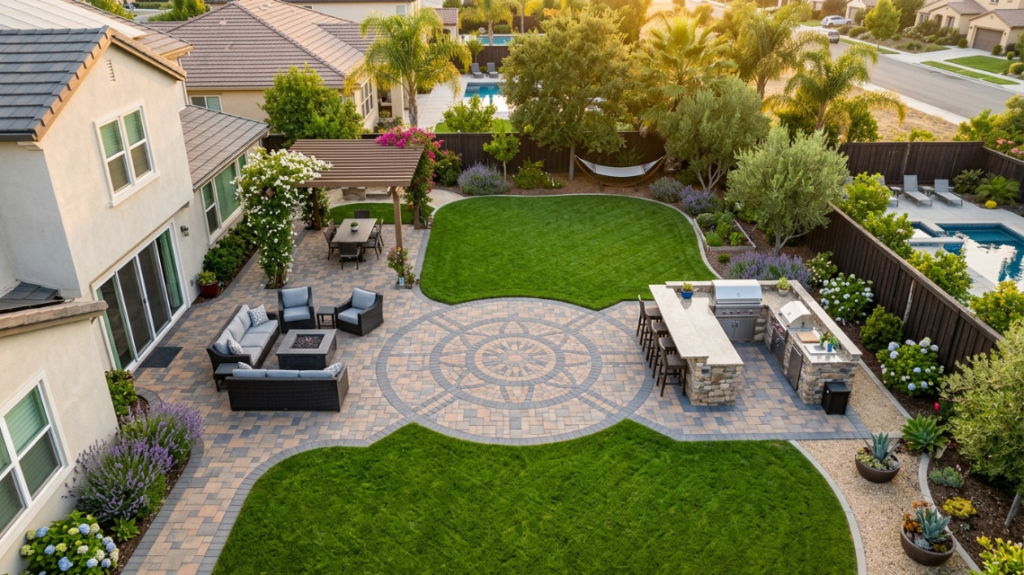
Pavers offer virtually unlimited design variety. You can mix colors, shapes, and laying patterns — herringbone, basketweave, running bond, circular — to create a completely custom look. Natural stone pavers offer organic variation that no manufactured surface can replicate.
Our pool deck installations at BBP Pavers regularly feature multi-color paver designs that complement a home’s architecture and landscaping in ways that stamped concrete simply cannot match.
Design Options with Stamped Concrete
Stamped concrete offers significant variety at the point of installation — dozens of pattern stamps and color options are available. The limitation is that the design is locked in permanently. If your taste changes or the sealant fades unevenly, modifications require major cost and effort.
UV exposure, foot traffic, and weathering cause stamped concrete color to fade noticeably over time — a known limitation that many contractors fail to mention upfront when presenting pavers vs stamped concrete options to homeowners.
Pavers vs Stamped Concrete Maintenance: What Each Surface Demands
Maintenance is a practical dimension of the pavers vs stamped concrete comparison that directly affects your time and budget for years after installation.
Maintaining Pavers
- Sweep off debris regularly
- Rinse with garden hose or pressure wash seasonally
- Apply polymeric sand to joints every 3–5 years
- Optional sealer every 3–5 years for color enhancement
- Replace individual damaged units as needed — rare and inexpensive
For homeowners in Fremont, Palo Alto, and Los Altos, where oak trees and coastal weather create extra debris and moisture, pavers are far simpler to maintain than stamped concrete.
Maintaining Stamped Concrete
- Reseal every 2–3 years — mandatory, not optional
- Clean with pH-neutral products only
- Fill cracks promptly before water infiltration worsens them
- Avoid deicing salts — causes surface spalling
- Full resurfacing may be required after 8–12 years
The mandatory resealing requirement alone shifts the math significantly in any pavers vs stamped concrete definitive comparison over a 10+ year horizon.
Repair and Replacement: The Biggest Practical Difference
This is where the pavers vs stamped concrete comparison becomes most practically significant.
When a paver cracks or shifts, a skilled installer lifts the affected unit, adjusts the base, and reinstalls or replaces that single piece. The repair is invisible, takes a few hours, and costs very little. BBP Pavers offers repair services throughout the Bay Area — see our warranty page for full details.
When stamped concrete cracks, the repair process is the opposite experience. Patched concrete never blends seamlessly. Color-matching is imperfect. The crack often reappears within a season as ground movement continues. Full slab replacement is eventually the only real solution.
For homeowners in Atherton, Orinda, and Moraga — areas known for expansive clay soils — this distinction in the pavers vs stamped concrete definitive comparison is especially critical.
Resale Value: Which Surface Adds More to Your Home?
Real estate professionals consistently recognize that high-quality outdoor hardscaping improves resale value. In the pavers vs stamped concrete comparison for ROI, pavers hold a clear advantage.
According to data from Remodeling Magazine’s Cost vs. Value Report, well-installed stone or paver hardscaping can return 70–80% of its cost in home value. Stamped concrete returns less — particularly when cracking or fading is already visible at the time of sale.
Buyers and their agents in premium Bay Area markets — from Lafayette to Palo Alto — recognize the quality difference immediately.
Environmental Considerations
An often-overlooked element of the pavers vs stamped concrete definitive comparison is environmental impact and stormwater management.
Permeable pavers allow rainwater to filter through joints into the ground below, reducing runoff, minimizing erosion, and supporting groundwater recharge. In California, where stormwater management regulations are increasingly strict, permeable paver systems are becoming a preferred choice for residential and commercial projects alike.
Stamped concrete is impermeable by nature, directing all runoff to drains and contributing to localized flooding. For eco-conscious homeowners, this is a decisive factor in the pavers vs stamped concrete decision. Learn more about our artificial turf and sustainable outdoor options.
What Real Customers Say About BBP Pavers
The best way to evaluate pavers vs stamped concrete in real-world conditions is to hear from homeowners who have already made the decision.
“BBP Pavers transformed our entire backyard. We had stamped concrete before and it cracked within 3 years. The pavers they installed look incredible and we haven’t had a single issue in 4 years.” — Maria T., Concord, CA (Google Review)
“We got quotes for both stamped concrete and pavers. BBP Pavers explained everything clearly, showed us samples, and the finished driveway exceeded every expectation. Highly recommend.” — James R., Walnut Creek, CA (Google Review)
“Professional, clean, and on time. Our patio pavers are absolutely beautiful. We went with pavers over stamped concrete and could not be happier.” — Sandra K., Lafayette, CA (Yelp Review)
Read more reviews on our Google Business Profile and Yelp page.
Local Case Study: Concord, CA Backyard Transformation
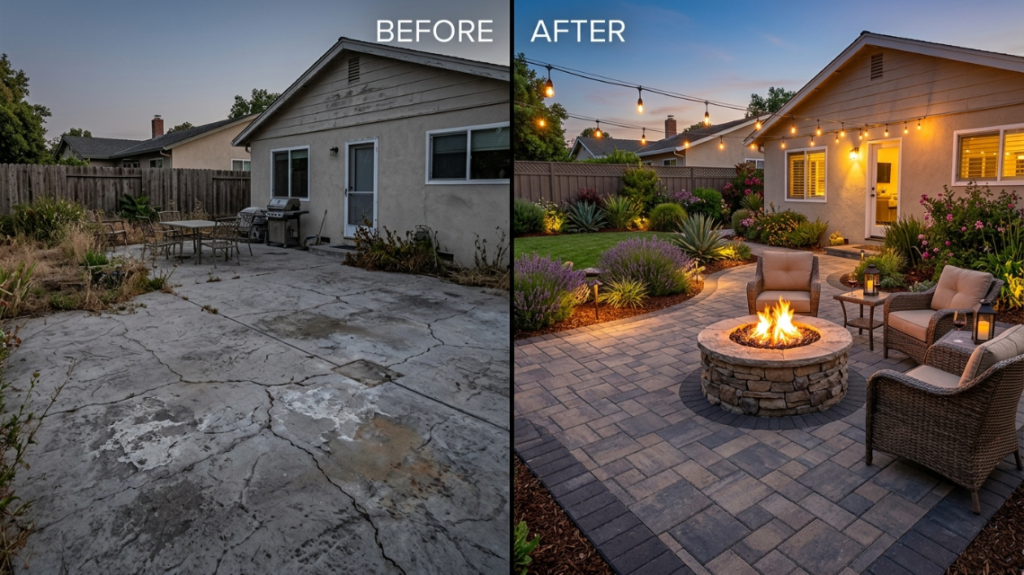
A homeowner near BBP Pavers’ headquarters on Clayton Road in Concord had an aging stamped concrete patio that had developed multiple cracks and lost most of its color after seven years. After consulting with our team, they chose a full interlocking paver patio in herringbone pattern with charcoal and sandstone tones, paired with a fire pit and outdoor lighting.
The project was completed in four days. The homeowner reported a $28,000 increase in appraised home value and has referred three neighbors since. This is exactly the outcome a thorough pavers vs stamped concrete definitive comparison predicts when the right material is chosen for the right conditions.
Common Mistakes Homeowners Make When Comparing Pavers vs Stamped Concrete
Any credible pavers vs stamped concrete definitive comparison must address the errors that lead homeowners to the wrong decision.
1. Choosing based on upfront price alone. Stamped concrete appears cheaper by $2–$5 per square foot at installation. Over 15 years, total cost of ownership often reverses due to resealing, repairs, and replacement.
2. Ignoring local soil conditions. Clay soil — prevalent throughout much of the Bay Area — expands and contracts dramatically with moisture. This makes cracking in stamped concrete nearly inevitable.
3. Not asking about base preparation. A paver installation is only as good as its base. Ask about gravel depth, compaction method, and sand layer specifications. BBP Pavers follows industry best practices on every project — details on our about pavers page.
4. Underestimating maintenance commitment. Stamped concrete requires mandatory resealing every 2–3 years. Skipping this step causes rapid deterioration that many homeowners are never warned about at the point of sale.
5. Not getting multiple quotes. Use trusted platforms like Houzz and Angi to compare contractors, read verified reviews, and understand fair market pricing before committing.
Head-to-Head Summary: Pavers vs Stamped Concrete
| Factor | Pavers | Stamped Concrete |
|---|---|---|
| Upfront Cost | Moderate–High | Low–Moderate |
| Long-Term Cost | Lower | Higher |
| Durability | 25–50+ years | 10–20 years |
| Crack Resistance | Excellent | Poor–Moderate |
| Repairability | Easy (individual units) | Difficult (visible patches) |
| Design Flexibility | Unlimited | Moderate (fixed at pour) |
| Maintenance | Low | Moderate–High |
| Resale Value Impact | High | Moderate |
| Permeability Option | Yes | No |
| Best For | Long-term value, premium homes | Budget-conscious short-term |
Frequently Asked Questions
Is stamped concrete cheaper than pavers?
Stamped concrete has a lower upfront cost, typically $8–$18 per square foot versus $10–$30 for pavers. However, when resealing, crack repairs, and eventual replacement are factored in, the pavers vs stamped concrete total cost comparison over 15–20 years consistently favors pavers.
How long does stamped concrete last compared to pavers?
Stamped concrete typically lasts 10–20 years before significant cracking or color fading requires major intervention. Pavers routinely last 25–50 years or more with minimal maintenance.
Can stamped concrete be repaired if it cracks?
Yes, but repairs are rarely seamless. Color matching is imperfect and patched areas remain visible. Individual pavers can be removed and replaced without any visible sign of repair — one of the strongest practical arguments in the pavers vs stamped concrete comparison.
Which is better for a pool deck — pavers or stamped concrete?
Pavers are the preferred choice for pool decks. They are slip-resistant, stay cooler underfoot, drain water between joints, and individual units can be replaced if damaged. See BBP Pavers’ pool deck services.
Do pavers add more value to a home than stamped concrete?
Yes. In most markets, pavers return a higher percentage of installation cost in home value — particularly in premium Bay Area markets. This is a consistent finding across pavers vs stamped concrete research from real estate professionals.
Conclusion: Pavers vs Stamped Concrete — Which Should You Choose?
After a full pavers vs stamped concrete definitive comparison across cost, durability, maintenance, repairability, aesthetics, environmental impact, and resale value, the conclusion is clear for most Bay Area homeowners.
If you want the best long-term investment, lowest cost of ownership, and maximum design flexibility, pavers are the right choice. If your budget is very tight and you need a short-term solution for a low-traffic area, stamped concrete can work — but go in with realistic expectations.
At BBP Pavers, we help homeowners throughout Concord, Walnut Creek, Lafayette, Moraga, Orinda, Fremont, Los Altos, Palo Alto, and Atherton make this decision with confidence every day.
Ready to make the right choice for your home? Contact BBP Pavers today for a free, no-obligation estimate.
Call: +1 844-497-3321 | Email: bbppavers@gmail.com Hours: Mon–Fri 9 AM–5 PM | Saturday 9 AM–2 PM 4918 Clayton Rd, Concord, CA 94521
Request Your Free Estimate | Explore Our Services | See Our Work on Instagram | Follow Us on Facebook | Save Ideas on Pinterest
BBP Pavers 4918 Clayton Rd, Concord, CA 94521, United States Phone: +1 844-497-3321 | Email: bbppavers@gmail.com Hours: Monday–Friday 9 AM–5 PM | Saturday 9 AM–2 PM All Service Areas | Privacy Policy | Terms & Conditions | Sitemap


