
A – Z Guide to Comparing Outdoor Lighting Options

Choose Outdoor Lighting by Purpose, Power, and Placement
The best outdoor lighting combines three layers: safe pathway and step lighting, warm ambient light for patios and entries, and focused accent or security light for key features. For most homes, low-voltage LED fixtures are a practical choice for walkways, pavers, planting beds, and patios. Add wall lights or motion-activated fixtures near doors and driveways, then use spotlights sparingly to highlight trees, walls, or architectural details.
When comparing options, focus on:
- Purpose: safety, security, curb appeal, entertaining, or all four
- Power system: low-voltage 12V, line-voltage 120V, solar, or a smart permanent system
- Light output: enough lumens to see steps and paths without harsh glare
- Color temperature: warm 2700K is a popular, inviting choice for residential outdoor spaces
- Durability: weather-rated fixtures in brass, copper, or quality aluminum stand up better to moisture and corrosion
Good lighting should make a paver driveway, patio, or walkway easier to use after dark, not turn the yard into a floodlit parking lot. A thoughtful plan also helps guide guests, define outdoor living areas, and bring out the texture and color of hardscapes.
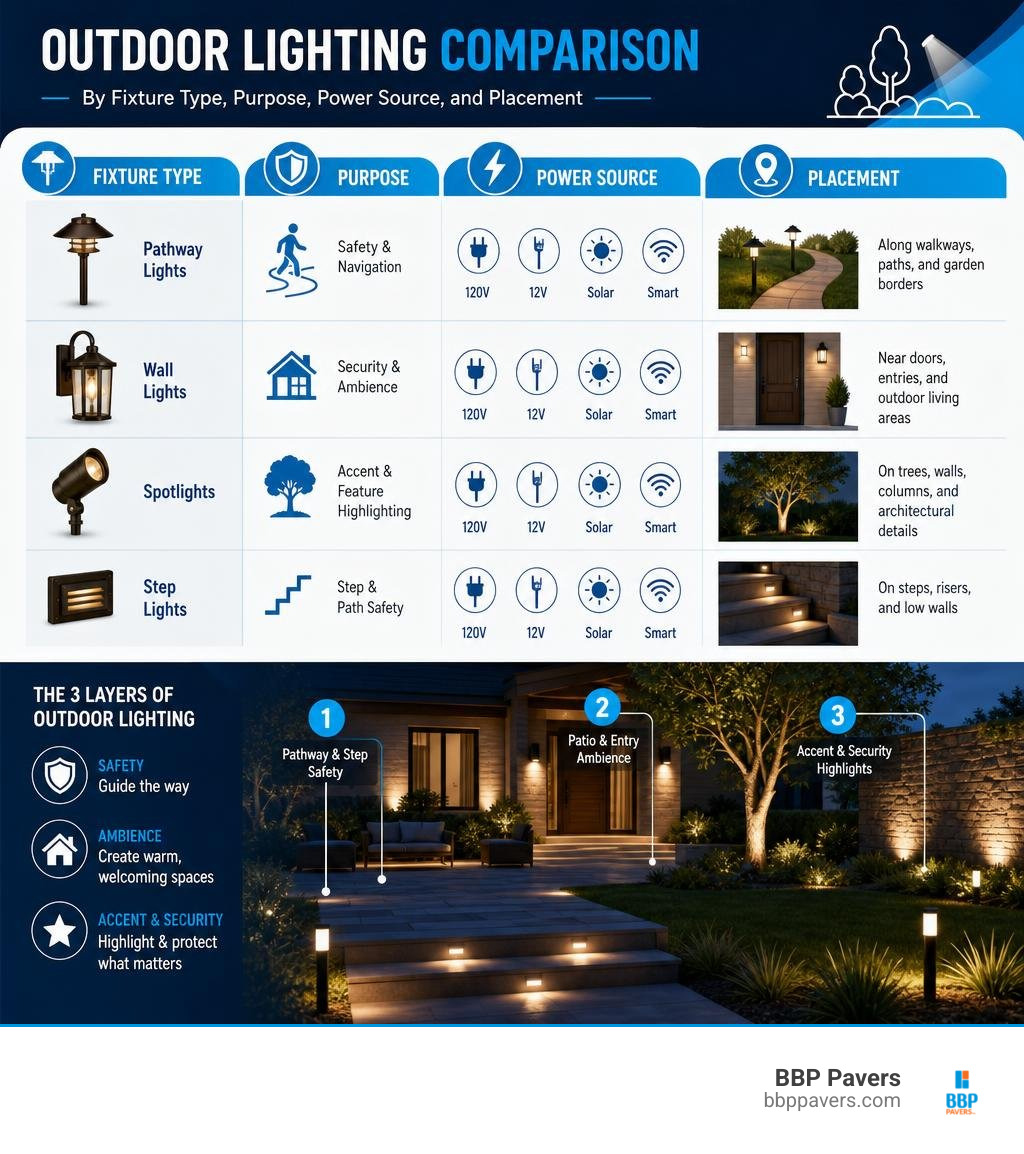
Modern Outdoor Lighting Systems and Fixture Types
Selecting the right fixtures requires balancing style, performance, and long-term durability. Exterior fixtures are not one-size-fits-all; a spotlight meant for a tall oak tree will create blinding glare if placed along a walkway. The core benefits of outdoor lighting come from layering different fixture styles so each zone of your yard serves its intended function.
Architectural, Pathway, and Accent Fixtures
A well-executed exterior scheme uses dedicated fixtures to shape how you experience your property after sunset:
- Path Lights: Featuring shielded hats or downward-facing louvers, path lights cast balanced pools of illumination across walkways and garden borders without shining directly into your eyes.
- Step and Deck Lights: Recessed into stair risers or surface-mounted to deck posts, these low-profile lights highlight level changes to prevent trips and falls.
- Wall Sconces and Lanterns: Mounted beside entry doors, garages, and along exterior walls, sconces provide eye-level ambient light that welcomes guests and anchors the home’s facade.
- Spotlights and Uplights: Featuring narrow beam spreads, spotlights highlight focal points such as ornamental trees, water features, statues, or architectural columns.
- Moonlighting: Fixtures installed high in mature tree canopies point downward through branches, casting soft, natural shadows across patios and lawns like a full moon.
- Hardscape and Grazing Fixtures: Mounted beneath retaining wall caps or along textured stone, grazing lights wash across stone surfaces to emphasize natural textures.
- Underwater Fixtures: Fully submersible units rated IP68 illuminate pond features, pool steps, and fountains from beneath the water surface.
When designing a cohesive layout, integrating bright outdoor lights for every corner of your property ensures dark pockets are eliminated while maintaining comfortable visual contrast.
Low-Voltage vs. Line-Voltage vs. Solar Outdoor Lighting
Outdoor illumination systems generally rely on one of three power distribution methods:
- Low-Voltage Systems (12V–24V): A central transformer steps down standard 120V household current to a safe 12V or 24V current. This is the industry standard for residential landscapes. Wiring does not require deep trenches or rigid metal conduit, making it safe around pets, children, and garden tools.
- Line-Voltage Systems (120V): Operating directly on household current, line voltage is necessary for high-draw commercial fixtures, street lighting, and large parking area floodlights. Installations must strictly comply with local electrical codes, requiring licensed electricians, junction boxes, and deep conduit trenches.
- Solar-Powered Fixtures: Solar lights rely on built-in photovoltaic cells and rechargeable lithium batteries. While wire-free, their light output is modest, and performance drops significantly during overcast winter days or in shaded yards.

Technical Specifications: Lumens, Color Temperature, and Build Durability
Understanding technical ratings prevents the two most common lighting mistakes: choosing fixtures that are blindingly bright and buying cheap materials that corrode after one rainy season.
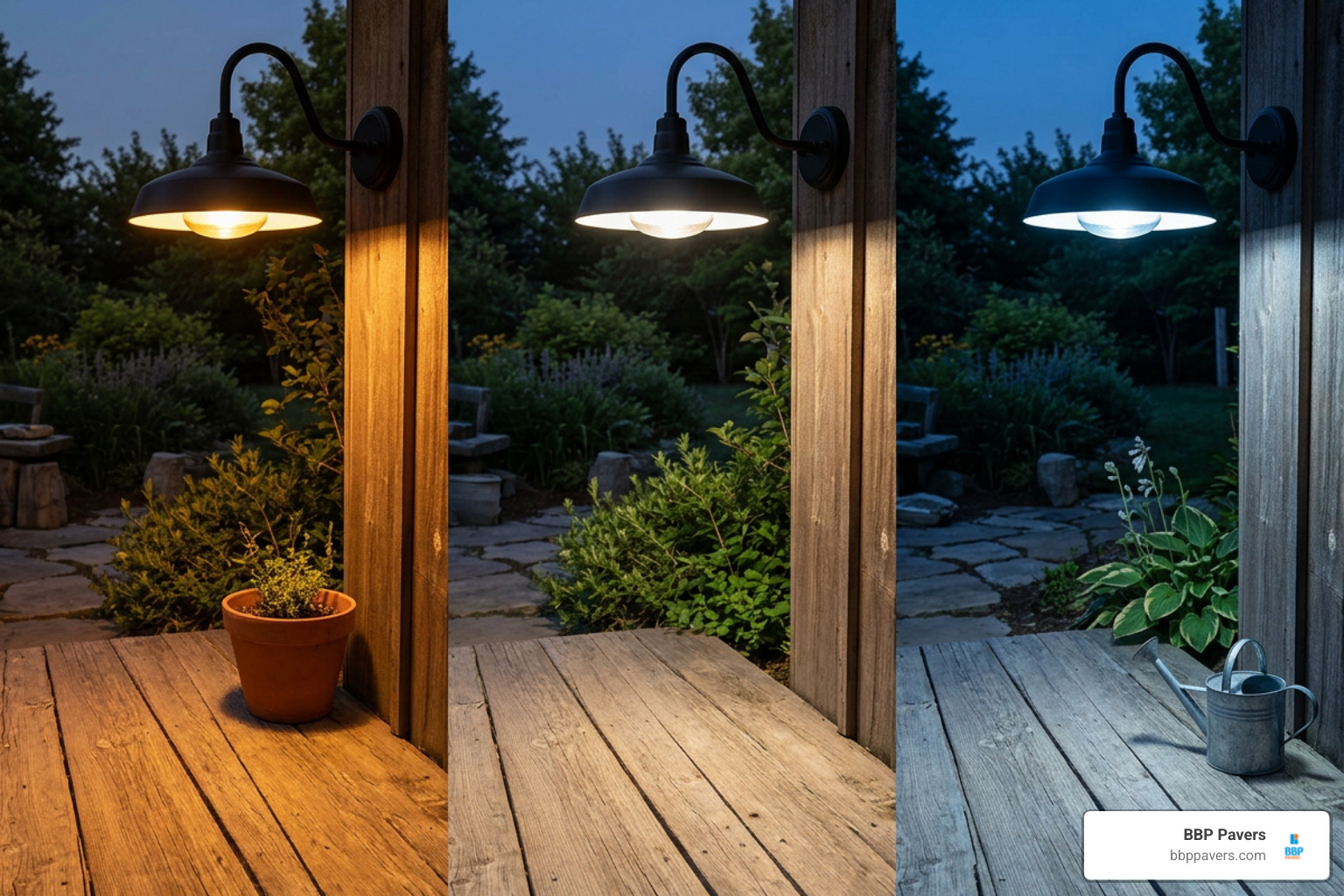
Sizing Lumens and Kelvins for Exterior Zones
Brightness is measured in lumens, while the warmth or coolness of light is measured in Kelvin (K).
Residential landscape fixtures typically range between 50 and 700 lumens:
- Path and Walkway Markers: 50 to 150 lumens (soft illumination to define walking edges)
- Hardscape Step & Wall Lights: 50 to 200 lumens (downward illumination for foot placement)
- Garden Accent and Shrub Uplighting: 150 to 300 lumens (gentle plant highlighting)
- Mature Tree and Facade Spotlights: 300 to 700 lumens (reaching upper branches and rooflines)
- Security Floodlights: 700 to 1,500+ lumens (broad coverage for driveways and gates)
Color temperature sets the mood:
- 2200K (Candlelight Glow): Ultra-warm, romantic tone ideal for fire pit zones and intimate outdoor dining areas.
- 2700K (Warm White): The gold standard for residential exteriors. It renders foliage green, complements wood and stone, and creates a welcoming atmosphere.
- 3000K (Neutral Warm): Crisp and clean; excellent for modern architecture, dark-colored stone, and commercial entryways.
- 4000K to 5000K (Cool White/Daylight): Best reserved for utility areas, commercial security, and task lighting. When used on residential foliage, it can make plants appear washed out or artificial.
High-quality LED chips should also feature a Color Rendering Index (CRI) of 80 or higher, ensuring that stone pavers, flowers, and natural wood retain their authentic, rich colors at night.
Fixture Durability, Ingress Protection, and Material Selection
Outdoor fixtures are exposed to rain, sprinkler spray, soil acidity, and sun exposure. The construction material directly dictates fixture lifespan:
- Solid Cast Brass: The premier choice for exterior lighting. Solid brass does not rust, corrode, or peel. Over time, it develops a natural patina that blends into garden mulch and plantings.
- Cast Aluminum with Powder Coating: A cost-effective, durable option when marine-grade coatings are used. However, low-grade aluminum can pit and oxidize if installed near saltwater or in acidic soils.
- Copper: Exceptionally long-lasting and naturally corrosion-resistant. Copper gradually transitions from a shiny penny finish to a distinguished green patina.
- Stainless Steel: Modern and sleek, but requires 316 marine-grade alloy to prevent surface staining in humid or coastal environments.
Always check the Ingress Protection (IP) rating:
- IP44: Protected against splashing water; suitable for covered porches and sheltered wall sconces.
- IP65: Protected against dust ingress and low-pressure water jets from any direction; the standard for garden path lights, uplights, and eave fixtures.
- IP67 / IP68: Protected against temporary or continuous water submersion; required for in-ground well lights, driveway paver inserts, and pond or fountain lighting.
Smart Automation, Permanent Eave Systems, and Control Protocols
Modern exterior systems integrate smart controls, allowing homeowners to schedule scenes, tune white color temperatures, or set custom holiday colors without climbing a ladder.
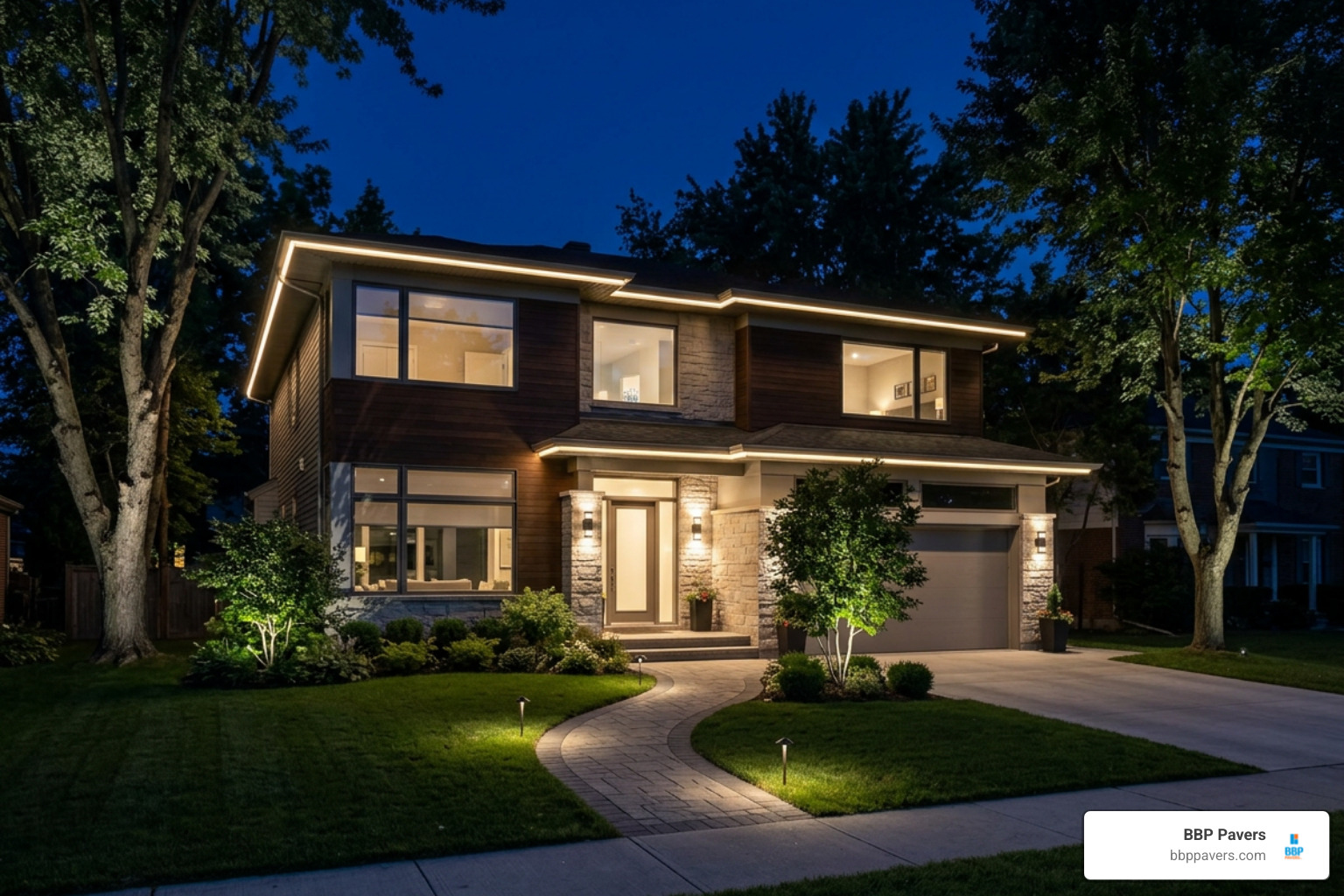
Permanent Eave and Soffit Smart Lights
Permanent roofline lighting systems have replaced traditional seasonal stringers. Mounted discreetly beneath eaves and soffits inside color-matched tracks, these systems remain invisible by day and provide fully customized architectural downlighting at night.
- Systems like the Nanoleaf Permanent Outdoor Lights offer individually addressable RGBWW LED pucks, delivering tunable warm-to-cool whites (2200K–6500K) for everyday accent lighting, alongside millions of vibrant colors for holidays and celebrations.
- With cross-platform smart home standards such as Matter over Wi-Fi, these systems connect directly into Apple Home, Google Home, Amazon Alexa, and SmartThings networks without requiring proprietary third-party hubs.
- High-lumen options like the LIFX Outdoor SuperColor Permanent Lights provide intense output with wide beam spreads, functioning both as perimeter security wash lighting and architectural accents.
Radar Detection, Motion Sensors, and Network Integration
Smart exterior lighting has evolved beyond basic PIR (passive infrared) motion detectors that trigger every time a tree branch sways in the wind:
- Advanced systems such as the eufy Permanent Outdoor Lights S4 utilize integrated radar detection, reducing false alarms by up to 98% compared to legacy infrared sensors. These can be configured to brighten paths when family members approach or trigger security strobes when unexpected motion occurs along property perimeters.
- Smart spotlight systems like the Philips Hue Lily XL output over 1,000 lumens of tunable light via low-voltage wiring, allowing dynamic zone dimming and automated astronomical dusk-to-dawn scheduling via mobile apps.
Design Strategies, Safety Standards, and Hardscape Layouts
A successful exterior layout weaves fixtures directly into the hardscape architecture rather than treating lighting as an afterthought.
Integrating Hardscapes with Professional Outdoor Lighting
Hardscape elements such as paver patios, sitting walls, outdoor kitchens, and stairways offer clean channels for integrated lighting hardware:
- Under-Cap Retaining Wall Lights: Thin, low-profile fixtures mount beneath wall caps and counter overhangs. They cast a warm downward glow that highlights the vertical texture of stone pavers while hiding the fixture body from view.
- Paver Step Risers: Recessing low-voltage fixtures directly into step risers provides crucial foot illumination, eliminating shadows on stair treads.
- Flush In-Ground Paver Lights: Drive-over and walk-over rated LED fixtures can be installed flush between pavers along driveways and walkways, creating runway-style perimeter boundaries.
- Conduit and Cabling Prep: When installing outdoor lighting with pavers, low-voltage conduits should be routed under the aggregate base layer before pavers are laid and compacted. This protects wiring from aeration spikes, edge trimmers, and shifting ground.
Exploring 10 stunning ways to combine outdoor lighting with pavers for a jaw-dropping nighttime look shows how combining hardscape under-cap lights with perimeter path markers creates a balanced resort-style ambiance.
Layout Planning, Zoning, and Dark-Sky Principles
To avoid creating light pollution or annoying your neighbors, balance fixture distribution across dedicated lighting zones:
- Calculate Transformer Loads: Tally the total wattage of all LED fixtures on a run and select a transformer rated at least 20% above the total load (e.g., use a 150W transformer for a 120W system) to account for line loss and future expansion.
- Prevent Voltage Drop: Run heavy-gauge (12 AWG or 14 AWG) direct-burial cable. Keep wire runs under 150 feet per line, or utilize a “hub-and-spoke” or “T-method” wiring layout so fixtures at the end of the line receive the same voltage and brightness as fixtures closest to the transformer.
- Follow Dark-Sky Guidelines: Choose full-cutoff fixtures that direct light downward onto walking surfaces and patios rather than scattering glare upward into the night sky. Use warm color temperatures (3000K or lower) to protect nocturnal wildlife and preserve starry night views.
For complex projects involving multi-tiered retaining walls, custom pergolas, and outdoor kitchens, our specialized outdoor lighting services provide precision wiring integration built to code.
Frequently Asked Questions About Exterior Illumination
What brightness (lumens) is recommended for different outdoor spaces?
Walkways and garden pathways generally require 50 to 150 lumens per fixture to define the path without glare. Hardscape step and under-cap fixtures perform best at 50 to 200 lumens. Architectural uplights and tree spotlights typically require 200 to 700 lumens depending on the height of the canopy. High-activity entertaining areas and security floodlights benefit from 700 to 1,500+ lumens.
How do permanent smart lights compare to traditional landscape lighting?
Permanent smart eave lights mount directly to rooflines and soffits, offering full RGBWW color changing, music sync, and automated holiday scenes via smartphone apps. Traditional landscape lighting focuses on low-voltage brass path lights, spotlights, and hardscape fixtures positioned at ground level. The most dynamic properties combine both: permanent roofline lights for architectural framing and ground-level low-voltage fixtures for pathways and landscape depth.
Why is 12V low-voltage preferred over 120V line-voltage for residential yards?
Low-voltage (12V) systems step down standard household electricity through a transformer, making the wiring safe from serious electrical shock hazards. Low-voltage cables only need to be buried 6 inches deep in planting beds, making system adjustments, expansions, and maintenance straightforward compared to 120V systems, which require rigid metal conduit buried 18 inches or more.
Conclusion
A well-designed exterior illumination system turns your outdoor living spaces into an evening retreat while boosting home security and nighttime curb appeal. By choosing the appropriate voltage system, selecting durable solid brass or copper fixtures, and maintaining warm 2700K color temperatures, you protect your property against harsh glare and premature fixture failure.
At BBP Pavers, we bring over two decades of local Bay Area hardscape and lighting craftsmanship to every project. Whether you are building an integrated paver patio, upgrading outdoor stair safety, or illuminating mature garden paths, our safety-first process and 100% satisfaction guarantee ensure your property shines beautifully for years to come. Reach out to our team today for a free design consultation and quote.


