Bright Outdoor Lights for Every Corner of Your Property

Types of Bright Outdoor Lights for Residential and Commercial Properties
Choosing the best bright outdoor lights requires matching fixture styles and lumen outputs to each zone of your property: high-output floodlights and commercial wall packs (3,000 to 10,000+ lumens) deliver wide-area security for driveways and perimeters, directional spotlights (400 to 1,200 lumens) accentuate architectural details and trees, and low-voltage fixtures (100 to 400 lumens) safely illuminate pathways and stairs without glare. Balancing broad coverage with targeted accents ensures your exterior remains safe, secure, and visually appealing.
If you are exploring broader layouts for your space, our guide on outdoor lighting ideas to transform your yard in spring 2026 offers great inspiration for combining living areas with functional illumination.
High-Output Floodlights and Wall Packs
When your primary goal is wide-area visibility and perimeter defense, high-output floodlights and commercial-grade wall packs are the undisputed heavyweights. Traditional floodlights cast wide beams (typically 90° to 120°) that wash across open driveways, sports courts, and side yards. Wall packs, commonly installed on vertical building facades, project light downward and outward to eliminate dark shadows along property boundaries.
In residential applications, high-efficiency LED floodlights delivering between 3,000 and 10,000 lumens provide ample coverage without creating blinding light trespass into neighboring windows. For massive commercial building facades or large construction areas requiring extreme illumination, specialized industrial units—such as the super bright high power LED architectural spotlight—can deliver tens of thousands of lumens using multi-optic lenses that project beams across vast distances. Modern LED wall packs also feature cut-off shields that direct output precisely toward the ground, ensuring high visibility while preventing glare.
Directional Spotlights and Landscape Accents
Unlike wide-angle floodlights, directional spotlights use narrow beam spreads (typically 15° to 45°) to concentrate light onto specific architectural elements, specimen trees, or textured stone retaining walls. This technique—often called grazing or uplighting—creates depth and dramatic contrast across your landscape rather than flattening the scene with broad light.
Low-voltage directional spotlights are exceptionally versatile for hardscape integration. For example, high-performance fixtures like the Philips Hue Lily XL outdoor spot light output over 1,000 lumens with precise optical hoods that prevent stray light from hitting viewer sightlines. We frequently install directional fixtures to accentuate hardscape textures, as detailed in our guide on integrating outdoor lighting with pavers. By positioning spotlights at the base of stonework or beneath broad tree canopies, you achieve an upscale resort aesthetic that doubles as functional perimeter safety.
Smart Color-Tunable and Perimeter Fixtures
Smart exterior lighting has evolved far beyond basic on/off switches. Today’s smart perimeter lights and color-tunable floodlights utilize advanced RGBWW (Red, Green, Blue, Warm White, Cool White) LED arrays that let you shift color temperatures on demand or program vibrant hues for holidays and special events.
Smart PAR38 bulbs and fixtures, such as the LIFX outdoor SuperColor flood light, deliver upwards of 1,600 lumens of tunable white light (from an ultra-warm 1500K to a crisp 9000K daylight) alongside rich color spectrums. These fixtures connect seamlessly to smart home platforms like Apple Home, Google Home, and Matter-enabled hubs via standard Wi-Fi, allowing you to set automated sunset routines, create dynamic lighting scenes, or trigger full-brightness white illumination whenever motion is detected around the perimeter.
Essential Technical Specifications to Consider
Finding the right fixtures requires looking past basic marketing claims and evaluating core electrical and optical specifications. To ensure you invest in fixtures that perform reliably year after year, professional designers evaluate four primary metrics: luminous output, efficacy ratios, thermal management, and ingress protection. For an overview of our installation standards and fixture selection, visit our dedicated outdoor lighting service page.
Matching Lumens and Wattage for Bright Outdoor Lights
For decades, homeowners relied on wattage to judge how bright a bulb would be. With modern solid-state LED technology, wattage only measures energy consumption—lumens measure actual brightness. LEDs deliver between 100 and 150 lumens per watt (lm/W), allowing a 50W LED fixture to produce the same illumination as an obsolete 250W metal-halide or 300W halogen bulb while cutting electricity use by 80% to 90%.
The table below outlines standard lumen ranges, average LED power requirements, and ideal property applications:
| Fixture Category | Typical Lumen Output | Average LED Wattage | Recommended Applications |
|---|---|---|---|
| Path & Step Lights | 100 – 400 lm | 2W – 5W | Walkway edges, paver stairs, garden borders |
| Landscape Spotlights | 400 – 1,200 lm | 5W – 15W | Tree uplighting, pillars, water features, statues |
| Residential Wall Sconces | 800 – 1,600 lm | 8W – 18W | Front porches, garage flanks, patio entryways |
| Security Motion Floodlights | 2,000 – 5,000 lm | 20W – 50W | Driveways, side yards, perimeter blind spots |
| Commercial Wall Packs | 5,000 – 12,000 lm | 40W – 90W | Commercial facades, loading bays, parking aprons |
| High-Mast Area / Stadium | 15,000 – 40,000+ lm | 120W – 300W+ | Large parking lots, athletic courts, open acreage |
In addition to superior energy efficiency, LED chips boast operating lifespans of 25,000 to 50,000 hours—meaning that under normal nightly operation, your fixtures can perform flawlessly for well over a decade without replacement.
Color Temperature and Weatherproof IP Ratings
Two of the most critical factors influencing visual comfort and long-term durability are Correlated Color Temperature (CCT) and Ingress Protection (IP) ratings.
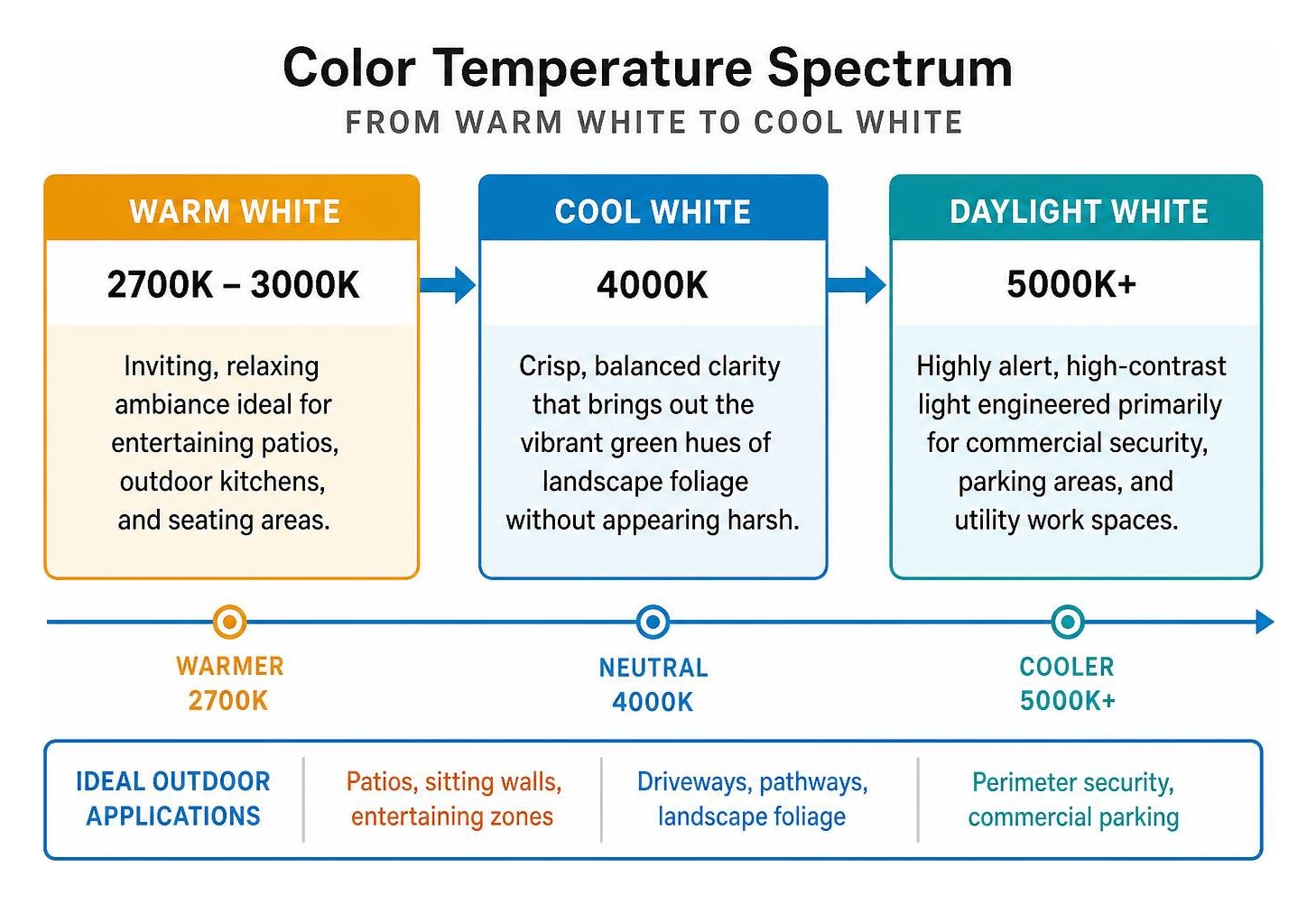
Color Temperature (CCT): Measured in Kelvin (K), color temperature dictates the hue of white light.
- 2700K – 3000K (Warm White): Creates an inviting, relaxing ambiance ideal for entertaining patios, outdoor kitchens, and seating areas.
- 4000K (Neutral/Cool White): Provides crisp, balanced clarity that brings out the vibrant green hues of landscape foliage without appearing harsh.
- 5000K (Daylight): Highly alert, high-contrast light engineered primarily for commercial security, parking areas, and utility work spaces.
Ingress Protection (IP Ratings): Outdoor fixtures must endure dust, heavy rain, irrigation spray, and freezing temperatures. The IP code consists of two digits: the first indicates solid particle protection (0–6), and the second indicates moisture protection (0–8).
- IP44: Protected against solid objects over 1mm and water splashes; suitable only for covered porches or soffits.
- IP65: Completely dust-tight and protected against water jets from any direction; the baseline gold standard for exposed outdoor spotlights, floodlights, and wall packs.
- IP68: Hermetically sealed against continuous water immersion; required for in-ground well lights, step lights set into paver joints, and fountain illumination.
Power Sources: Hardwired vs Solar Fixtures
Choosing how to power your exterior fixtures directly determines their maximum brightness, consistency during bad weather, and installation complexity.
Hardwired Systems for Maximum Output
When consistent, uncompromising brightness and long-term reliability are non-negotiable, hardwired lighting systems are the industry benchmark. Hardwired exterior setups fall into two categories:
- Line-Voltage (120V): Typically used for high-output commercial wall packs, building floodlights, and stadium lighting. Line voltage allows for ultra-high lumen outputs (5,000 to 30,000+ lumens) across large spaces but requires rigid conduit, buried junction boxes, and professional electrical installation.
- Low-Voltage (12V / 24V): The premier choice for residential landscape and hardscape systems. A central multi-tap transformer steps standard household 120V power down to a safe 12V or 24V current. Low-voltage systems are remarkably safe around children and pets, energy-efficient, and easy to service.
To ensure hardwired systems perform at their peak, careful wire sizing and transformer calculations are essential to prevent voltage drop—a phenomenon where fixtures installed at the end of a long wire run receive less power, causing them to look noticeably dimmer.
Solar Solutions and Strategic Placement
Solar-powered outdoor lighting has advanced significantly thanks to high-efficiency monocrystalline photovoltaic panels and durable lithium-ion battery cells. Quality solar security lights can produce bursts of 1,500 to 2,500 lumens, making them a practical choice for remote gates, perimeter fence lines, or detached sheds where running electrical conduit is cost-prohibitive.
However, solar fixtures come with inherent engineering trade-offs:
- Solar Access Dependencies: They require 6 to 8 hours of direct, unshaded sunlight to achieve a full battery charge. Mounting them beneath dense tree canopies or north-facing eaves drastically cuts runtime.
- Seasonal Dimming: During short, overcast winter days, battery reserves drop, leading to dimmed outputs or premature shut-offs.
- Motion-Triggered Output: To conserve battery life, most high-output solar fixtures remain in a low-lumen standby mode (100–200 lumens) and only flare to full brightness when passive infrared (PIR) sensors detect motion.
For high-traffic entertaining patios, front entryways, and main driveways, hardwired systems deliver continuous, predictable illumination regardless of the weather.
Strategic Placement and Installation Best Practices
Even the highest-quality lighting fixture will underperform if mounted at the wrong angle or height. Proper placement achieves uniform illumination, prevents harsh glare that blinds oncoming drivers or guests, and preserves dark-sky friendliness. For a deeper look at architectural lighting layouts, explore our tips on outdoor lighting design in Concord, CA.
Positioning Bright Outdoor Lights for Security and Hardscapes
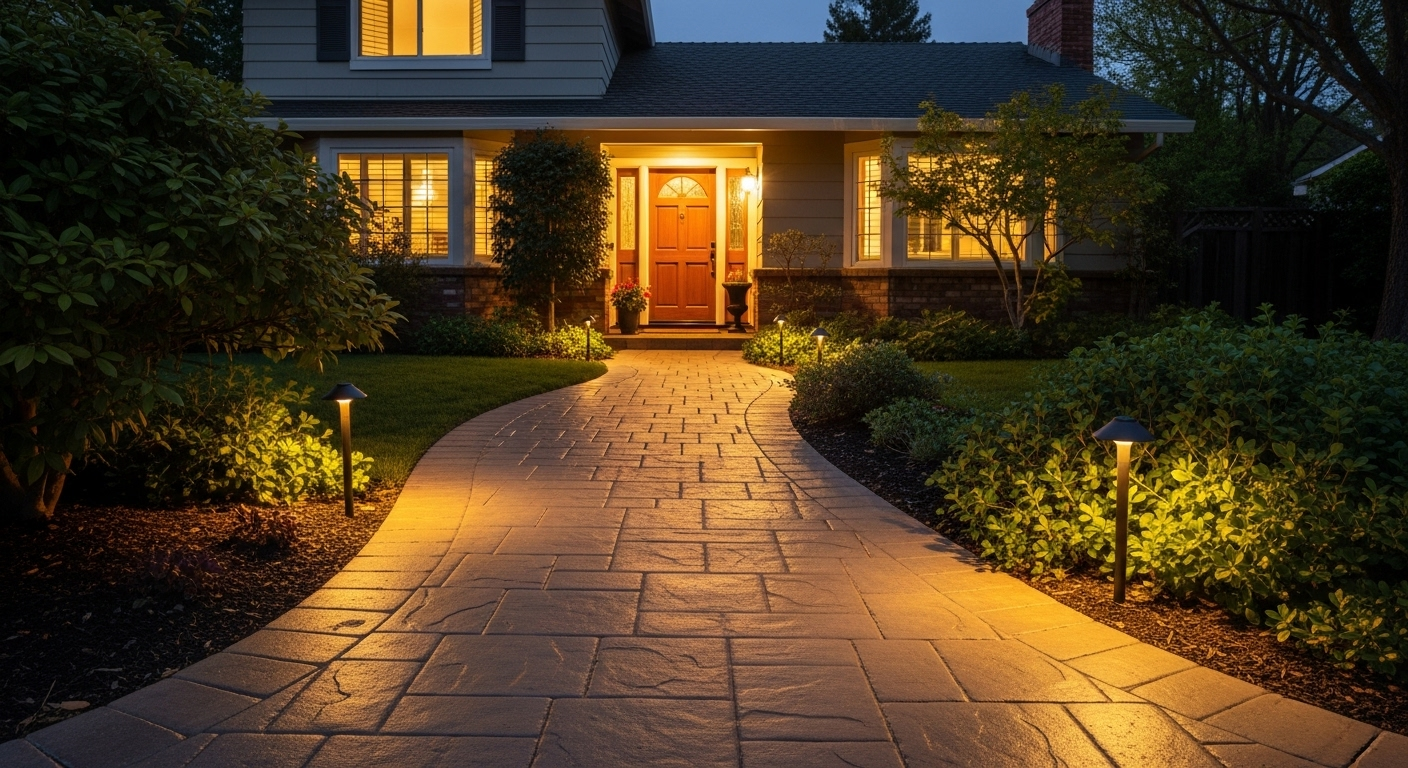
Effective security lighting relies on overlapping fields of view rather than a single blinding light source. When mounting security floodlights on garage gables or building corners:
- Mount at 8 to 12 Feet: Mounting fixtures at this height keeps them above head height to prevent tampering while positioning the motion sensors for optimal horizontal sweeping.
- Utilize 240-Degree Sensors with 70-Foot Range: Advanced security fixtures feature dual or triple-head LED designs with motion detection spanning 240 degrees and reaching up to 70 feet out. Angle the outer heads outward to cover side entryways while aiming the center head downward to cover the main driveway.
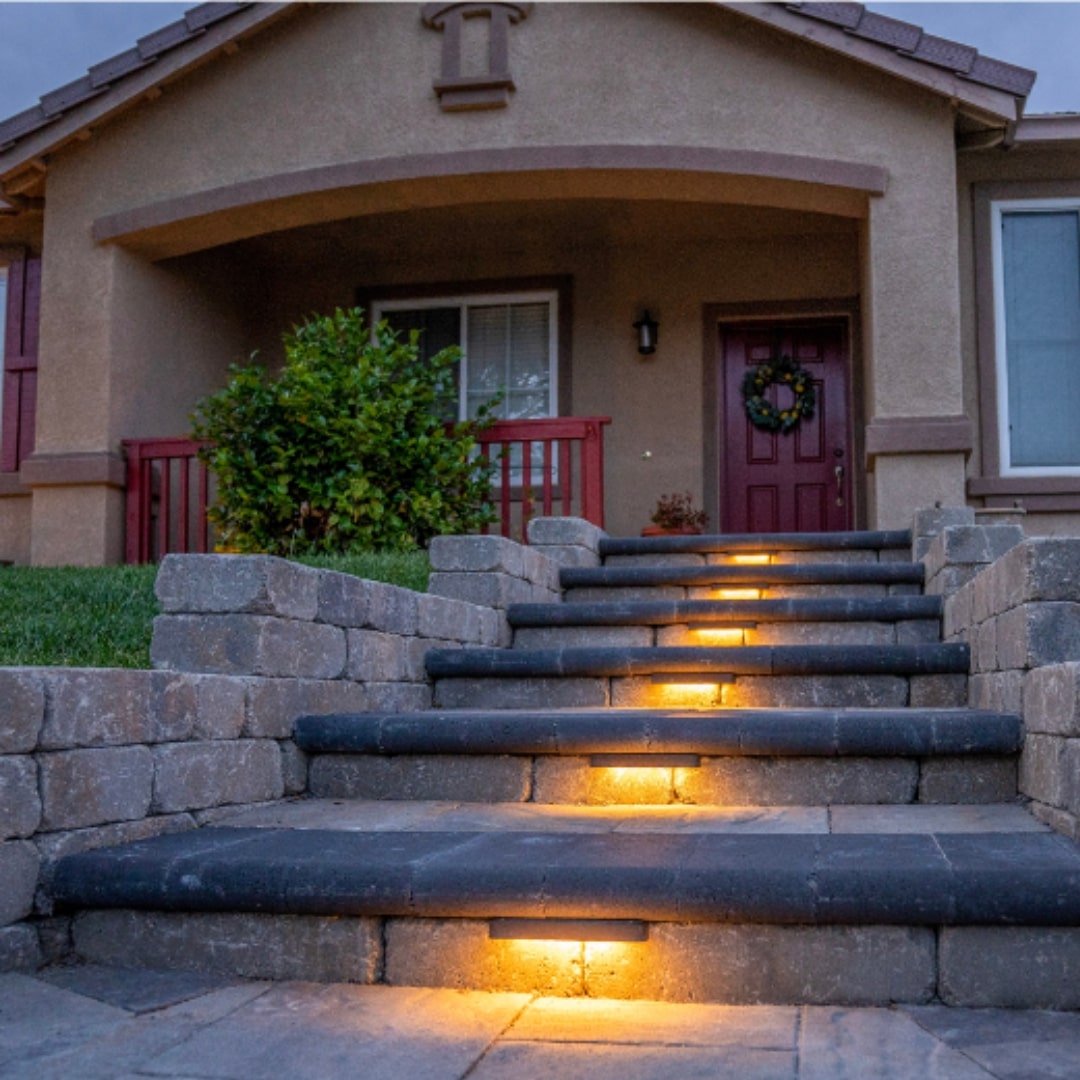
- Layer Low-Level Hardscape Lights: High-mounted security lights should be paired with low-level step, wall, and path lights. Integrating fixtures into retaining walls and paver steps eliminates trip hazards without casting harsh shadows. Check out our design guide on 10 stunning ways to combine outdoor lighting with pavers for step-by-step layout strategies.
Smart Controls, Sensors, and Commercial Rebates
Modern commercial and high-end residential fixtures feature built-in controls that maximize energy savings and convenience:
- Photocells (Dusk-to-Dawn): Integrated light sensors that automatically activate fixtures at sunset and power them down at sunrise, ensuring zero wasted energy during daylight hours.
- Field-Selectable CCT and Wattage: Many premium fixtures now feature internal dip switches that let you toggle between 3000K, 4000K, and 5000K color temperatures, or dial wattage up and down (e.g., 30W / 40W / 50W) during installation to match the exact scale of the space.
- Energy Certifications and Rebates: When upgrading commercial properties, look for fixtures certified by DLC (DesignLights Consortium) and Energy Star. DLC listing ensures the fixture meets stringent commercial efficiency, optical quality, and lumen-maintenance standards. More importantly, DLC certification qualifies commercial building owners for substantial local utility rebates that can significantly offset upfront fixture and installation costs.
Frequently Asked Questions About Bright Outdoor Lighting
How many lumens do I need for a bright outdoor space?
The required lumen output depends on the square footage and specific use of the area:
- Walkways and Steps: 100 to 400 lumens per fixture spaced 6 to 8 feet apart provides safe footing without glare.
- Patios and Outdoor Living Spaces: 1,500 to 3,000 total lumens across layered fixtures (wall sconces, overhead pergola lights, and accent spots) creates a comfortable, functional setting.
- Residential Driveways and Security Areas: 3,000 to 5,000 lumens from dual- or triple-head floodlights ensures complete visibility across dark corners.
- Commercial Parking Lots and Facades: 10,000 to 30,000+ lumens per fixture mounted on tall poles or upper wall packs provides uniform, shadow-free commercial coverage.
What IP rating is recommended for exposed exterior fixtures?
For any fixture fully exposed to the elements—including roofline floodlights, wall sconces, and landscape spotlights—we recommend an IP65 rating. An IP65 rating guarantees that the housing is completely impervious to dust and can withstand direct water jets from rainstorms and garden sprinklers. For fixtures installed directly flush into paver surfaces, driveways, or near water features where standing water can occur, choose IP67 or IP68 submersible-rated housings.
Can bright outdoor LED fixtures qualify for energy rebates?
Yes. Commercial property owners and multi-family residential managers can take advantage of substantial energy efficiency rebates from municipal utility providers by installing DLC-listed (DesignLights Consortium) exterior LED fixtures. DLC-certified wall packs, area shoebox fixtures, and high-output canopy lights meet strict lumens-per-watt efficiency benchmarks, often qualifying projects for cash-back incentives that cover 20% to 50% of the fixture costs.
Conclusion
Illuminating your exterior spaces with bright, well-engineered lighting transforms the way you experience your property after sunset. By pairing the right fixture types—from wide-beam security floodlights and sleek architectural wall packs to precision landscape accents—with appropriate lumen outputs, warm-to-cool color temperatures, and durable IP65+ weatherproofing, you create an exterior that is safe, secure, and visually striking.
At BBP Pavers, our team brings over 20 years of Bay Area hardscaping and exterior lighting expertise to every project. Whether you are building a custom paver patio, upgrading your driveway, or installing a comprehensive low-voltage lighting system, we combine premium materials with a safety-first process and a 100% satisfaction guarantee.
Ready to transform your property’s nighttime curb appeal? Explore our full suite of Bay Area hardscape and lighting services and contact our team today for a free design consultation and quote!