Permeable Pavers Contra Costa County: C.3 Stormwater Rules Explained
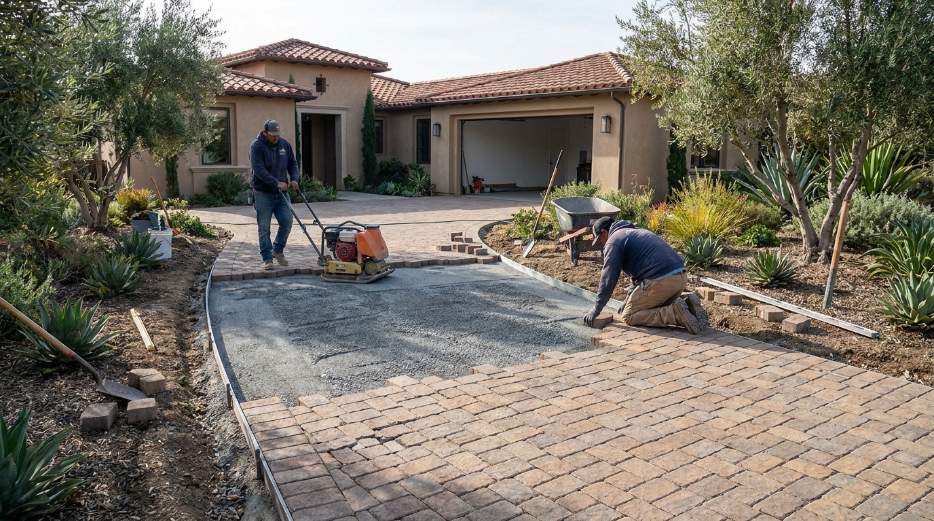
Table of Contents
- Direct Answer
- Why Stormwater Matters for Paver Projects
- What Are the C.3 Stormwater Requirements?
- How Permeable Pavers Help With Stormwater
- Does Your Paver Project Need Permeable Pavement?
- How Is Permeable Pavement Installed?
- Where Permeable Pavers Make Sense in Contra Costa
- How Do You Maintain Permeable Pavers?
- Frequently Asked Questions
- What Should You Do Before Installing Pavers?
Direct Answer
Permeable pavers Contra Costa homeowners choose can help reduce stormwater runoff by allowing rainwater to move through pavement and into a prepared base. However, permeable pavers are not automatically required for every project. Requirements depend on the project’s size, impervious surface, location, and applicable C.3 stormwater rules.
Why Does Stormwater Matter for Paver Projects?
When rain falls on a natural landscape, some of the water can soak into the soil. When that same rain falls on a roof, concrete driveway, asphalt surface, or other impervious area, much more water can become surface runoff.
That runoff can carry pollutants toward storm drains and local waterways. Stormwater regulations in Contra Costa County are designed to reduce pollutants, slow runoff, and encourage infiltration where appropriate.
For homeowners planning a driveway, patio, walkway, or other hardscape project, this means drainage should be considered as part of the design instead of being treated as an afterthought.
This is especially important when a project creates or replaces a substantial amount of impervious surface. The amount of surface being changed can determine whether additional stormwater requirements apply.
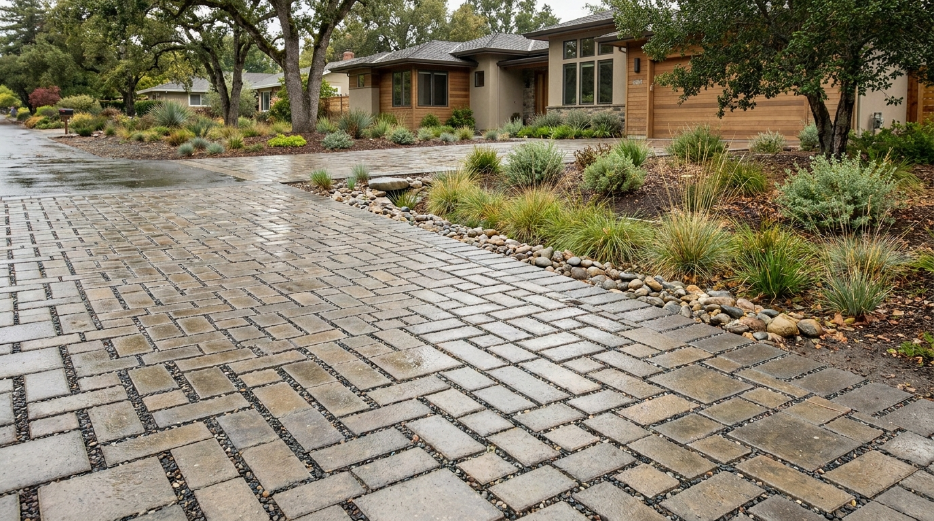
What Are the C.3 Stormwater Requirements?
C.3 refers to Provision C.3 of the Municipal Regional Stormwater Permit framework used by Contra Costa Clean Water Program jurisdictions.
Under the current MRP 3.0 requirements, the impervious-surface threshold for many regulated projects is 5,000 square feet. Contra Costa County identifies facilities, roads, sidewalks, and trails that create or replace 5,000 square feet of impervious surface among the projects that can trigger C.3 requirements.
Detached single-family homes have a separate threshold of 10,000 square feet of created or replaced impervious surface.
These thresholds are important, but they should not be interpreted as meaning that every project under the threshold has no stormwater responsibilities. Projects that are not required to comply with full C.3 requirements may still need to implement permanent stormwater controls to the maximum extent practicable.
The exact requirements can also depend on the type of project and the local agency reviewing it. For that reason, homeowners should confirm project-specific requirements before construction begins.
Does every driveway need to comply with C.3?
No. A residential driveway does not automatically become a C.3-regulated project simply because it uses pavers.
The important factors include the amount of impervious surface being created or replaced, the type of project, and the applicable local requirements.
If your project is close to a regulatory threshold, it is particularly important to determine the impervious-surface area before choosing the final pavement design.
Contra Costa County stormwater development information provides additional guidance on current C.3 applicability.
How Can Permeable Pavers Contra Costa Homeowners Use Help With Stormwater?
Permeable pavement is designed so that rainfall can enter the pavement system instead of being treated as runoff from a completely sealed surface.
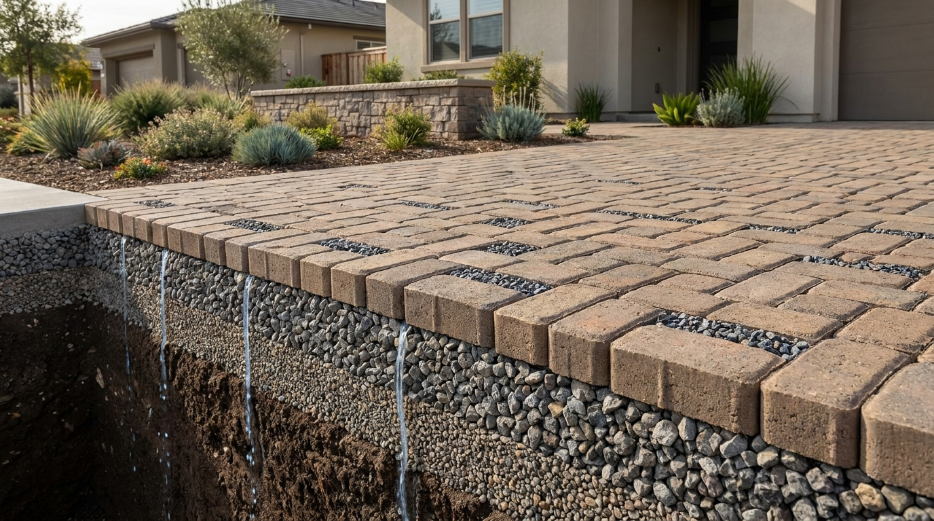
Depending on the system, water can pass through openings between pavement units and move into an open-graded stone base beneath the surface. The base can temporarily store water and allow it to infiltrate into the underlying soil when site conditions permit.
The important point is that permeable pavement is a complete system. Simply installing ordinary pavers with wider joints does not automatically create a properly functioning permeable pavement system.
- Paver surface: Provides the finished walking or driving surface.
- Open joints: Allow rainfall to enter the pavement assembly.
- Stone reservoir: Provides storage below the pavement.
- Subgrade: Determines how water can move into the native soil.
- Drainage design: Helps manage water when rainfall exceeds infiltration capacity.
Contra Costa Clean Water guidance identifies pervious pavement as one possible approach for reducing runoff and encouraging infiltration where feasible.
Contra Costa Clean Water Program C.3 requirements provides current information about stormwater design requirements and pervious pavement.
Does Your Paver Project Need Permeable Pavement?
Not necessarily. One of the most common misconceptions about stormwater regulations is that every property owner must install permeable pavers.
That is not how the requirements work.
A project may be able to address stormwater through a combination of site design, landscape areas, bioretention, drainage improvements, or permeable pavement, depending on the project and applicable requirements.
What should you evaluate before choosing a pavement system?
- The total amount of impervious surface being created or replaced.
- The existing drainage pattern on the property.
- The slope of the proposed pavement area.
- The condition and permeability of the native soil.
- Whether the surface will be used by pedestrians or vehicles.
- How much stormwater the site needs to manage.
- The requirements of the local reviewing agency.
A good paver contractor should be able to discuss these factors with you before installation begins.
The goal should not simply be to select the most expensive or most complicated pavement system. The goal is to choose a solution that works for the property and the intended use.
How Is Permeable Pavement Installed?
A successful permeable pavement installation begins below the visible pavers.
The contractor first prepares the area and establishes the appropriate grade. The existing soil must be evaluated and prepared according to the requirements of the selected system.
An open-graded stone base is then installed beneath the pavement. This base serves an important role because it provides structural support while also creating space for temporary water storage.
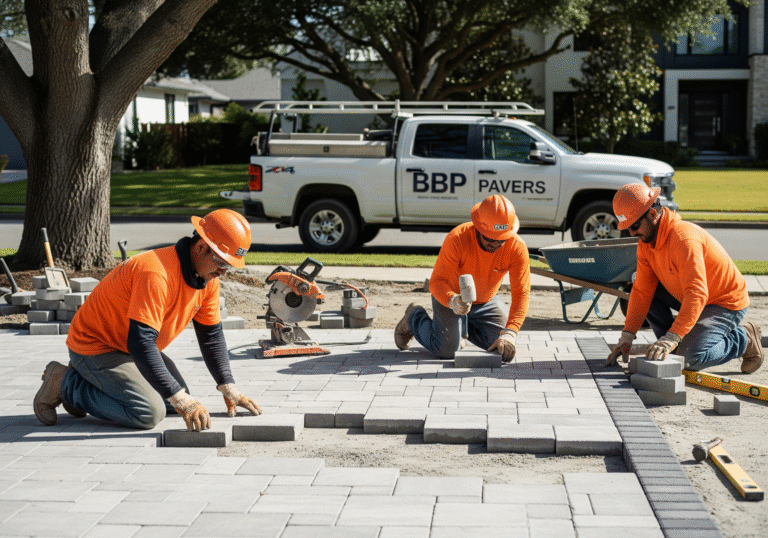
The pavers are installed over the prepared base with appropriate joints and edge restraints. The joint material must allow water to enter the pavement system.
Proper installation is critical because the performance of the finished surface depends on the entire assembly rather than the appearance of the individual pavers.
Why does the base matter?
The base is one of the most important components of a permeable pavement system.
It supports the pavement while creating void space beneath the surface. The exact material, depth, and construction method should be selected according to the site conditions, pavement use, and applicable specifications.
This is why permeable pavement should not be installed exactly like a conventional paver driveway without considering its drainage function.
Where Do Permeable Pavers Make Sense in Contra Costa?
Permeable pavers Contra Costa property owners choose can be useful in a variety of residential and commercial hardscape applications when the site conditions support the system.
Concord
In Concord, permeable pavement can be considered for driveway renovations, patios, walkways, and other hardscape projects where stormwater management is part of the design.
Homeowners replacing an older driveway can evaluate whether the new pavement should continue using a conventional drainage approach or incorporate a permeable system.
Walnut Creek
Walnut Creek properties can include a mixture of driveways, patios, landscaped areas, and outdoor living spaces. A permeable pavement design can sometimes be incorporated into a larger landscape and drainage strategy.
Lafayette, Moraga, and Orinda
Properties in Lafayette, Moraga, and Orinda can present different drainage considerations because terrain and site conditions vary significantly between properties.
On sloped properties, the pavement system should be evaluated together with grading and drainage rather than treated as an isolated surface.
For local installation information, homeowners can also review BBP Pavers service areas.
How Do You Maintain Permeable Pavers?
Permeable pavement requires maintenance to preserve the openings that allow water to enter the system.
Leaves, dirt, sediment, and other fine materials can accumulate in pavement joints over time. If those materials are allowed to build up, the surface may become less effective at accepting rainfall.
Routine maintenance can include:
- Removing leaves and debris.
- Sweeping the pavement surface.
- Monitoring areas where water appears to drain slowly.
- Replacing or restoring joint material when necessary.
- Keeping surrounding landscape areas from washing sediment onto the pavement.
The exact maintenance requirements depend on the pavement system and the conditions around the property.
When selecting a contractor, ask what maintenance the proposed system requires and how the contractor recommends keeping the pavement functioning over time.
Frequently Asked Questions About Permeable Pavers Contra Costa
Are permeable pavers required in Contra Costa County?
No. Permeable pavers are not automatically required for every driveway, patio, or walkway. Applicable stormwater requirements depend on the project type, impervious surface area, jurisdiction, and other project-specific factors.
What is the current C.3 threshold?
For many C.3-regulated project categories, the threshold is 5,000 square feet of created or replaced impervious surface. Detached single-family homes have a separate 10,000-square-foot threshold.
Can permeable pavers be used on a driveway?
Yes. Properly designed permeable pavement systems can be used for selected residential driveway applications. The pavement needs to be designed for the expected vehicle loads and site conditions.
Are permeable pavers better than concrete?
Neither material is automatically better for every property. Permeable pavers can provide stormwater-management benefits that conventional impervious concrete does not, but the appropriate solution depends on drainage, soil, use, design, maintenance, and project requirements.
Do permeable pavers prevent all stormwater runoff?
No. A permeable pavement system is designed to manage rainfall, but its performance depends on the pavement assembly, soil conditions, rainfall intensity, maintenance, and overall site drainage design.
What happens if the soil does not drain well?
Poorly draining soil can affect the performance of an infiltration-based pavement system. The site may require a different design or additional drainage measures. Soil and drainage conditions should be evaluated before selecting the system.
How long do permeable pavers last?
The service life depends on the paver material, installation quality, traffic, soil conditions, drainage, and maintenance. Proper maintenance is important for preserving the drainage performance of the pavement system.
What Should You Do Before Installing Pavers?
If you are planning a driveway, patio, walkway, or other hardscape project, start by understanding the property rather than choosing the paver color first.
Determine how much impervious surface will be created or replaced, understand how water currently moves across the property, and identify whether local stormwater requirements apply.
Permeable pavers Contra Costa homeowners consider can be an effective part of a stormwater strategy, but they are not a universal solution for every property.
The best approach is to evaluate the site, intended use, drainage conditions, and applicable requirements before construction begins.
If you are planning a paver project in Contra Costa County, contact BBP Pavers for a project consultation and discuss your property, design goals, and available pavement options.
Choosing the right pavement system from the beginning can help you create a durable outdoor space while addressing stormwater considerations as part of the overall design.