What You Should Realistically Pay for a Paver Driveway Installation

What You Should Realistically Pay for a Paver Driveway Installation
Understanding Driveway Pavers Cost per Sq Ft: National Averages and Ranges
When planning a hardscape upgrade, getting a clear grasp of installed pricing helps avoid surprise costs. Across the United States in 2026, the national average to install driveway pavers sits between $10 and $30 per square foot, with a solid mid-range sweet spot of $17.88 to $23.75 per square foot. Total project investments commonly fall between $6,000 and $18,000, averaging around $12,000 for standard residential properties.
These figures cover everything from rough site excavation to setting the final edge restraints. However, unit costs shift based on region, ground conditions, and chosen styles. Looking at reliable data from Homewyse driveway paver installation pricing estimates, labor alone can make up 40% to 60% of the overall invoice.
Here is how total project costs scale across typical residential driveway sizes:
| Driveway Type | Square Footage | Estimated Cost Range (Installed) | Average Mid-Range Total |
|---|---|---|---|
| Small 1-Car | 200 – 300 sq ft | $2,400 – $9,000 | $5,500 |
| Standard 2-Car | 400 – 600 sq ft | $5,000 – $18,000 | $12,000 |
| Large 3-Car | 600 – 900 sq ft | $7,500 – $27,000 | $17,500 |
| Circular / Estate | 1,000 – 1,500+ sq ft | $12,000 – $45,000+ | $31,000 |
In high-demand metro areas like the San Francisco Bay Area, local labor rates, strict municipal stormwater regulations, and disposal fees push final invoices toward the upper half of these national brackets.
Baseline Material and Labor Price Tiers
To build an accurate budget, it helps to look at the two main components of an estimate: raw materials and crew labor.
Material costs alone range from $1 to $30 per square foot depending on the quality, thickness, and finish you choose:
- Standard concrete pavers: $2.50 to $6.00 per sq ft for materials ($6.50 to $15.00 installed).
- Clay Brick Pavers: $3.00 to $8.00 per sq ft for materials ($10.00 to $22.00 installed).
- Natural Stone (Travertine, Granite, Slate): $7.00 to $20.00+ per sq ft for materials ($15.00 to $35.00+ installed).
Labor rates typically run between $8 and $20 per square foot ($50 to $100+ per worker hour). A standard hardscaping crew consists of two to four skilled installers who spend 15 to 40 hours prepping the site, establishing grades, laying units, cutting borders, and securing joints.
Subgrade Excavation, Compaction, and Drainage Foundations
A paver driveway is only as good as the foundation beneath it. Simply laying stone on dirt is a fast route to tire ruts, sunken corners, and puddles.
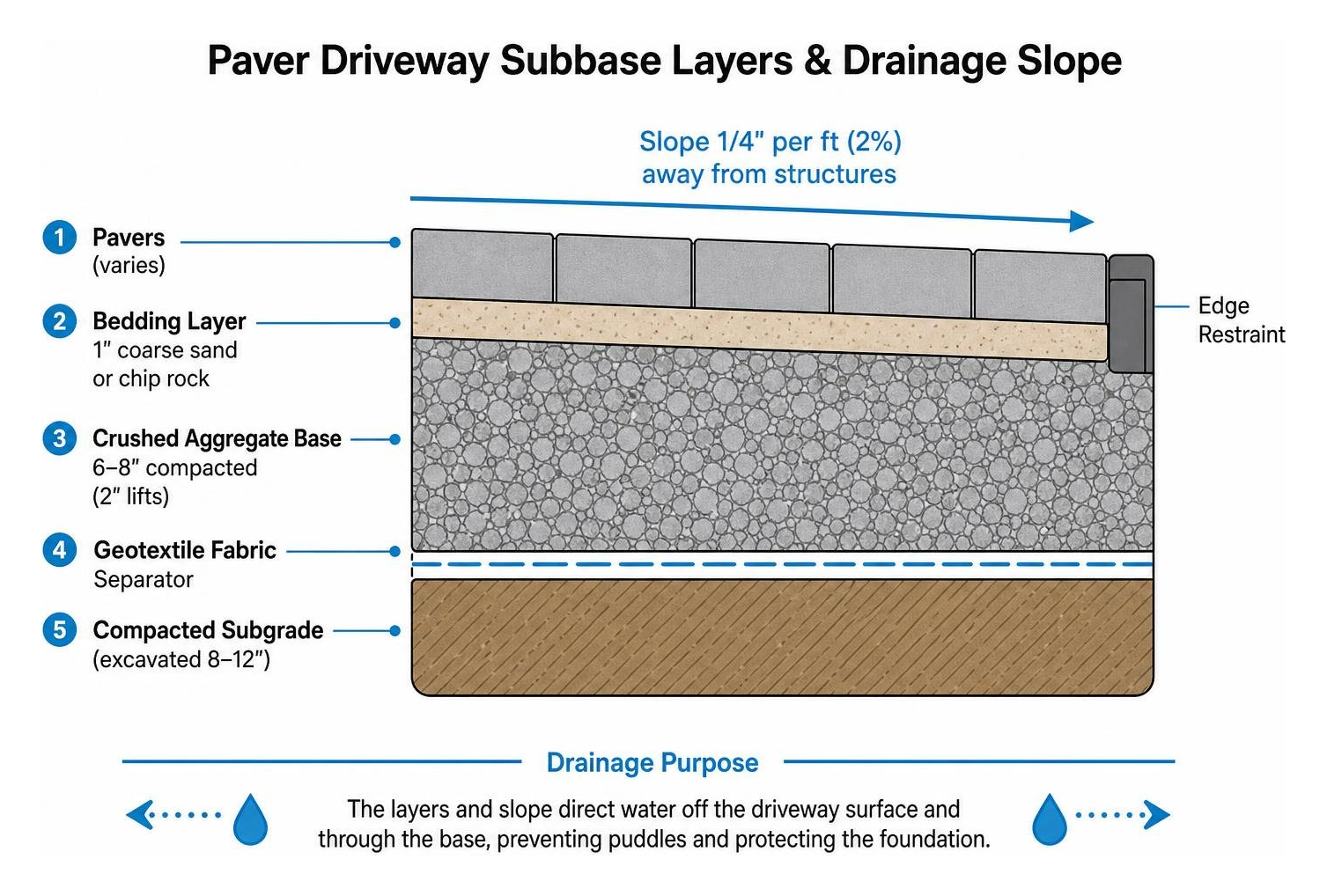
A proper vehicular hardscape requires:
- Excavation: Digging 8 to 12 inches down to remove soft topsoil.
- Geotextile Fabric: Placing a commercial-grade woven barrier to keep subsoil from mixing into the clean stone base.
- Crushed Aggregate Base: Spreading 6 to 8 inches of aggregate rock, compacted in 2-inch lifts with a heavy plate compactor to eliminate settling.
- Bedding Layer: Screeding a smooth 1-inch layer of coarse sand or chip rock.
- Slope Management: Ensuring a minimum 1% to 2% slope away from the home’s foundation for positive water runoff.
Following proper paver installation preparation protects the investment and keeps the driveway smooth for decades under heavy vehicle weight.
Key Factors That Shape Your Overall Project Investment
Every property comes with its own unique layout and ground conditions. While square footage sets the baseline, several site-specific factors influence the final quote.
- Demolition and Haul-Away: Removing an existing cracked concrete or asphalt driveway costs between $1.00 and $3.00 per square foot ($550 to $2,000 total).
- Site Grading and Slopes: Hillside driveways require extra grading, soil stabilization, and sometimes low retaining walls to prevent washouts.
- Property Access: If our crews have to move tons of crushed base via wheelbarrows through narrow side yards rather than using mini-excavators, labor hours increase.
- Material Waste Margins: Complex patterns and curved borders require more cuts. We typically order 10% to 15% extra material to cover cut waste and leave you with extra pavers for future repairs.
- Contractor Markup & Supervision: Transparent bids clearly budget for site supervision, safety equipment, insurance coverage, and building permits.
How Material Selection Dictates Driveway Pavers Cost per Sq Ft
Material choice directly influences appearance, load tolerance, and overall budget.

- Concrete Interlocking Pavers: The most popular and cost-effective option. Engineered to withstand 8,000+ PSI (far stronger than standard poured concrete slabs), these pavers handle vehicle weight easily and offer hundreds of shapes and colors.
- Clay Brick: A classic, timeless material. Kiln-fired clay retains its rich color without fading under the sun. Brick material costs run $3 to $6 per square foot wholesale, with installed costs averaging $11 to $22 per square foot.
- Natural Stone: Flagstone, granite, and porphyry offer an upscale, custom appearance. While material costs reach $10 to $20+ per square foot, their natural durability can last for generations.
- Permeable Pavers: Designed with wider, aggregate-filled joints that let rainwater drain straight into the ground. Installed costs range from $8 to $30 per square foot, and they help reduce municipal stormwater runoff while preventing surface pooling.
Driveway Pavers Cost per Sq Ft by Project Scale and Layout Complexity
Pattern design plays a big role in labor pricing. A simple running bond pattern laid in straight lines requires minimal saw cutting, keeping installation moving quickly.
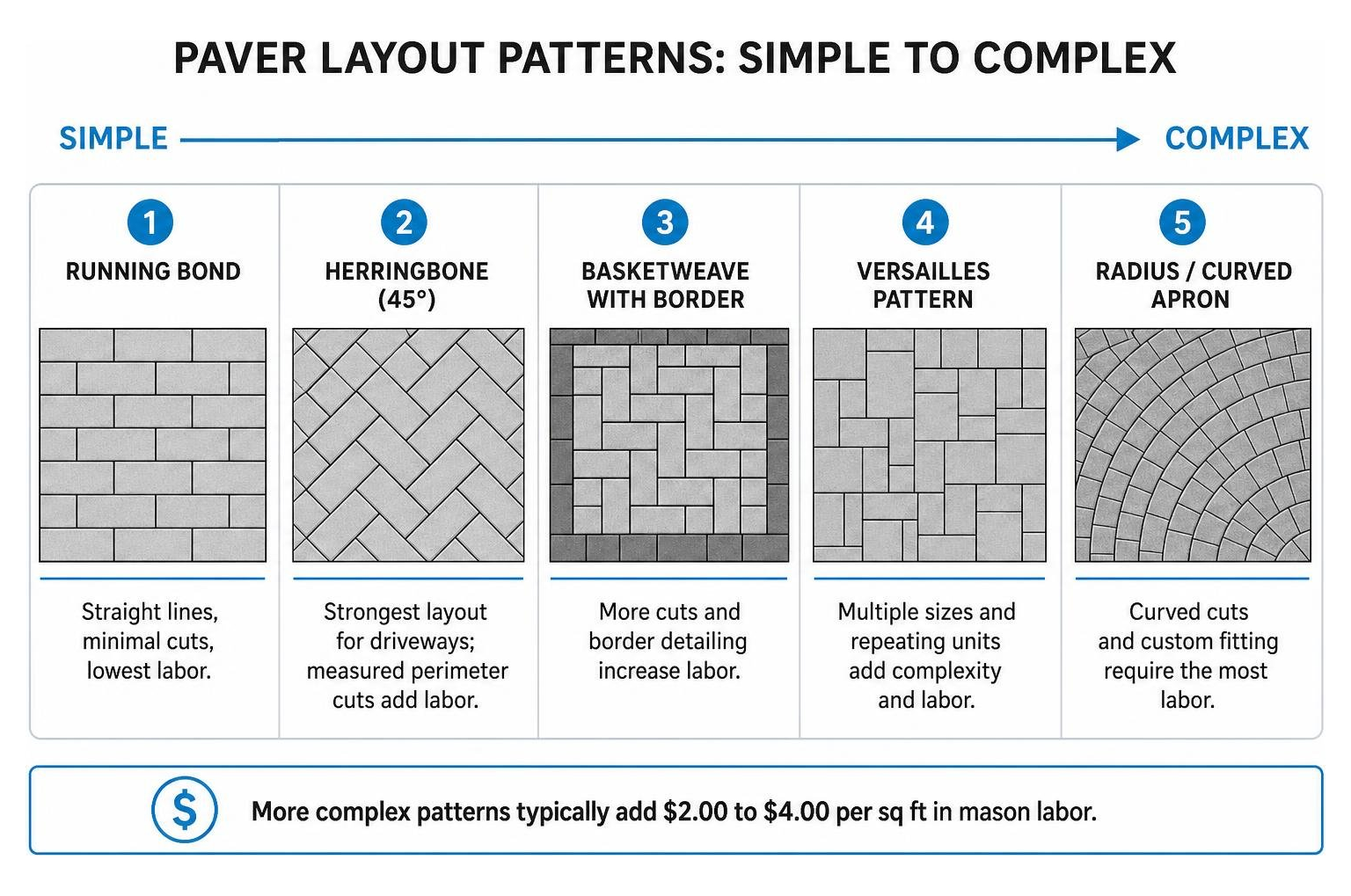
In contrast, laying a 45-degree herringbone pattern—the strongest layout for driveways because it locks pavers together across vehicle braking axes—requires measured perimeter cuts along every edge. Complex layouts like Versailles, basketweave with borders, or sweeping radius aprons can add $2.00 to $4.00 per square foot in mason labor.
Long-Term Value and Cost-Efficiency of Paver Driveways
Poured concrete or basic asphalt may cost less initially, but pavers provide better long-term value. Data from Fixr driveway paving cost benchmarks shows asphalt costs $3 to $7 per square foot and plain concrete runs $5 to $9 per square foot installed. However, solid slabs regularly crack from ground settling, seismic shifts, and freeze-thaw cycles.
When solid concrete cracks, patching it creates an obvious, mismatched line, and replacing it means jackhammering the entire slab. Pavers flex naturally with soil movement. If a tree root pushes up a section or an oil spill stains a spot, you simply lift out the affected pieces, adjust the sand base, and slide new matching pavers back into place.
Long-Term Value and Lifecycle Maintenance Realities
Evaluating paving options requires looking at upfront expenses alongside decades of upkeep.
| Driveway Surface | Installed Cost / Sq Ft | Expected Lifespan | Typical Maintenance Needs | 10-Year Repair Risk |
|---|---|---|---|---|
| Interlocking Pavers | $10 – $30 | 30 – 50+ Years | Occasional joint re-sanding, sealing every 3–5 yrs | Low (individual units can be replaced) |
| Poured Concrete Slab | $6 – $12 | 15 – 25 Years | Sealing every 2–3 yrs, expansion joint caulking | High (settling leads to permanent cracks) |
| Asphalt Pavement | $4 – $8 | 12 – 20 Years | Sealcoating every 2–3 yrs, edge patching | Moderate to High (potholes and edge crumbling) |
| Gravel / Crushed Stone | $2 – $5 | 10 – 30 Years | Regular raking, weed removal, periodic stone top-up | High (ruts, washouts, and stone scatter) |
Understanding pavers vs concrete durability helps explain why pavers maintain their value. Routine maintenance is simple: an occasional pressure wash, sweeping polymeric sand into joints if needed, and learning how to seal pavers every 3 to 5 years protects the colors and keeps joint sand locked in place.
Strategic Ways to Maximize Value Without Sacrificing Durability
You do not need to cut structural corners to keep your paver project on budget. Here are practical ways to manage costs:
- Choose High-Quality Concrete Pavers: Modern manufactured concrete pavers closely replicate the look of natural flagstone or cobblestone at a fraction of the quarry price.
- Keep the Core Field Simple: Use an efficient layout like a 90-degree herringbone or running bond for the main driving area, then add a contrasting border for a custom accent.
- Use Standard Paver Sizes: Working with standard dimensions (such as 4×8, 6×6, or 6×9 inches) speeds up placement and reduces cutting time.
- Plan During Off-Peak Months: Scheduling installation during late winter or early spring can sometimes help you secure better scheduling availability.
- Request Itemized Quotes: Make sure every estimate details excavation depth, base tonnage, drainage solutions, and paver models so you can compare proposals fairly.
Professional Hardscaping Standards vs. DIY Considerations
Installing a paver driveway is heavy, physically demanding work. A standard two-car driveway requires removing roughly 20 to 30 tons of soil and hauling in 30 to 45 tons of crushed aggregate and bedding sand.
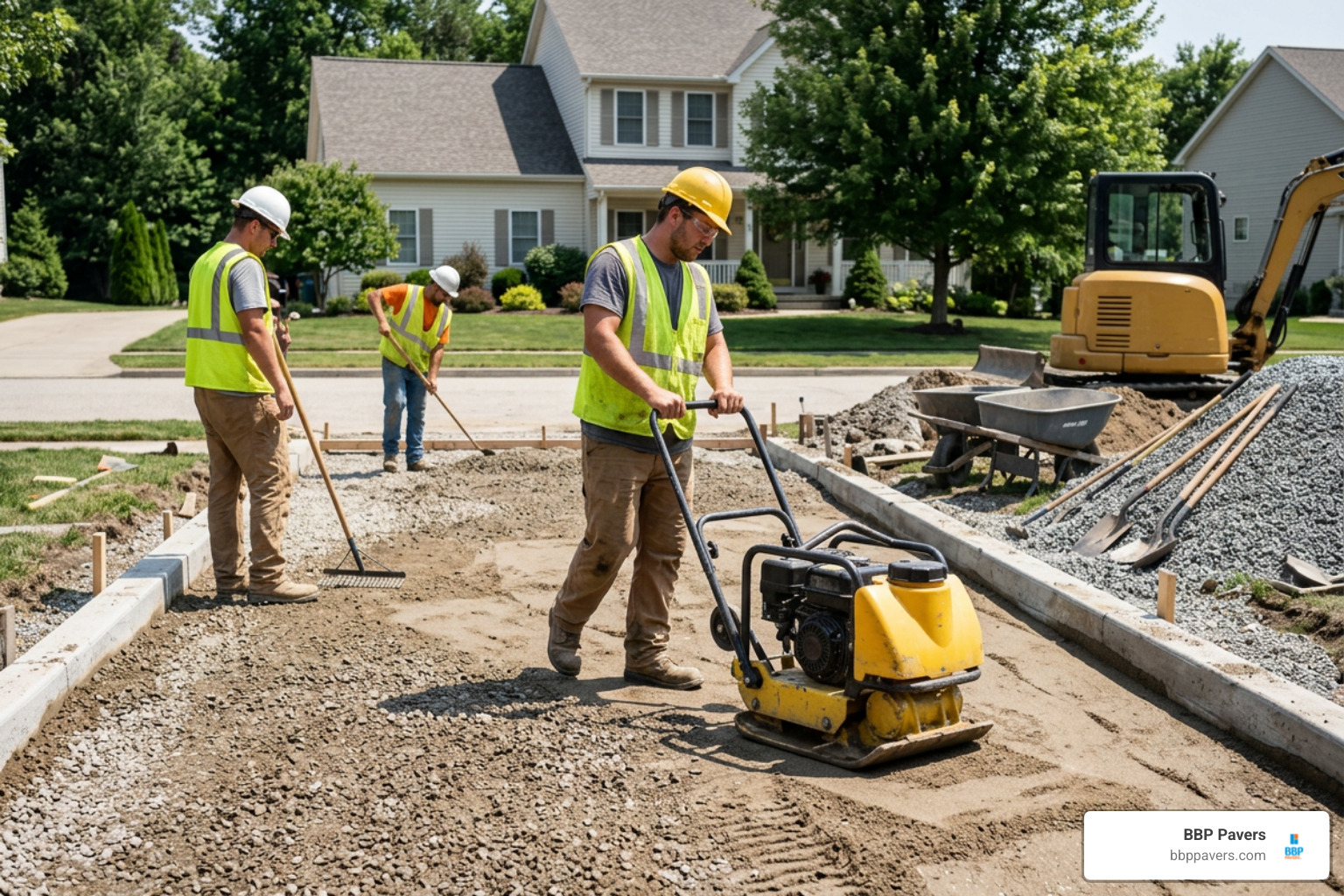
While DIY installation can save $5 to $10 per square foot in upfront labor, common installation errors—like skipping subbase compaction, using rounded play sand instead of angular bedding sand, or installing flimsy edge restraints—can lead to rutting and costly tear-outs within a couple of years.
Working with an experienced team ensures:
- Commercial excavation and plate-compaction equipment that reaches the required 98% Standard Proctor Density.
- Proper laser levels and transit grading for positive water drainage away from your garage.
- Robust warranties covering craftsmanship and structural base settling.
Knowing what to look for when hiring a licensed landscape contractor gives you peace of mind that your investment will hold up to daily vehicle traffic.
Frequently Asked Questions About Paver Driveway Costs
What is the realistic lifespan of a paver driveway?
With a properly compacted base and basic maintenance, a residential interlocking paver driveway will easily last 30 to 50 years, with high-density stone and cobblestones lasting even longer. Because pavers distribute wheel loads across individual interlocking units, they resist cracking under heavy SUVs, trucks, and RVs far better than rigid concrete slabs.
How much does site demolition and old driveway removal add to total costs?
Demolishing and hauling away an existing asphalt or concrete driveway generally adds $1.00 to $3.00 per square foot to the total project cost. For a typical 500-square-foot driveway, demolition, concrete breakout, and local disposal fees usually run between $550 and $1,500.
Do permeable driveway pavers cost significantly more than standard pavers?
Permeable pavers themselves cost roughly the same as standard concrete pavers ($3.00 to $8.00 per sq ft for materials), but the total installed price ($15.00 to $30.00+ per sq ft) is slightly higher due to the deeper aggregate reservoir base required for water storage (often 12 to 18 inches deep). However, they can help lower municipal stormwater utility fees and qualify for local water agency rebates.
Conclusion
A custom paver driveway is one of the most durable, visually appealing upgrades you can make to your home. While the initial investment is higher than poured concrete or asphalt, pavers eliminate recurring crack repairs, boost curb appeal, and deliver dependable performance for decades.
At BBP Pavers, our family brings over 20 years of Northern California hardscape expertise to every project. We handle the entire process from structural excavation and laser grading to custom patterns and clean joint finishing, backed by our safety-first process and a 100% satisfaction guarantee.
If you are planning your exterior hardscape budget, take a look at our comprehensive paver patio and driveway installation cost guide or reach out to our team today for a free, itemized project estimate.