Is Natural Stone or Porcelain Better for a Patio?

Did you know that choosing the wrong paver material can cost you thousands in repairs within just five years? When it comes to the timeless debate of natural stone vs porcelain pavers — which is better — there is no one-size-fits-all answer. But there is a right answer for your specific project, budget, climate, and lifestyle.
If you are planning a new patio in the Concord, Walnut Creek, or East Bay area, this guide is designed to give you a clear, honest, and expert comparison so you can invest with confidence. By the end of this article, you will know the differences in cost, durability, maintenance, aesthetics, and installation — and which material makes the most sense for your outdoor living space.
Continue reading to discover exactly how these two popular paving materials stack up — and which one deserves a place in your backyard.
Patio Pavers | Pool Decks | Driveway Pavers | Walkway Pavers
What Are Natural Stone Pavers?
Natural stone pavers are quarried directly from the earth and cut into usable tiles or blocks. Common types used in outdoor patios and walkways include:
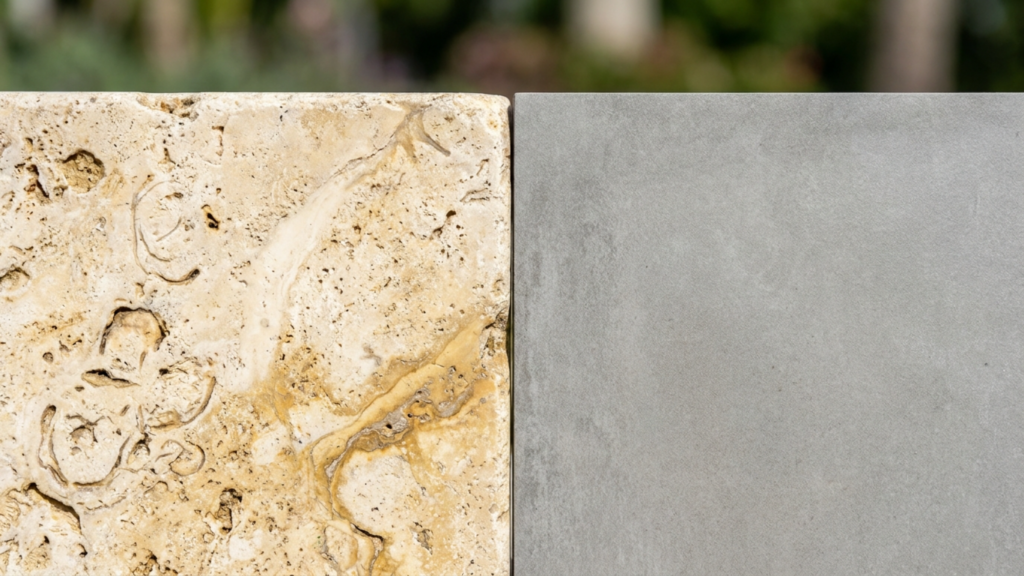
- Travertine: A porous limestone found near hot springs, popular for its warm earthy tones and naturally textured surface.
- Slate: A fine-grained rock with a naturally layered surface, ideal for non-slip applications and contemporary designs.
- Bluestone: A dense sandstone known for its blue-gray hues and excellent durability in wet climates.
- Granite: One of the hardest natural stones available, excellent for high-traffic areas like driveways and pool decks.
- Limestone: Soft and elegant, often used in Mediterranean-style landscapes and traditional garden paths.
Each piece of natural stone is unique — formed by millions of years of geological activity. That uniqueness is both its greatest strength and a key factor in understanding the natural stone vs porcelain pavers debate. No two slabs look identical, giving your patio a truly one-of-a-kind character that no manufactured product can fully replicate.
For a deeper look at how natural pavers perform long-term, visit our About Pavers resource page.
What Are Porcelain Pavers?
Porcelain pavers are manufactured ceramic tiles fired at extremely high temperatures — above 2,200°F. The result is a dense, non-porous, highly durable surface that mimics the look of natural stone, wood, or concrete with greater consistency and significantly lower maintenance requirements.
Porcelain pavers have surged in popularity across California patios over the last decade. When homeowners in the Concord or Walnut Creek area ask us about porcelain vs natural stone pavers for their outdoor spaces, the conversation almost always circles back to two things: longevity and design control.
Key characteristics of porcelain pavers include:
- Non-porous surface that resists staining, moisture, and bacteria
- Manufactured to precise dimensions for easier, more consistent installation
- Available in large-format sizes (24×24, 24×48 inches) for a sleek, modern aesthetic
- Consistent color and texture guaranteed throughout the batch
- Frost-resistant, UV stable, and chemical-resistant
See our full range of patio paver options to explore both porcelain and natural stone solutions for your project.
Natural Stone vs Porcelain Pavers: Which Is Better? — Complete Comparison
The table below provides a direct side-by-side comparison across the most important decision factors:
| Category | Natural Stone Pavers | Porcelain Pavers | Winner |
|---|---|---|---|
| Cost (per sq ft) | $15 – $30+ | $12 – $25 | Porcelain |
| Durability | High (varies by stone) | Very High | Porcelain |
| Maintenance | Moderate–High | Low | Porcelain |
| Aesthetics | Unique, natural beauty | Consistent, modern | Tie |
| Slip Resistance | Naturally textured | Requires texture finish | Natural Stone |
| Heat Resistance | Stays cool underfoot | Can get hot in sun | Natural Stone |
| Eco-Friendliness | Natural quarried material | Manufactured product | Natural Stone |
| Lifespan | 30–50 years (with care) | 50+ years | Porcelain |
| Installation Complexity | Moderate | Moderate–High | Natural Stone |
| Pool Deck Suitability | Excellent (travertine) | Good (with grip finish) | Natural Stone |
Costs reflect supply-only pricing. Installation labor in the Bay Area adds $10–$20/sq ft. Contact BBP Pavers for a free estimate.
Cost Comparison: Natural Stone vs Porcelain Pavers
How Much Do Natural Stone Pavers Cost?
Natural stone pavers generally range from $15 to $30+ per square foot for materials alone, depending on the stone type. Rare stones like quartzite or premium imported granite can reach $50/sq ft or more. Installation in the Bay Area adds another $10–$20/sq ft, meaning a 400 sq ft patio could easily cost $10,000 to $20,000 all-in.
Factors that influence natural stone cost include:
- Stone type and rarity (granite, travertine, slate, limestone)
- Origin and transportation distance from quarry
- Cut size and finish type (honed, polished, brushed, tumbled)
- Site preparation, sub-base depth, and drainage requirements
How Much Do Porcelain Pavers Cost?
Porcelain pavers typically cost $12 to $25 per square foot for materials, making them slightly more affordable upfront for most standard styles. However, large-format or imported Italian porcelain tiles can approach $35/sq ft. Installation costs are similar to natural stone, though some large-format sizes require specialized cutting equipment which can add to overall labor time.
Over a 10-year horizon, porcelain’s dramatically lower maintenance costs — no sealing required, no staining treatments, minimal cleaning — often make it the more economical option overall when you factor in total cost of ownership.
Want to explore payment solutions? BBP Pavers offers flexible options through our Financing page.
Durability and Lifespan: Which Paver Material Lasts Longer?
When evaluating natural stone vs porcelain pavers which is better for long-term use, durability is one of the most critical factors — especially in Northern California where we see wet winters, hot dry summers, and everything in between.
Natural Stone Durability
Natural stone has been used in architecture for thousands of years — Roman aqueducts, Greek temples, and ancient trade routes were all built on stone. With proper installation and maintenance, natural stone pavers can last 30–50 years or more.
However, durability varies significantly by stone type. Granite and bluestone are extremely hard and resist cracking under heavy loads. Limestone and travertine, being porous and softer, are more susceptible to freeze-thaw cycles, acidic cleaners, and staining from organic debris like fallen leaves or iron-rich water.
Porcelain Paver Durability
Porcelain pavers fired at high temperatures achieve a Mohs hardness rating of 7–8 and a water absorption rate of less than 0.5% — far lower than most natural stones. This makes them:
- Virtually freeze-proof, even in wet California winters
- Stain-resistant to oil, wine, chlorine, and common cleaning agents
- Resistant to UV fading over decades of direct sun exposure
- Rated for 50+ years of normal residential and commercial use
For high-traffic areas like pool decks and driveways across the East Bay, porcelain often outperforms natural stone on long-term durability. Explore our Pool Deck services and Driveway Pavers for more information on both material options.
Maintenance Requirements: What Takes More Work?
Maintaining Natural Stone Pavers
Natural stone pavers — particularly porous varieties like travertine and limestone — require consistent maintenance to preserve their beauty and structural integrity:
- Seal annually or biannually to prevent moisture infiltration and surface staining
- Clean with pH-neutral stone cleaners — never bleach, vinegar, or acidic solutions
- Inspect for cracking after wet winters, especially in Concord and the East Bay
- Refill joints with polymeric sand every 2–3 years as it compacts and erodes
- Schedule professional deep cleaning every 3–5 years for best long-term results
Failure to seal natural stone can lead to efflorescence (white mineral deposits), mold growth in shaded areas, and surface spalling — all costly repairs that could have been prevented with routine upkeep.
Maintaining Porcelain Pavers
One of the biggest practical advantages when comparing porcelain pavers vs natural stone is how little maintenance porcelain actually demands:
- No sealing required — ever
- Clean with water, mild soap, or a standard pressure washer
- No staining from oil, wine, fertilizer, or pool chemicals
- Grout joints may need occasional re-pointing after 10+ years
- No special cleaning products needed
For busy families and professionals throughout Walnut Creek, Lafayette, and Orinda, porcelain’s low-maintenance profile is often the deciding factor. We serve all these communities: Walnut Creek | Lafayette | Orinda
Aesthetics and Design: Natural Beauty vs Modern Precision
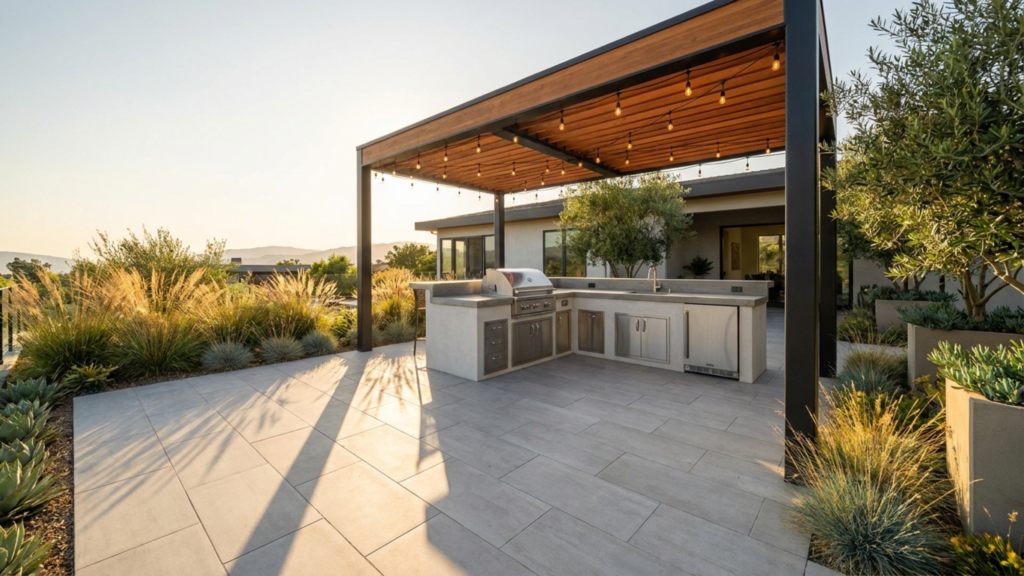
This is where the natural stone vs porcelain pavers debate gets truly personal — because both materials can be strikingly beautiful, just in entirely different ways.
The Aesthetic Appeal of Natural Stone
Nothing replicates the earthy warmth and organic variation of genuine natural stone. Each travertine tile carries millennia of geological history in its veining and color. Slate has a raw, layered quality that adds visual depth and character to any space. Granite catches light in ways that no manufactured material fully duplicates.
Natural stone pairs beautifully with:
- Mediterranean and Spanish-colonial architecture (common throughout Concord and Walnut Creek)
- Rustic or Tuscan-inspired outdoor kitchens and fire pit areas
- Lush landscaping and organic-shaped garden pathways
- Traditional pool surrounds with natural plant borders
The Aesthetic Appeal of Porcelain Pavers
Modern porcelain offers a level of design control that natural stone simply cannot match. Want a patio that looks exactly like Italian limestone — but with zero maintenance? Porcelain delivers precisely that.
Popular porcelain styles trending in Bay Area homes include:
- Concrete-look large-format tiles for minimalist modern patios
- Wood-effect porcelain for a Scandinavian or coastal-inspired aesthetic
- Marble-look finishes for luxury pool decks and covered outdoor rooms
- Stone-effect tiles that closely mimic travertine, slate, or granite at lower cost
If you are building an outdoor kitchen or pergola alongside your new patio, consistent porcelain helps create a cohesive, high-end look throughout the space. See our Outdoor Kitchens & BBQ Islands and Pergolas services.
Installation: What to Expect for Each Material
Installing Natural Stone Pavers
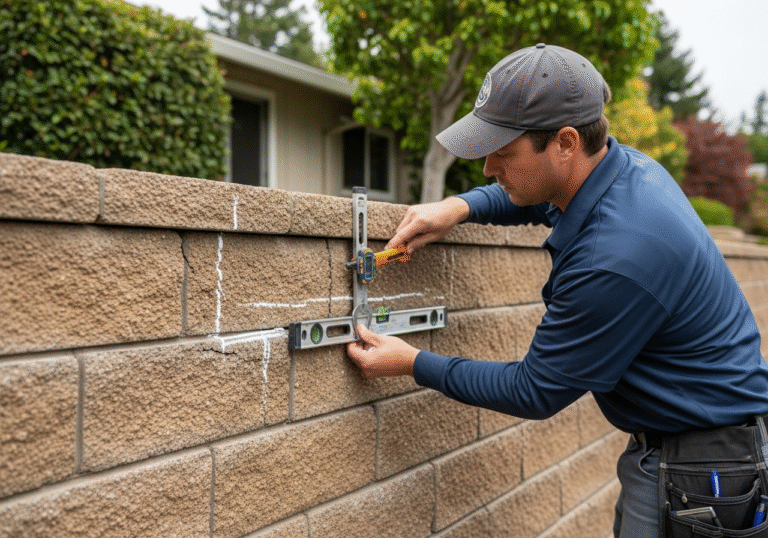
Natural stone installation requires skilled craftsmanship. Because each piece varies slightly in thickness and dimension, professional installers must:
- Prepare a stable compacted gravel and sand sub-base (typically 3–6 inches deep)
- Sort and dry-lay stone pieces before permanent setting to plan the pattern
- Make hand-cut adjustments for irregular shapes and curves
- Fill joints with polymeric sand or mortar depending on the application
- Apply an initial penetrating sealer before the area is opened to foot traffic
The irregular nature of natural stone makes it particularly forgiving on curved or organic-shaped patios — a popular choice for California landscapes with flowing garden beds and non-rectangular layouts.
Installing Porcelain Pavers
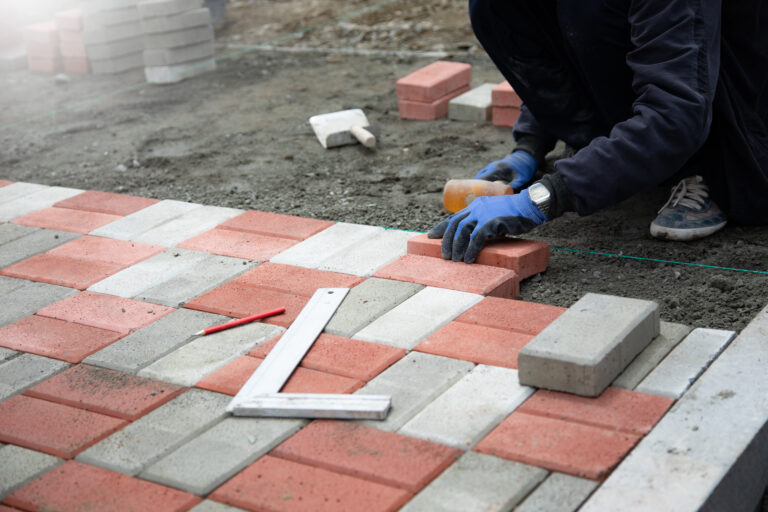
Porcelain pavers — especially large-format options — demand a very flat, stable sub-base. Any imperfection in the base will show as a visible lippage (height difference) between adjacent tiles. Professional installation typically involves:
- Compacted aggregate base followed by a precisely screeded sand or mortar bed
- Use of tile leveling clips to guarantee a flush, lippage-free installation
- Diamond blade wet saw for clean, precise cuts through the dense tile body
- Grout joints finished with epoxy or standard polymer grout for a sealed result
At BBP Pavers, our crews are trained in both natural stone and porcelain installation across the entire Bay Area — from Fremont to Palo Alto to Atherton. Every project is backed by our industry warranty.
Real-World Case Studies: BBP Pavers Clients in the Bay Area
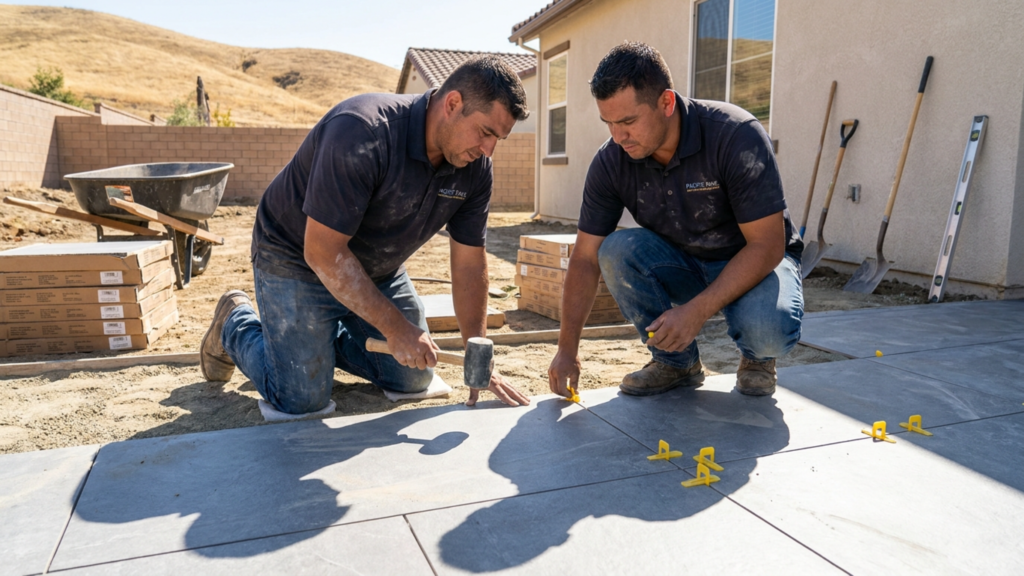
Case Study 1: Travertine Pool Deck in Walnut Creek
A family in Walnut Creek came to BBP Pavers with a failing concrete pool deck — cracked, stained, and dangerously slippery. After reviewing their options, they chose tumbled travertine pavers for the pool surround and adjacent patio. The result: a resort-style backyard that increased their property’s visual appeal and provided a naturally cool, slip-resistant surface for their children throughout the hot East Bay summers.
“BBP Pavers completely transformed our backyard. The travertine is gorgeous and stays cool even on the hottest summer days. The team was professional, arrived on time, and cleaned up every single day. We could not be happier with the result.” — Sarah M., Walnut Creek, CA (Google Review)
Case Study 2: Modern Porcelain Patio in Concord
A busy professional couple in Concord wanted a low-maintenance, contemporary patio designed for frequent entertaining. They selected 24×48 inch concrete-look porcelain pavers in a light gray tone. Three years after installation, the patio looks exactly as it did on day one — no sealing, no staining, just a quick rinse before each gathering.
“The BBP Pavers team helped us select the perfect porcelain tiles for our lifestyle. They were knowledgeable, efficient, and the finished patio is exactly what we envisioned. We have already referred them to three neighbors.” — Carlos R., Concord, CA (Yelp Review)
Ready to start your own transformation? Request a free quote from BBP Pavers today.
Common Mistakes to Avoid When Choosing Paver Material
- Choosing based on looks alone: Always factor in your local climate, anticipated traffic load, and realistic maintenance availability before selecting a material — beauty fades fast if a paver can not handle the conditions.
- Skipping proper sub-base preparation: Inadequate base preparation is the number one cause of paver failure, regardless of material quality or installation skill.
- Buying porcelain from multiple production batches: Porcelain color and tone vary between manufacturing runs. Always order 10–15% extra from a single batch at the time of purchase.
- Ignoring slip resistance ratings: Smooth polished porcelain is dangerous when wet. Always specify a textured finish rated R10 or R11 for any pool deck, walkway, or outdoor kitchen floor.
- Leaving natural stone unsealed: Travertine and limestone left unsealed through California’s wet winters will stain, develop mold, and deteriorate within 2–3 years.
- Attempting DIY large-format porcelain installation: Slabs measuring 24×48 inches are extremely heavy, fragile during handling, and require professional leveling systems and wet saw equipment.
Avoid these costly mistakes by working with a trusted, experienced contractor from day one. Our FAQ page answers the most common questions homeowners have before starting a paver project.
So, Is Natural Stone or Porcelain Better for a Patio?
For most California homeowners comparing natural stone vs porcelain pavers which is better, porcelain is the stronger overall choice for low maintenance, consistent aesthetics, and long-term durability. However, natural stone wins where organic warmth, authentic character, and natural slip resistance matter most — particularly for pool decks and traditional garden patios.
Choose Natural Stone Pavers If You:
- Want a truly unique, one-of-a-kind patio with natural organic character
- Prefer a surface that stays cool underfoot during hot California summers
- Are building a traditional, rustic, or Mediterranean-style outdoor space
- Value quarried natural materials over manufactured alternatives
- Have a professional maintenance plan in place including annual sealing
Choose Porcelain Pavers If You:
- Want a virtually maintenance-free outdoor surface for the long term
- Prefer modern, large-format aesthetics with guaranteed color consistency
- Are installing near a pool, outdoor kitchen, or high-traffic entertainment area
- Live in an area with expansive soil movement or seasonal wet conditions
- Want the visual appeal of stone without the ongoing upkeep commitment
What About Pool Decks Specifically?
For pool surrounds, both materials are popular and proven. Travertine remains the gold standard for natural pool decks due to its cool-to-touch surface and inherent non-slip texture. However, textured porcelain with a grip finish rated R11 or higher is equally safe and dramatically easier to maintain around chlorinated water and heavy foot traffic. Explore both options on our Pool Deck Pavers page.
People Also Ask: Your Top Questions Answered
Is porcelain or natural stone better for a patio in California?
In California’s climate — hot dry summers and wet winters — porcelain pavers generally outperform natural stone on durability and maintenance demands. However, natural stone travertine remains exceptionally popular for pool decks because of its naturally cool surface temperature and organic aesthetic that blends seamlessly with California landscaping.
Which paver is more slippery, porcelain or natural stone?
Polished or glazed porcelain can be slippery when wet. Natural stone, particularly tumbled or brushed varieties, tends to offer superior natural grip. Always specify a textured, non-slip porcelain finish rated R10 or R11 for any application around pools, wet bars, or in areas exposed to regular rain.
How long do natural stone vs porcelain pavers last?
With proper installation and consistent maintenance, natural stone pavers can last 30–50 years. Porcelain pavers, being denser and completely non-porous, frequently exceed 50 years with minimal care. Both materials significantly outlast standard poured concrete or stamped concrete surfaces.
Can you mix natural stone and porcelain pavers on a patio?
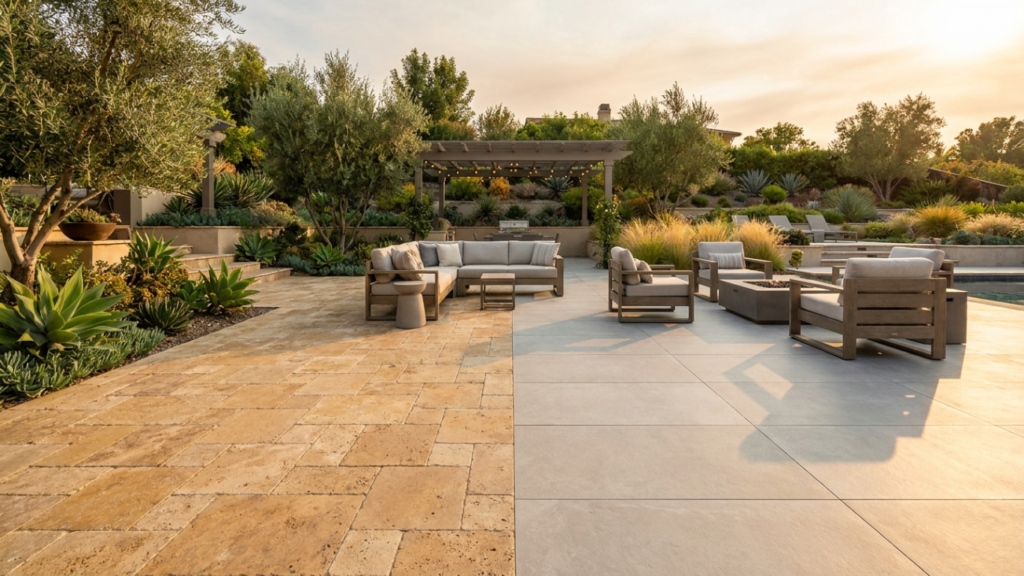
Yes — and it is a growing design trend in Bay Area homes. A popular approach uses natural travertine on the main patio field with porcelain pavers for the outdoor kitchen area, fire pit surround, or entry steps where spills and staining are more likely. Our design team at BBP Pavers can help you plan a cohesive mixed-material layout.
What is the best natural stone for a California patio?
Travertine, granite, and bluestone are consistently the top choices for California patios. Travertine offers warmth and natural beauty ideal for pool surrounds; granite handles heavy traffic on driveways and walkways without showing wear; bluestone suits contemporary and modern landscape styles with its clean blue-gray tones.
Before making your final decision on natural stone vs porcelain pavers, these authoritative resources offer helpful additional perspective:
- Houzz: Natural Stone Paver Ideas — Thousands of real project photos organized by style, budget, and climate zone.
- Angi: Paver Installation Cost Guide — Up-to-date regional cost data for paver installation across California.
- HomeAdvisor: Patio Paver Project Calculator — Estimate your project costs before requesting contractor quotes.
Follow BBP Pavers for ongoing project inspiration: Facebook | Instagram | Pinterest | Google Maps
Ready to Build Your Dream Patio in Concord or the Bay Area?
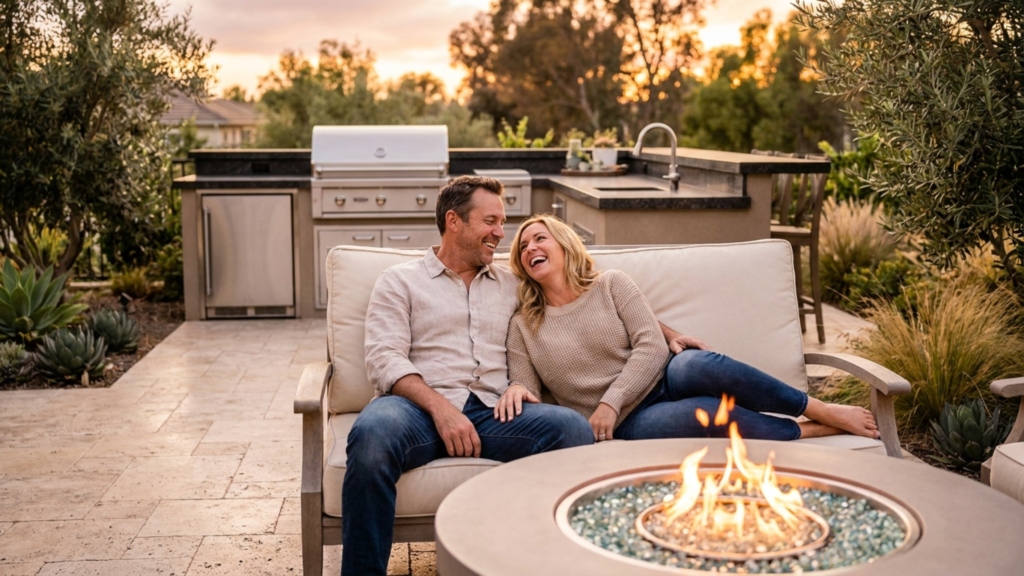
At BBP Pavers, we have helped hundreds of homeowners throughout Concord, Walnut Creek, Lafayette, Moraga, Fremont, Los Altos, Palo Alto, and Atherton transform their outdoor spaces with both natural stone and porcelain pavers. Our team of certified installers will guide you from material selection through final installation — with craftsmanship that stands behind our warranty commitment.
We serve: Concord | Walnut Creek | Lafayette | Moraga | Los Altos | Palo Alto | Atherton | All service areas
Get your free, no-obligation estimate — Contact BBP Pavers today
Conclusion: The Verdict on Natural Stone vs Porcelain Pavers
The natural stone vs porcelain pavers which is better question ultimately comes down to your priorities. Here is the clear summary:
- Choose natural stone for organic beauty, a cool-to-touch surface, and a timeless one-of-a-kind aesthetic that no manufactured product can match.
- Choose porcelain pavers for low maintenance, consistent modern design, and superior stain and frost resistance over decades of use.
- On budget: porcelain is slightly more affordable upfront; natural stone typically requires more long-term maintenance spending to protect the investment.
- On use case: pool decks favor travertine or grip-rated porcelain; high-traffic driveways favor granite or concrete-look porcelain; walkways work well with either.
No matter which material you choose, the quality of installation matters as much as the material itself. Cutting corners on sub-base preparation, joint filling, or sealing will shorten the life of any paver surface — regardless of how much you paid for the material.
That is why working with an experienced, trusted local contractor like BBP Pavers makes all the difference. We bring deep knowledge of both materials, the unique East Bay climate, and the local soil conditions that affect paver performance long-term — so your patio looks great and lasts for decades.
Ready to start your patio project in Concord or the Bay Area? Request your free quote with BBP Pavers. Visit bbppavers.com/contact-us or call us at +1 844-497-3321. Available Monday–Friday 9 AM–5 PM | Saturday 9 AM–2 PM.
BBP Pavers — Contact Information
BBP Pavers | The Best Pavers Services in Concord CA Address: 4918 Clayton Rd, Concord, CA 94521, United States Phone: +1 844-497-3321 Email: bbppavers@gmail.com Office Hours: Monday–Friday 9 AM–5 PM | Saturday 9 AM–2 PM View on Google Maps | Yelp Profile