
French Drain vs. Permeable Pavers: Which One Actually Fixes a Flooded East Bay Driveway?

Table of Contents
- Why Is a Flooded Driveway So Confusing to Fix?
- What Is the Difference Between a French Drain and Permeable Pavers?
- Where Is the Water on Your Driveway Coming From?
- French Drain vs Permeable Pavers: Side-by-Side Comparison
- The Problem Nobody Mentions: Water Needs Somewhere to Go
- Which One Should You Choose? A Decision Guide by Water Source
- Can You Use a French Drain and Permeable Pavers Together?
- Where Permeable Pavers Make Sense in the East Bay (and When They Don’t)
- A Typical Scenario: A Sloped Driveway in Lafayette
- How Do You Keep Either System Working Year After Year?
- Frequently Asked Questions
- Is a french drain better than permeable pavers for a driveway?
- Can you put pavers over a french drain?
- How often do permeable pavers need maintenance?
- Why does my paver driveway still flood after it rains?
- What affects the cost of fixing a flooded driveway?
- What should you ask a contractor before fixing driveway drainage?
- The Bottom Line
Direct Answer: In the french drain vs permeable pavers decision, the right fix depends on where the water comes from: permeable pavers handle rain falling on the driveway itself, while a french drain intercepts water moving underground or from higher ground and carries it to an outlet.
Why Is a Flooded Driveway So Confusing to Fix?
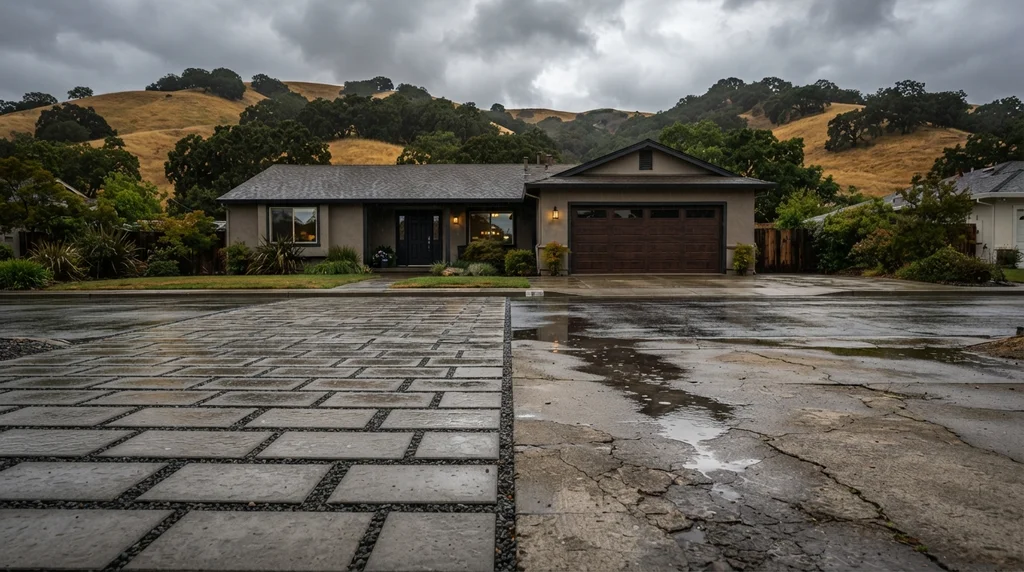
A flooded driveway after the first big storm of the season is frustrating, and the internet makes it more confusing. You search for help and get a dozen terms thrown at you: French drain, permeable pavers, PICP, channel drain, trench drain, dry well. Some of these sound interchangeable. They are not.
Here is the honest version. The french drain vs permeable pavers question usually gets framed as a contest with one winner, but these two systems solve different problems. Picking the wrong one can leave you with a beautiful new surface and the same puddle in front of the garage.
In this guide, we cover three things: how to figure out where your water is actually coming from, what each system can and cannot do, and when the smart move is to call a drainage specialist before anyone touches your driveway. If you’d rather have someone look at it in person, you can request an on-site driveway assessment from our team.
What Is the Difference Between a French Drain and Permeable Pavers?
A French drain collects water below the surface and moves it somewhere else, while permeable pavers let rain soak through the driving surface into a stone base underneath. One is a pipeline. The other is a sponge with a hard top.
A French drain is a trench filled with gravel, usually wrapped in filter fabric, with a perforated pipe at the bottom. Water in the soil enters the gravel, finds the pipe, and travels by gravity to an outlet. That outlet is the part people forget, and it matters more than the trench itself.
Permeable pavers (the industry calls them permeable interlocking concrete pavers, or PICP) are solid pavers with wider joints that hold small, clean stone instead of sand. Rain drops through those joints into a deep open-graded aggregate base. That base holds the water and releases it slowly into the soil below or into an underdrain.
So when you compare a french drain vs permeable pavers, you are really comparing two jobs. A French drain moves water that is already in the ground. Permeable pavers stop rain that lands on your driveway from becoming runoff in the first place.
Where Is the Water on Your Driveway Coming From?
The water source decides the fix, so start by watching your driveway during a real rainstorm. Grab an umbrella, walk the property while it’s pouring, and note where water starts, where it travels, and where it stops. Ten minutes of observation will tell you more than any product brochure.
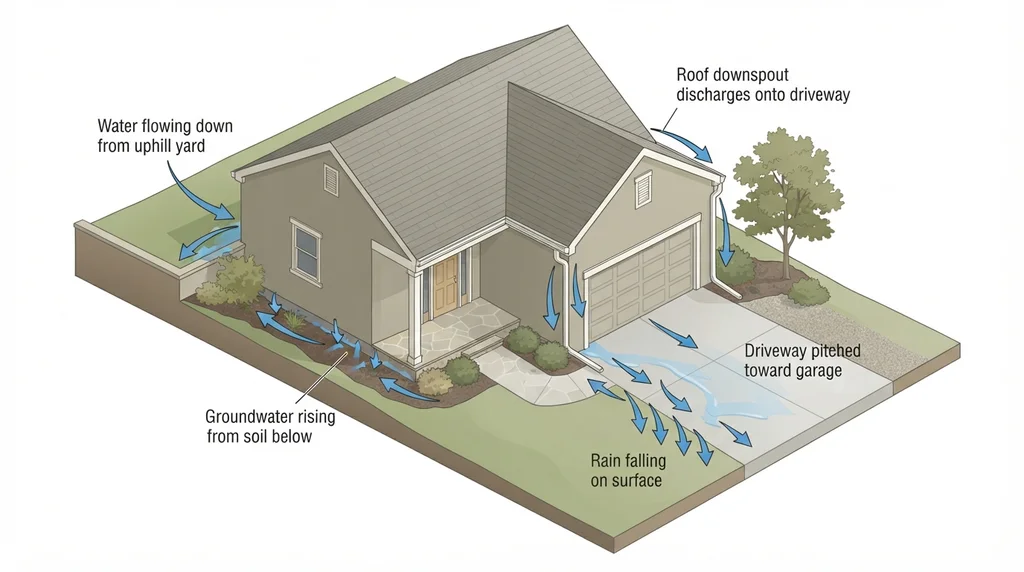
In our experience, flooded driveways in the East Bay almost always trace back to one of five causes:
- Rain falling on the driveway itself. A solid concrete or asphalt surface sheds every drop, and on a large driveway that adds up fast.
- Roof runoff. A downspout that empties onto the driveway can dump far more water there than the rain alone.
- Water from higher ground. A neighbor’s yard, a hillside, or a sloped lawn above the driveway sends water down across the surface.
- Groundwater or saturated soil. Water seeps up from below, or the soil near the foundation stays wet long after the rain stops.
- Wrong slope or sunken sections. The driveway pitches toward the house or garage, or low spots have settled and hold water.
Once you know which of these you’re dealing with, the french drain vs permeable pavers choice gets a lot simpler. Many properties have two causes at once, which is why the answer is sometimes “both.”
A quick safety note: if water is entering your garage, pooling against your foundation, or reaching outlets, water heaters, or any electrical equipment, get a professional evaluation soon. That’s no longer a cosmetic problem.
French Drain vs Permeable Pavers: Side-by-Side Comparison
This table lays out the french drain vs permeable pavers trade-offs by what each system solves, what it doesn’t, and where it tends to go wrong.
| Factor | French Drain | Permeable Pavers |
|---|---|---|
| Best for | Subsurface water, saturated soil, water moving underground from higher ground | Rain falling directly on the driveway surface |
| How it works | Gravel trench and perforated pipe carry water by gravity to an outlet | Open joints let water into a stone base that stores and releases it |
| Does not solve | Surface sheeting across a solid driveway, or a driveway sloped toward the house | Heavy runoff from other areas, high groundwater, or bad slope toward the garage |
| Needs an outlet? | Yes, always. No outlet means no drain. | Sometimes. Poorly draining soils may need an underdrain. |
| Visible on surface? | Mostly hidden | It is the surface |
| Maintenance | Keep the inlet and outlet clear; fabric helps prevent silt clogging | Sweep and refill joint stone; vacuum joints if silt builds up |
| Where it fails | No proper slope, no outlet, or silt clogging the gravel | Clogged joints, wrong base material, or soil that can’t absorb the stored water |
Notice the pattern? Neither column says “fixes every flooded driveway.” That’s the honest answer.
The Problem Nobody Mentions: Water Needs Somewhere to Go
The weak point on both sides of the french drain vs permeable pavers comparison is the same: water has to end up somewhere, and if it can’t, it comes back. A French drain without a working outlet just collects water underground. A permeable driveway sitting on soil that drains slowly can fill its base during a long storm and start acting like a regular surface.
The technical cause is simple. Both systems store or move water temporarily, but the soil or an outlet has to accept it in the end. When that last step is missing, you’ve only moved the flooding a few feet.
Here’s how a well-planned project avoids that:
- Map the outlet before digging. Check your city or county rules and your neighbor’s property line before you pick an outlet.
- Use the correct base. Permeable systems need clean, open-graded stone, not sand or fine gravel that seals up.
- Plan for slow-draining soil with an underdrain or overflow path when the site calls for it.
- Keep silt out during and after installation, since fine sediment is what clogs both systems.
- Fix the slope first if the driveway pitches toward the house. No drain compensates for grading in the wrong direction.
Before you hire anyone, ask this: “When the base or pipe is full, where does the water go next?” A contractor who can answer that clearly has thought about your whole property, not just the surface.
Which One Should You Choose? A Decision Guide by Water Source
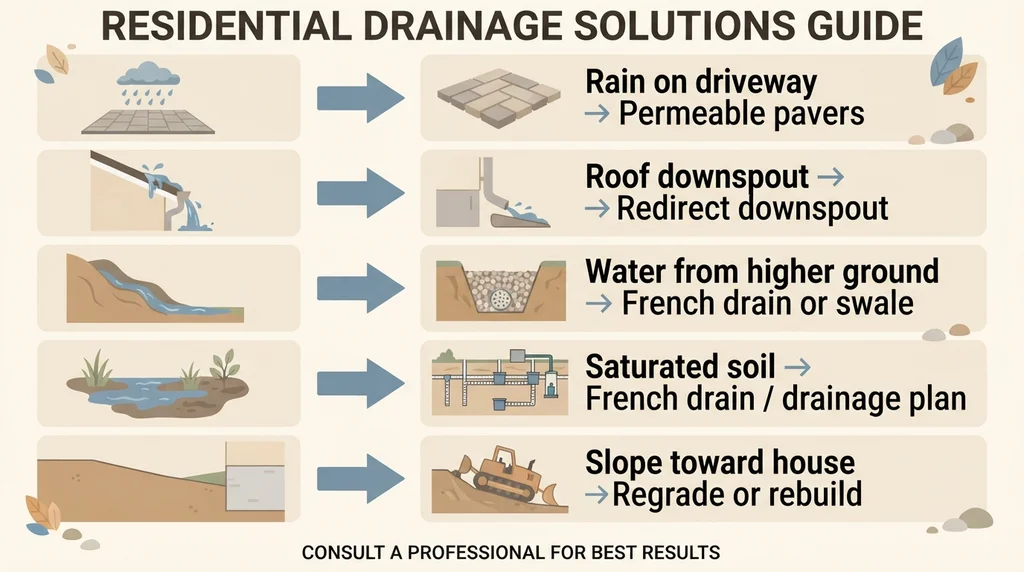
Match the solution to the cause you saw during the storm. Use this french drain vs permeable pavers quick reference:
- Rain on the driveway only: Permeable pavers are a strong fit. Common mistake: assuming they’ll also absorb a hillside’s worth of runoff.
- Roof downspout dumping onto the driveway: Redirect the downspout first. Common mistake: paving over the problem without changing where the roof water lands.
- Water flowing down from higher ground: A French drain, swale, or interceptor drain above the driveway usually makes more sense. Common mistake: expecting the driveway surface to catch it all.
- Saturated soil or groundwater: A French drain or a broader drainage plan, often with an engineer involved. Common mistake: adding permeable pavers to soil that is already full of water.
- Driveway sloped toward the house: Regrade or rebuild with proper pitch. Common mistake: adding a drain and keeping the wrong slope.
If your situation lands on permeable pavers or a rebuilt driveway with corrected slope, that’s our side of the work. Our driveway pavers service page breaks down what goes into a new paver driveway. French drains are often handled by a drainage or landscape contractor, or alongside your paver project when the scope allows. Not sure which bucket you’re in? Talk to our team about your driveway and we’ll walk through it with you.
Can You Use a French Drain and Permeable Pavers Together?
Yes, and on many properties that’s the most realistic answer to the french drain vs permeable pavers debate. The two systems complement each other: the drain handles water arriving from above or below, and the pavers handle the rain that lands on the driveway.
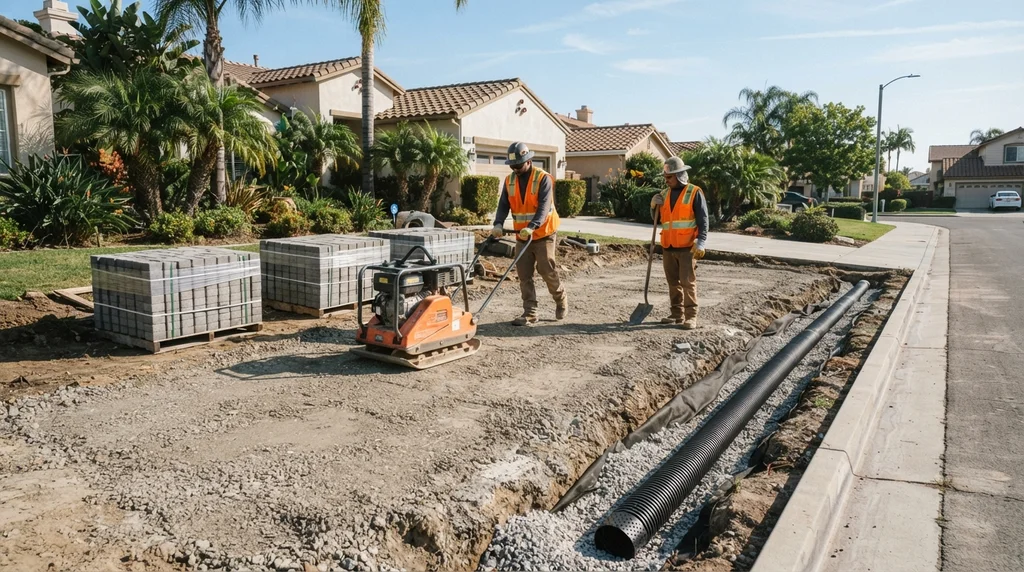
A common layout puts a French drain along the uphill edge of the driveway to intercept water from the slope, then uses permeable pavers on the driving surface. Some permeable installations also include a perforated underdrain inside the stone base, which works a lot like a French drain built into the driveway.
Pavers can also sit over a French drain trench, as long as your installer backfills and compacts the trench properly so the surface doesn’t settle. Settling over a loosely filled trench is one of the most common complaints we hear about DIY attempts.
Where Permeable Pavers Make Sense in the East Bay (and When They Don’t)
In a french drain vs permeable pavers decision, permeable pavers win when the main problem is rain on the driveway itself and the site has a realistic path for stored water. A flat driveway in Concord or Walnut Creek that sheds rain into the street is a classic fit. So is a wide parking pad where a solid slab creates a sheet of water every storm.
Soil matters too. We already wrote a full guide on how permeable pavers perform on Bay Area clay soil, and a separate one on stormwater rules in Contra Costa County, so we won’t repeat those here. Our guide on permeable pavers and Bay Area clay soil explains when an underdrain becomes necessary, and our guide on Contra Costa County permeable paver rules breaks down when they might be required.
When neither option is the right first step:
- Water is entering the garage, crawl space, or living areas
- The driveway sits below a steep hillside, common on lots in Orinda, Moraga, and Lafayette
- You see cracks in the foundation, retaining walls leaning, or soil movement
- The soil stays soggy for days after rain, which may point to high groundwater
In those cases, bring in a drainage specialist, and a civil or geotechnical engineer when slopes, foundations, or groundwater are involved. A paver project should come after the drainage plan, not instead of it.
A Typical Scenario: A Sloped Driveway in Lafayette
Here’s a hypothetical example of how a french drain vs permeable pavers question plays out on a real site. A homeowner on a sloped Lafayette lot calls about water pooling at the garage door after every storm and asks for permeable pavers. During a site visit, it turns out most of the water isn’t rain on the driveway. It’s runoff from the hillside yard above, plus a downspout aimed right at the driveway.
In that situation, permeable pavers alone would leave the pooling unsolved. The better plan is to redirect the downspout, address the hillside flow with a drainage contractor, and then rebuild the driveway with permeable pavers and the correct pitch away from the garage. Each piece handles one water source.
That’s the real lesson of the french drain vs permeable pavers comparison: diagnosis first, materials second. If you want to see how our past projects went, our reviews on Yelp and our BBB business profile are a good place to start.

How Do You Keep Either System Working Year After Year?
Both systems need light, regular attention, mostly before and after the rainy season. Skip it for a few years and performance drops.
For permeable pavers, sweep debris off the surface, top up joint stone when it gets low, and vacuum the joints if silt builds up and water starts sitting on top. For a French drain, keep the outlet clear of leaves and soil, and check that water actually flows out during a storm. A quick check every fall goes a long way. Whatever the french drain vs permeable pavers outcome for your property, maintenance is what keeps it working.
Frequently Asked Questions
Is a french drain better than permeable pavers for a driveway?
A French drain is not better or worse than permeable pavers, because the two systems solve different water problems. A French drain is the better fit when water is moving underground or flowing in from higher ground. Permeable pavers are the better fit when the main issue is rain falling directly on the driveway surface. Many driveways benefit from both.
Can you put pavers over a french drain?
Yes, you can install pavers over a French drain trench. Your installer needs to backfill the trench with suitable stone and compact it properly, or the pavers above it can settle over time. Permeable pavers are often a good match above a French drain because water can still reach the drain through the joints. The drain still needs a working outlet.
How often do permeable pavers need maintenance?
Permeable pavers need routine sweeping and an inspection at least once a year, ideally before the rainy season. Top up the joint stone when it gets low. If silt clogs the joints and water starts pooling on the surface, a crew can vacuum and refill the joints to restore drainage. Driveways near trees or bare soil usually need attention more often.
Why does my paver driveway still flood after it rains?
A paver driveway usually floods after rain for one of four reasons: the driveway slopes toward the house or garage, sections have sunk, runoff is arriving from roofs or higher ground, or the joints and base have clogged with sediment. Standard pavers on a sand base shed most water like a solid surface. Watching the driveway during a storm is the fastest way to find the real cause.
What affects the cost of fixing a flooded driveway?
The cost of fixing a flooded driveway depends on the size of the area, how much excavation is needed, whether the existing surface has to be removed, and the type of base and pavers used. Site access, slope, soil conditions, and whether an outlet or underdrain is required also play a role. Combining drainage work with a paver project can change the scope. An on-site assessment is the only way to get an accurate quote.
What should you ask a contractor before fixing driveway drainage?
Before hiring a contractor for driveway drainage, ask where the water is coming from and how they confirmed it. Ask where the water will go when the base or pipe is full, and what happens during a long storm. Ask what base material they will use, how the slope will be corrected, and what maintenance the system needs. Also ask whether the job needs a drainage specialist or engineer.
The Bottom Line
The french drain vs permeable pavers question doesn’t have one winner. It has a right answer for your property, and that answer depends on where your water comes from. Rain on the surface points to permeable pavers. Water from the hillside or the ground below points to a French drain. Bad slope points to a rebuild.
If you’re ready to sort out a flooded driveway, BBP Pavers can take a look at your site, explain what we see, and tell you honestly whether pavers are the right fix. Contact BBP Pavers or call us at +1 844-497-3321, Monday through Friday, 7:00 AM to 5:00 PM.