Permeable Pavers in the Bay Area: Do They Actually Work on Our Clay Soil?

Table of Contents
- What Are Permeable Pavers, and Why Does Clay Change the Conversation?
- Do Permeable Pavers Actually Work on Clay Soil?
- The Problem Nobody Mentions: Clay Drinks Slowly
- Permeable Pavers, Bay Area Style: How the System Is Built for Clay
- Full, Partial or No Infiltration: Which Design Fits Your Lot?
- Where Permeable Pavers Make Sense (and When They Don’t)
- A Typical Clay Soil Project in Central Contra Costa
- Frequently Asked Questions
- How are permeable pavers different from traditional pavers on clay soil?
- Can I put a permeable paver driveway over clay soil?
- How much maintenance do permeable pavers need over time?
- Why do some permeable pavers end up with standing water?
- What affects the cost of permeable pavers on clay soil?
- What should I ask a contractor before installing permeable pavers?
- The Bottom Line on Clay
Direct Answer: Yes, permeable pavers Bay Area homeowners install over clay soil can work well, but clay drains slowly, so the system usually relies on a deeper open-graded stone reservoir and often an underdrain that releases stored water gradually instead of soaking it all in.
If you’ve been reading about permeable pavers, you’ve probably run into a pile of overlapping names: PICP (permeable interlocking concrete pavers), pervious concrete, porous pavers, “eco pavers,” “green pavers.” Then someone at a barbecue tells you they don’t work here because “it’s all clay under us.” So which is it?
The honest answer is that permeable pavers, Bay Area clay and all, can perform well, but only when the system under the pavers is designed for clay from day one. The pavers themselves aren’t the magic. The base is.
In this guide, we’ll cover three things: why clay changes how a permeable system behaves, what the layers underneath actually do, and how to tell whether your lot is a good fit or a better candidate for a different drainage approach. If you’d rather talk through your yard with someone who has seen it, you can reach our team for a site visit any weekday.
What Are Permeable Pavers, and Why Does Clay Change the Conversation?
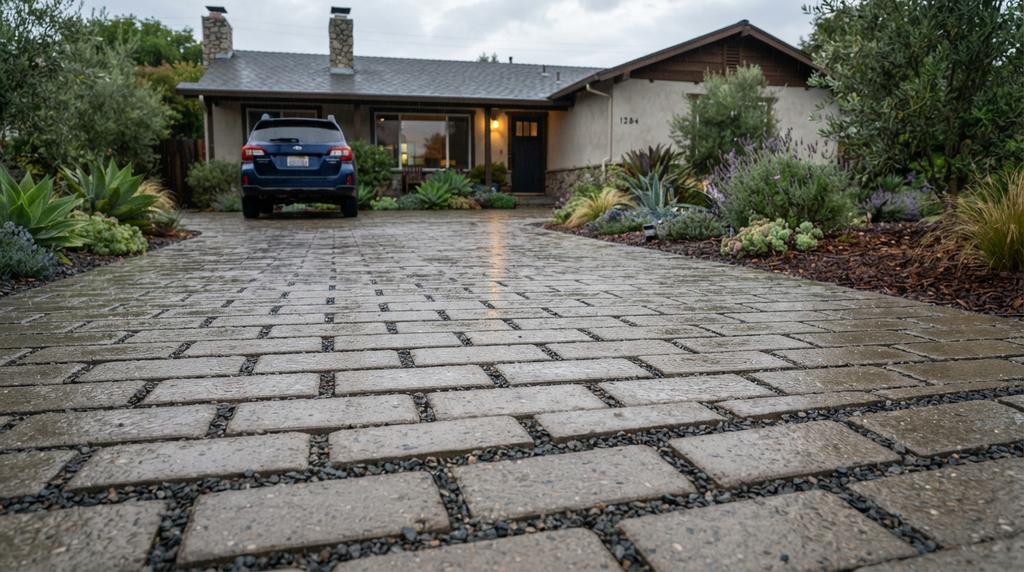
Permeable pavers are concrete or clay pavers laid with wider joints that are filled with small, clean crushed stone instead of sand, so rainwater passes between the units into a stone base below. The pavers don’t absorb the water. The joints and the base do the work.
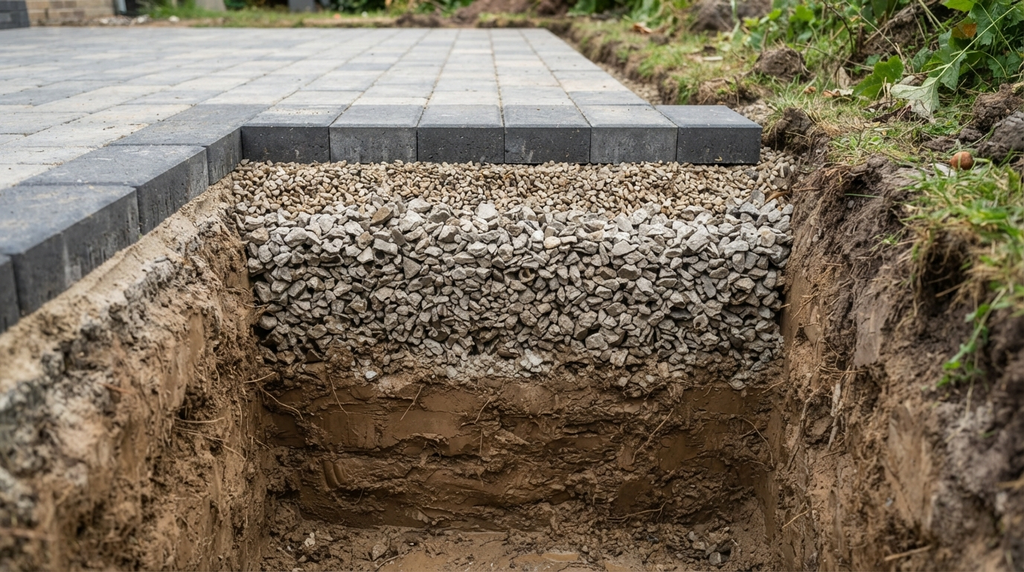
That base is the part most people never see. A permeable paver system sits on layers of open-graded crushed stone, which is rock screened to remove the fine particles, leaving open space between the stones for water to fill. Think of it as a hidden storage tank shaped like your driveway or patio.
Clay matters because of what happens at the bottom of that tank. Soil scientists group soils by how fast they take in water, and the USDA’s Group D soils, which are mostly clay-heavy soils, absorb water very slowly once they’re wet. That makes clay the first thing to check when you plan permeable pavers. Bay Area lots often have clay-heavy soil, though soil varies a lot from one street to the next, which is why we test before we design anything.
Do Permeable Pavers Actually Work on Clay Soil?
Yes, permeable pavers work on clay soil, but “work” means something slightly different than it does on sand. On sandy soil, most of the rain soaks straight into the ground. On clay, the system usually stores water in the stone base and lets it out slowly, partly into the soil and partly through a drain pipe.
Sandy soil drinks. Clay sips. A good design for permeable pavers Bay Area clay sites respects that difference instead of pretending it isn’t there.
Research backs up the idea that clay isn’t a dead end. The trade group behind the industry’s permeable paver specifications funded a study of a small permeable paver site built over Group D clay soils, and it found the clay still infiltrated some water. “Some” is the key word. You plan for slow infiltration, not zero, and not fast.
Local stormwater rules point the same direction. Under the Bay Area’s Municipal Regional Permit (Provision C.3), new development and redevelopment projects are expected to use pervious surfaces where feasible so runoff can soak into the soil. Our guide on whether you need permeable pavers in Contra Costa County explains when those rules apply to a home project. This article stays focused on the other half of the question: how the system behaves once it’s in the ground.
The Problem Nobody Mentions: Clay Drinks Slowly
The downside nobody puts in the brochure is this: on clay, a permeable paver system can fill up faster than the soil can empty it. When that happens during a long winter storm, water backs up in the base and eventually sits at the surface or spills off the edges.
The technical cause is simple. Clay particles are tiny and pack tightly, so water moves through them at a crawl, especially once the soil is already saturated after a few rainy days. The stone base above can only hold so much before it needs somewhere to send the extra.
Here’s how a well-designed system for permeable pavers, Bay Area clay included, deals with that:
- A deeper stone reservoir sized to hold water from a storm while the clay slowly takes it in.
- A perforated underdrain pipe in the lower base layer that carries excess water to an approved outlet, so the base never stays flooded.
- Geotextile fabric between the clay and the stone where the design calls for it, which keeps clay from migrating up into the base.
- Protecting the subgrade during construction by keeping heavy equipment and muddy runoff off the native soil, since compaction and sediment reduce what little infiltration clay offers.
- A soil test before design, not after, so the reservoir and drain are sized for your actual dirt.
Before you sign anything, ask the contractor one question: “Where does the water go when the clay can’t take any more?” If they don’t have a specific answer, keep looking.
Permeable Pavers, Bay Area Style: How the System Is Built for Clay
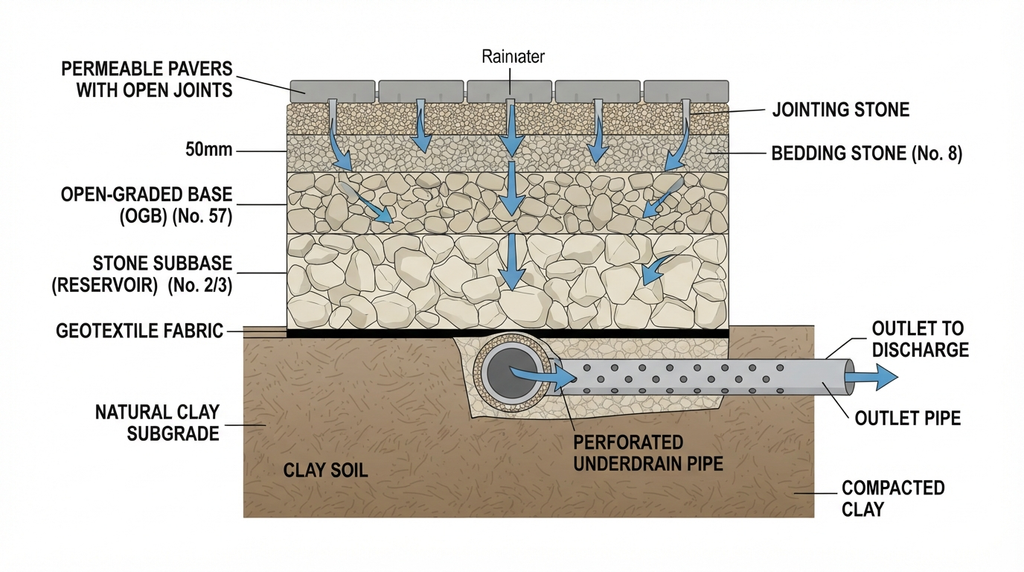
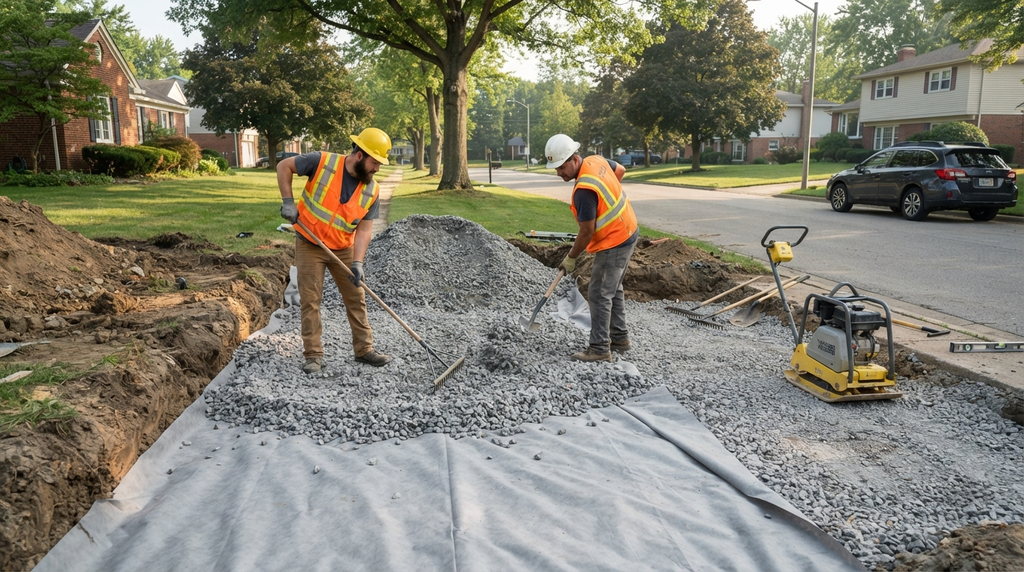
A permeable paver system built for clay has the same basic layers as any permeable installation, with extra attention on storage and drainage. The industry’s guide specification describes a bedding layer of small crushed stone (typically ASTM No. 8), an open-graded base (typically No. 57 stone), and a subbase of larger stone, and it notes that on low-infiltration soils some or all drainage is sent to an outlet through perforated underdrains in the subbase.
Here’s what each part does, and the mistake we see most often with each one:
- Pavers with open joints: the walking or driving surface. Common mistake: filling joints with sand or polymeric sand, which seals the surface and defeats the whole point.
- Joint and bedding stone: small clean aggregate that lets water drop through and keeps pavers level. Common mistake: using “dirty” stone with fines, which clogs faster.
- Open-graded base and subbase: the reservoir that holds water on clay. Common mistake: using the dense road base used under traditional pavers, which barely stores water at all.
- Geotextile (when specified): a separation layer between clay and stone. Common mistake: skipping it on soft, moist clay where soil migration is likely.
- Underdrain and outlet: the relief valve. Common mistake: installing a pipe with nowhere legal or practical to discharge.
- Edge restraint: holds the system together at the perimeter. Common mistake: using edging details meant for sand-set pavers.
Ready to see what your lot needs? Our crews start every permeable project with a site check, and you can schedule yours here.
Full, Partial or No Infiltration: Which Design Fits Your Lot?
Permeable paver systems generally come in three configurations, and the soil test decides which one you get. Stormwater design references describe the same three options: no underdrain for full infiltration, an underdrain for partial infiltration, or a liner plus underdrain when water should not soak into the ground at all.
| Design | Where the water goes | Typical fit | Main trade-off |
|---|---|---|---|
| Full infiltration (no underdrain) | All of it soaks into the native soil | Sandy or well-drained soils | Rarely the right call on heavy clay |
| Partial infiltration (with underdrain) | Some soaks in, the rest leaves slowly through a pipe | Most clay-heavy residential lots | Needs a practical outlet for the pipe |
| No infiltration (liner plus underdrain) | Stored, filtered, then released through a pipe | Next to foundations, unstable slopes, contaminated soil | Acts like detention, not groundwater recharge |
For most permeable pavers Bay Area clay projects we see, partial infiltration is the realistic target. It still slows runoff and filters it through stone, even if the clay isn’t absorbing every drop.
Where Permeable Pavers Make Sense (and When They Don’t)
Permeable pavers make the most sense on gently sloped areas where you want a hard surface without sending all the rain into the gutter. Here are real-world spots where permeable pavers, Bay Area clay notwithstanding, earn their place:
- A front driveway in Concord or Walnut Creek that currently sheds water across the sidewalk every storm. Our guide on driveway pavers breaks down how base depth changes for vehicle loads.
- A backyard patio in Lafayette or Moraga where a lawn area is staying soggy and you’d rather have usable space. Our guide on patio pavers compares layout and material options.
- A side yard or walkway that collects roof runoff and needs a surface that won’t puddle.
And here’s when permeable pavers are not the best choice, even if you love the look:
- Steep slopes or hillside lots, common in parts of Orinda and the Oakland hills, where water in the base can travel downhill and cause problems. Stormwater references generally recommend gentle surface slopes for permeable paving.
- Right against your foundation, unless the design uses a liner. Guidance commonly places permeable paving downslope from buildings for a reason.
- Very tight clay with no place to discharge an underdrain. Without an outlet, the reservoir has nowhere to go.
- Areas that collect heavy sediment, like the bottom of a bare dirt slope, which will clog the joints quickly.
In those cases, a traditional paver surface with good grading and a separate drainage solution often performs better. A good contractor will tell you that, even when it means a different scope.
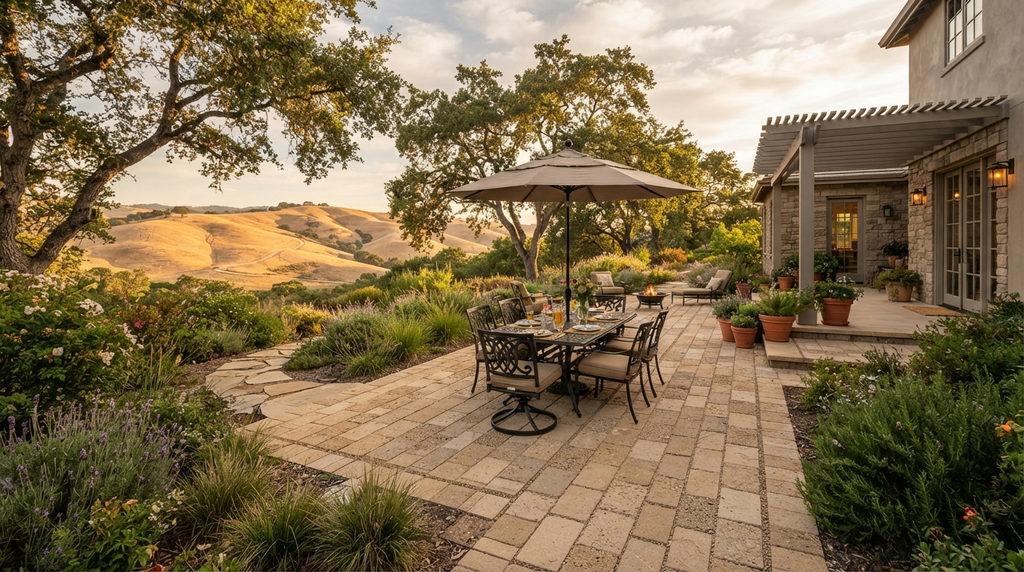
A Typical Clay Soil Project in Central Contra Costa
The following is a representative example of the kind of project we see often, not a specific client’s story.
Picture a homeowner near downtown Concord with a cracked concrete driveway. Every winter, water sheets off the slab, pools at the low corner by the garage, and leaves a muddy line across the sidewalk. They ask for permeable pavers because a neighbor said it would “fix the drainage.”
On a project like this, our first step is the soil. If the test shows dense clay, we’d plan a partial infiltration design: an open-graded stone reservoir under the pavers, geotextile where the clay is soft, and a perforated underdrain running to an outlet the homeowner and city can live with. We’d also regrade so the driveway falls away from the garage.
The result we’d expect isn’t “the water disappears.” It’s calmer than that. Rain drops through the joints instead of racing to the street, the base holds it during the storm, and the pipe lets it out slowly afterward. Fewer puddles, less runoff, and a driveway that’s built for the soil it sits on.
Curious what neighbors say about working with our crews? You can read through our reviews on BBP Pavers’ Yelp page or check our Better Business Bureau profile, and browse finished hardscape projects on our Instagram.
Frequently Asked Questions
How are permeable pavers different from traditional pavers on clay soil?
Traditional pavers sit on dense, compacted road base and tight sand joints, so rain runs off the surface toward a drain or the street. Permeable pavers use open joints and an open-graded stone base that stores water underneath. On clay soil, that stored water drains out slowly, often through an underdrain pipe. Both can be durable driveways; the difference is what happens to the rain.
Can I put a permeable paver driveway over clay soil?
Yes, a permeable paver driveway can be built over clay soil when the base is designed for both vehicle loads and slow drainage. That usually means a thicker reservoir than a patio needs and, in most clay conditions, an underdrain. A permeable paver driveway on clay is a poor fit if the driveway is steep or there’s no practical outlet for the pipe. A site evaluation should come first.
How much maintenance do permeable pavers need over time?
Permeable pavers need their joints kept open, because sediment, leaves and debris slowly clog the stone between the units. Regular sweeping and keeping mulch and soil from washing onto the surface go a long way. Over the years, the top of the joint stone may need to be vacuumed out and topped off. Clogged joints are the most common reason a permeable surface starts to puddle.
Why do some permeable pavers end up with standing water?
Standing water on permeable pavers usually comes from one of three causes: clogged joints at the surface, a base that was built with dense material instead of open-graded stone, or a reservoir sitting on clay with no underdrain to relieve it. Sediment washing in from bare soil nearby speeds up clogging. Construction mistakes, like driving muddy equipment over the base, can also reduce performance from the start.
What affects the cost of permeable pavers on clay soil?
The cost of permeable pavers on clay depends mostly on what goes under the surface. Excavation depth for the stone reservoir, whether an underdrain and outlet are needed, how much regrading the site requires, access for equipment, and the paver style you choose all play a role. Driveways need more base than patios. A site visit is the only reliable way to scope a specific project.
What should I ask a contractor before installing permeable pavers?
Before hiring anyone for permeable pavers, ask these questions:
- Will you test or evaluate my soil before designing the base?
- Will this be full, partial or no infiltration, and why?
- Where will the underdrain discharge, if there is one?
- What joint and base stone will you use?
- Does my project need a permit or input from my city or an engineer?
The Bottom Line on Clay
Clay doesn’t rule out permeable paving. It changes the design. When the reservoir is sized for slow soil, the underdrain has a real outlet, and the subgrade is protected during the build, permeable pavers on clay can quietly do their job for years. When those pieces are skipped, you get a pretty surface that puddles.
If you’re weighing permeable pavers, Bay Area clay is exactly the kind of challenge our crews plan around every week. Tell us about your driveway, patio or walkway, and request a site evaluation from BBP Pavers. You can also call us at +1 844-497-3321, Monday through Friday, 7:00 AM to 5:00 PM.