Artificial Turf vs Real Grass: Which Wins in 2026?

Did you know that the average American homeowner spends $1,200-$3,000 per year maintaining a natural grass lawn, while California’s ongoing drought restrictions make that investment increasingly uncertain and frustrating? If you’re weighing artificial turf vs real grass for your yard, you’re facing one of the most consequential landscaping decisions of 2026—one that affects your water bills, maintenance schedule, property value, environmental footprint, and daily enjoyment of your outdoor space for the next 15-25 years.
The artificial turf vs real grass debate has intensified dramatically in recent years, driven by California’s water conservation mandates, advances in synthetic turf technology that make modern products nearly indistinguishable from natural grass, and growing awareness of the true long-term costs of lawn maintenance. What was once a clear choice for most homeowners has become a genuinely complex decision requiring careful analysis of your specific situation, climate, budget, and priorities.
This comprehensive guide examines every dimension of the artificial turf vs real grass comparison—upfront costs, long-term expenses, water consumption, maintenance requirements, environmental impact, safety considerations, aesthetic quality, and property value effects. You’ll find honest assessments of both options, real cost data from Bay Area homeowners, and a clear framework for making the right choice for your specific property and lifestyle. Ready to settle the artificial turf vs real grass debate once and for all? Let’s examine every factor that matters.
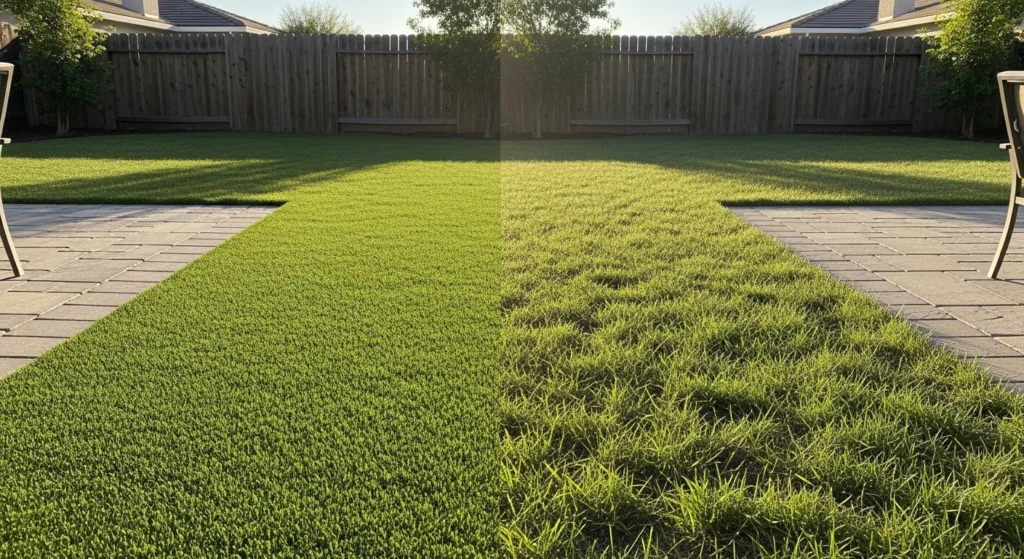
What is the Real Difference Between Artificial Turf and Real Grass?
Understanding the fundamental differences between artificial turf vs real grass goes beyond surface appearance to encompass materials, performance characteristics, environmental interactions, and long-term behavior.
Artificial Turf: Modern Synthetic Lawns
What Artificial Turf Is: Modern artificial turf consists of synthetic fibers—typically polyethylene, polypropylene, or nylon—manufactured to mimic natural grass blades. Professional artificial turf installation includes multiple layers:
System Components:
- Backing material (primary and secondary layers)
- Synthetic grass fibers (pile height 1-2.5 inches typical)
- Infill material (crumb rubber, sand, or organic alternatives)
- Drainage layer (perforated backing or aggregate base)
- Weed barrier fabric
- Compacted aggregate base (3-4 inches)
Technology Evolution: Artificial turf vs real grass comparisons have shifted dramatically as technology improved:
- 1960s-1980s: Astroturf (flat, carpet-like, obviously synthetic)
- 1990s-2000s: Second generation (improved texture, still recognizable)
- 2010s: Third generation (realistic appearance, better drainage)
- 2020s: Fourth generation (near-indistinguishable from natural grass, advanced infill)
Current Quality Levels:
- Entry-level: $5-$8 per square foot (basic appearance)
- Mid-range: $8-$12 per square foot (good realism)
- Premium: $12-$20 per square foot (exceptional realism)
- Ultra-premium: $20-$30 per square foot (professional grade)
Real Grass: Natural Lawn Options
What Real Grass Is: Natural grass lawns consist of living plant systems requiring soil, water, nutrients, and maintenance to thrive. The artificial turf vs real grass choice involves selecting from multiple grass varieties suited to different climates.
Grass Types for California:
- Bermuda grass: Drought-tolerant, heat-resistant, fast-growing
- Fescue (tall and fine): Cool-season, shade-tolerant, popular in Bay Area
- Zoysia: Drought-tolerant, dense, slow-growing
- St. Augustine: Warm-season, shade-tolerant, coastal areas
- Buffalo grass: Native, extremely drought-tolerant
Natural Lawn System:
- Soil preparation and amendment
- Seed or sod installation
- Irrigation system
- Fertilization program
- Pest and weed management
- Regular mowing and edging
BBP Pavers provides professional artificial turf installation throughout the Bay Area, helping homeowners in Concord, Walnut Creek, Lafayette, and surrounding communities make informed decisions and achieve beautiful results.
Artificial Turf vs Real Grass: Complete Cost Comparison
Cost represents the most decisive factor in the artificial turf vs real grass decision for most homeowners. Understanding both upfront and long-term expenses reveals the true financial picture.
Upfront Installation Costs
Artificial Turf Installation Costs: Professional artificial turf installation includes:
- Material (turf): $5-$20 per square foot
- Base preparation: $2-$4 per square foot
- Labor: $3-$6 per square foot
- Weed barrier: $0.50-$1 per square foot
- Infill material: $1-$2 per square foot
- Total installed: $8-$30 per square foot
Real Grass Installation Costs: Natural lawn installation includes:
- Soil preparation: $1-$3 per square foot
- Sod installation: $1.50-$3.50 per square foot
- Seed installation: $0.50-$1.50 per square foot
- Irrigation system: $1-$3 per square foot
- Initial fertilization: $0.25-$0.50 per square foot
- Total installed (sod): $4-$11 per square foot
- Total installed (seed): $3-$8 per square foot
Upfront Cost Comparison (1,000 sq ft):
| Option | Low Estimate | High Estimate | Average |
|---|---|---|---|
| Artificial Turf | $8,000 | $30,000 | $15,000 |
| Sod Lawn | $4,000 | $11,000 | $7,000 |
| Seeded Lawn | $3,000 | $8,000 | $5,000 |
Verdict on Upfront Costs: Real grass wins the upfront cost comparison in artificial turf vs real grass, costing 40-60% less initially. However, this advantage diminishes significantly when long-term costs are considered.
Annual Maintenance Costs
Artificial Turf Annual Costs: Ongoing artificial turf vs real grass maintenance expenses:
- Occasional brushing/grooming: $0-$200
- Spot cleaning: $0-$100
- Infill replenishment (every 3-5 years): $200-$500 annually
- Weed control (minimal): $50-$150
- Seam or repair maintenance: $100-$300
- Annual total: $350-$1,250
Real Grass Annual Costs: Natural lawn maintenance in California:
- Water (irrigation): $600-$2,400 annually
- Mowing (professional): $800-$2,400 annually
- Fertilization (4x per year): $200-$600
- Weed control: $150-$400
- Pest and disease treatment: $100-$400
- Aeration and overseeding: $200-$600
- Equipment maintenance: $100-$300
- Annual total: $2,150-$7,100
10-Year Total Cost Comparison (1,000 sq ft):
| Option | Installation | 10-Year Maintenance | 10-Year Total |
|---|---|---|---|
| Artificial Turf | $15,000 | $5,000 | $20,000 |
| Natural Grass | $7,000 | $35,000 | $42,000 |
| Savings with Turf | — | $30,000 | $22,000 |
Long-Term Verdict: Artificial turf wins decisively in the artificial turf vs real grass long-term cost comparison, saving most California homeowners $15,000-$30,000 over 10 years despite higher upfront investment.
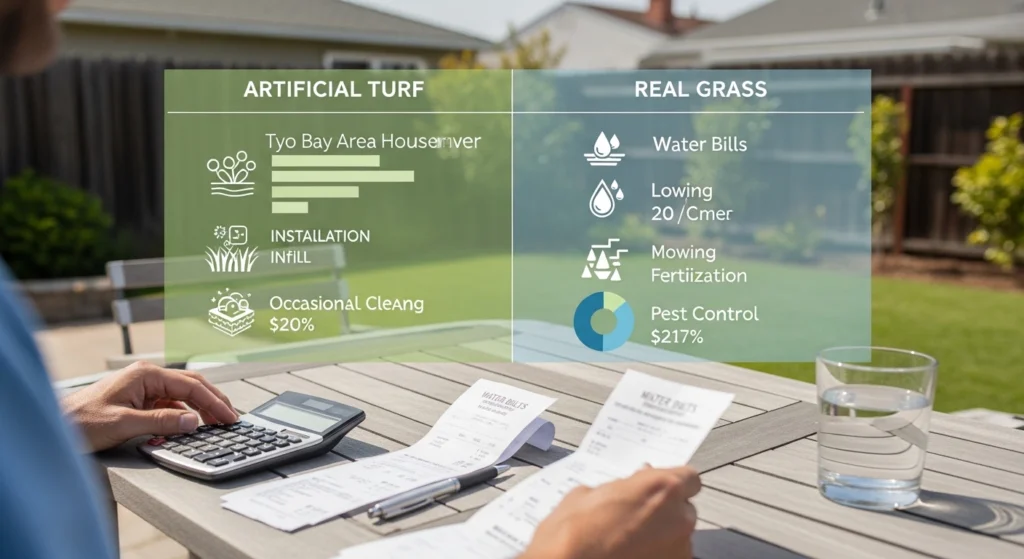
Water Consumption: Artificial Turf vs Real Grass
Water usage represents the most significant ongoing cost and environmental consideration in the artificial turf vs real grass comparison, particularly in California’s drought-prone climate.
Real Grass Water Requirements
Irrigation Needs: Natural grass water consumption in California:
- Cool-season grasses (fescue): 1-1.5 inches per week
- Warm-season grasses (Bermuda): 0.75-1 inch per week
- Annual water use (1,000 sq ft): 20,000-40,000 gallons
- Monthly water cost: $50-$200 (varies by district)
- Annual water cost: $600-$2,400
California Drought Impact: Water restrictions significantly affect artificial turf vs real grass decisions:
- Mandatory watering day restrictions
- Drought surcharges on water bills
- Lawn watering bans during severe drought
- Fines for excessive water use
- Uncertainty of future restrictions
East Bay MUD Water Rates: Bay Area homeowners face premium water pricing:
- Tier 1 (baseline): $4-$6 per CCF
- Tier 2 (above baseline): $8-$12 per CCF
- Drought surcharges: Additional 25-50%
- Annual lawn irrigation cost: $800-$2,500
Artificial Turf Water Requirements
Minimal Water Use: Artificial turf vs real grass water comparison strongly favors synthetic:
- No irrigation required for growth
- Occasional rinsing for cleaning: 50-100 gallons monthly
- Annual water use: 600-1,200 gallons (vs. 20,000-40,000 for grass)
- Water savings: 95-97% reduction
- Annual savings: $600-$2,000 on water bills
California Rebate Programs: Water conservation incentives make artificial turf vs real grass economics even more favorable:
- East Bay MUD: $1-$2 per square foot rebate
- EBMUD maximum rebate: $2,000-$4,000
- Santa Clara Valley Water District: Similar programs
- Contra Costa Water District: Turf replacement rebates
- State programs: Additional incentives available
Water Savings Over 10 Years:
- Water cost savings: $6,000-$20,000
- Rebate value: $1,000-$4,000
- Total water-related savings: $7,000-$24,000
Maintenance Requirements: Artificial Turf vs Real Grass
The time and effort required for ongoing maintenance represents a major quality-of-life factor in the artificial turf vs real grass decision.
Real Grass Maintenance Schedule
Weekly Tasks:
- Mowing (spring-fall): 1-2 hours per week
- Edging: 30-60 minutes per week
- Watering management: 30 minutes per week
- Spot weed removal: 15-30 minutes
Monthly Tasks:
- Fertilization application: 1-2 hours
- Pest inspection and treatment: 30-60 minutes
- Irrigation system check: 30 minutes
- Thatch management: Seasonal
Annual Tasks:
- Aeration: 2-4 hours
- Overseeding: 2-4 hours
- Soil testing and amendment: 2-3 hours
- Irrigation system winterization: 1-2 hours
Total Annual Time Investment:
- DIY maintenance: 80-150 hours per year
- Professional service: $1,500-$4,000 annually
- Equipment costs: $500-$2,000 (mower, edger, spreader)
Artificial Turf Maintenance Schedule
Weekly Tasks:
- Visual inspection: 5 minutes
- Debris removal (leaves, etc.): 10-20 minutes
- Pet waste removal: As needed
Monthly Tasks:
- Light brushing to maintain pile: 20-30 minutes
- Spot cleaning if needed: 15-30 minutes
- Infill check: 10 minutes
Annual Tasks:
- Deep cleaning with hose: 1-2 hours
- Infill replenishment check: 30 minutes
- Seam and edge inspection: 30 minutes
- Professional grooming (optional): $200-$400
Total Annual Time Investment:
- DIY maintenance: 15-25 hours per year
- Professional service: $200-$500 annually
- Equipment costs: Minimal (brush, hose)
Maintenance Comparison:
| Factor | Artificial Turf | Real Grass |
|---|---|---|
| Weekly time | 15-25 min | 2-3 hours |
| Annual time | 15-25 hours | 80-150 hours |
| Annual cost | $350-$1,250 | $2,150-$7,100 |
| Equipment needed | Minimal | Significant |
| Seasonal variation | Minimal | High |
| Expertise required | Low | Medium |
Maintenance Verdict: Artificial turf wins the maintenance comparison decisively in artificial turf vs real grass, saving 60-80 hours annually and $1,800-$5,850 per year in maintenance costs.
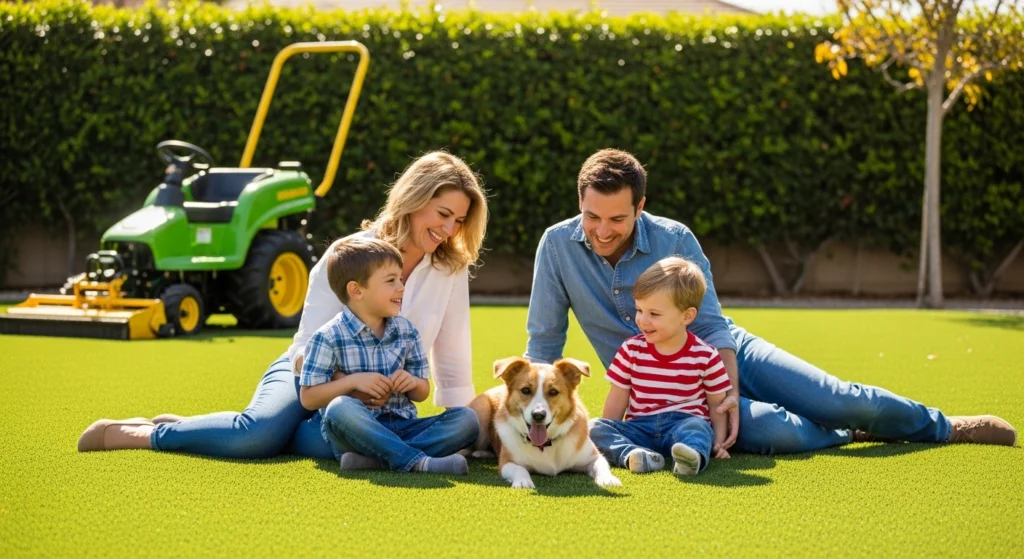
Environmental Impact: Artificial Turf vs Real Grass
Environmental considerations have become increasingly important in the artificial turf vs real grass debate, with valid arguments on both sides.
Real Grass Environmental Benefits
Ecological Advantages: Natural grass provides genuine environmental benefits:
- Carbon sequestration (absorbs CO2)
- Oxygen production
- Soil microbiome support
- Habitat for insects and birds
- Natural cooling through transpiration
- Stormwater absorption
- Biodiversity support
Environmental Concerns: However, real grass maintenance creates environmental issues:
- Pesticide and herbicide runoff
- Fertilizer nutrient pollution
- Gas-powered mower emissions
- Excessive water consumption
- Soil compaction from heavy equipment
Artificial Turf Environmental Considerations
Environmental Benefits: Artificial turf vs real grass environmental comparison includes synthetic advantages:
- Eliminates pesticide and herbicide use
- Eliminates fertilizer runoff
- Eliminates mower emissions
- Dramatically reduces water consumption
- Qualifies for water conservation rebates
- Reduces carbon footprint of maintenance
Environmental Concerns: Honest artificial turf vs real grass analysis acknowledges synthetic drawbacks:
- Petroleum-based materials (non-renewable)
- Heat island effect (surface temperatures 20-50°F higher)
- End-of-life disposal challenges
- Microplastic concerns (ongoing research)
- No carbon sequestration
- Reduced habitat value
Environmental Verdict: The artificial turf vs real grass environmental comparison is genuinely complex. In water-scarce California, artificial turf’s dramatic water savings and elimination of chemical inputs often outweigh concerns about synthetic materials, particularly when eco-friendly infill options are selected.
Eco-Friendly Artificial Turf Options
Sustainable Infill Alternatives: Modern artificial turf vs real grass decisions can favor eco-friendly options:
- Cork infill (natural, biodegradable)
- Coconut fiber infill (sustainable)
- Organic infill systems
- Recycled content turf fibers
- Recyclable backing materials
Safety and Health: Artificial Turf vs Real Grass
Safety considerations affect families with children and pets in the artificial turf vs real grass decision.
Heat Concerns
Surface Temperature: A significant artificial turf vs real grass safety consideration:
- Natural grass: 10-15°F above air temperature
- Artificial turf: 20-50°F above air temperature
- On 90°F days: Turf surface can reach 130-160°F
- Mitigation: Shade structures, cooling systems, watering
Heat Management Strategies:
- Install pergola or shade structures
- Choose lighter-colored turf products
- Select cooling infill systems
- Water turf briefly before use on hot days
- Plant shade trees strategically
Pet Safety
Artificial Turf for Pets: Artificial turf vs real grass pet considerations:
- No pesticides or herbicides (safer for pets)
- Easy waste cleanup
- No mud tracking into home
- Durable against digging
- Antimicrobial infill options available
Pet-Specific Products:
- Drainage systems for urine management
- Antimicrobial backing materials
- Odor control infill systems
- Durable fibers resisting pet wear
- Easy-clean surfaces
Real Grass Pet Concerns:
- Pesticide exposure risk
- Mud and tracking issues
- Lawn damage from pet use
- Parasite habitat (fleas, ticks)
- Urine burn spots
Child Safety
Play Area Considerations: Artificial turf vs real grass for children:
- Consistent, even surface (fewer trip hazards)
- No pesticide exposure
- Cushioning from quality infill
- Year-round usability
- No bee or insect concerns
Safety Standards: Quality artificial turf meets:
- ASTM safety standards
- Lead-free certification
- Non-toxic material requirements
- Appropriate G-max ratings for play areas
Aesthetic Quality: Artificial Turf vs Real Grass
Appearance matters significantly in the artificial turf vs real grass decision, particularly for homeowners focused on curb appeal and property presentation.
Modern Artificial Turf Realism
Technology Advances: 2026 artificial turf vs real grass aesthetic comparison has narrowed dramatically:
- Multi-tone fiber colors (not uniform green)
- Varied blade heights and textures
- Thatching fibers for natural appearance
- Realistic blade shapes (flat, C-shaped, W-shaped)
- Natural-looking color variations
Visual Characteristics:
- Year-round consistent green appearance
- No brown patches or bare spots
- No seasonal color changes
- Uniform density throughout
- Professional, manicured appearance
Limitations:
- Lacks natural variation of real grass
- Visible seams if poorly installed
- Sheen in certain lighting conditions
- Cannot replicate exact natural texture
- Appearance degrades over time (15-20 years)
Real Grass Aesthetic Appeal
Natural Beauty: Real grass provides authentic aesthetic qualities:
- Genuine natural appearance
- Seasonal variation (some find appealing)
- Unique texture and movement
- Natural fragrance
- Living, dynamic appearance
Aesthetic Challenges:
- Brown patches during drought or stress
- Bare spots from heavy use
- Seasonal dormancy (brown in winter for warm-season)
- Weed intrusion affecting appearance
- Requires consistent maintenance for good appearance
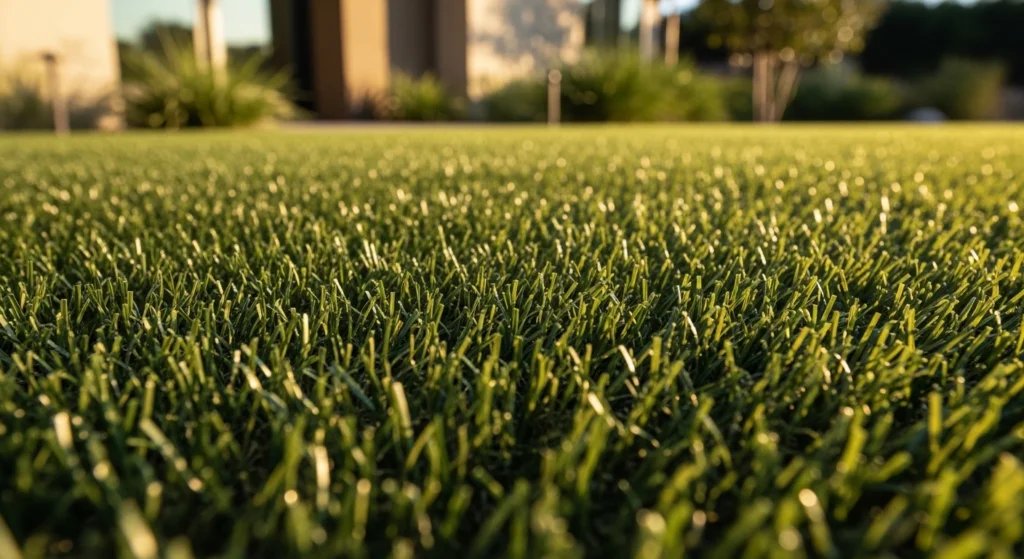
Real Project Examples: Artificial Turf vs Real Grass in the Bay Area
Case Study 1: Concord Family Converts to Artificial Turf
Background: A Concord family with two children and a dog spent $2,800 annually maintaining their 1,200 sq ft natural grass lawn, including water, mowing, fertilization, and pest control.
Project Details:
- Location: Concord, CA
- Area: 1,200 square feet
- Product: Premium polyethylene turf (1.75 inch pile)
- Infill: Silica sand with organic top layer
Investment:
- Artificial turf installation: $14,400
- EBMUD rebate received: $2,400
- Net investment: $12,000
Annual Savings:
- Water savings: $1,440
- Mowing savings: $1,200
- Fertilization/pest control: $600
- Total annual savings: $3,240
Payback Period: 3.7 years (after rebate)
Homeowner Feedback: “We switched from real grass to artificial turf with BBP Pavers two years ago, and it’s been the best home improvement decision we’ve made. Our water bill dropped by $120 per month, and we never have to mow again. The kids and dog love it!”
Case Study 2: Lafayette Homeowner Keeps Natural Grass
Background: A Lafayette homeowner with a large, shaded backyard evaluated artificial turf vs real grass and chose to maintain natural grass with improved irrigation.
Decision Factors:
- Large mature trees providing shade (reduces heat concern)
- Existing irrigation system in good condition
- Personal preference for natural appearance
- Lower water rates in their district
- Enjoyment of gardening activities
Improvements Made:
- Smart irrigation controller: $400
- Drought-tolerant grass overseeding: $600
- Soil amendment: $300
- Total investment: $1,300
Annual Savings:
- Smart irrigation reduced water use 30%: $480 savings
- Maintained natural appearance preference
- Continued enjoying lawn activities
Lesson: The artificial turf vs real grass decision isn’t always clear-cut. For some homeowners with specific conditions and preferences, optimized natural grass remains the better choice.
Case Study 3: Walnut Creek Backyard Transformation
Background: A Walnut Creek homeowner combined artificial turf with paver patio installation for a complete backyard transformation.
Project Scope:
- 800 sq ft artificial turf installation
- 350 sq ft paver patio with fire pit area
- Outdoor lighting package
- Retaining wall for level change
Investment:
- Artificial turf: $9,600
- Paver patio: $7,000
- Fire pit: $4,500
- Lighting: $2,200
- Retaining wall: $3,500
- Total: $26,800
Results:
- Property value increased by estimated $35,000
- Annual maintenance savings: $2,800
- Water savings: $1,200 annually
- Complete outdoor living transformation
Client Testimonial: “BBP Pavers transformed our entire backyard with artificial turf and a beautiful paver patio. The combination looks incredible, and we’ve essentially eliminated lawn maintenance. Best investment we’ve made in our home.” – Walnut Creek Homeowner, Google Review
Who Should Choose Artificial Turf vs Real Grass?
Making the right artificial turf vs real grass choice depends on your specific situation, priorities, and property characteristics.
Choose Artificial Turf If You:
Ideal Candidates:
- Live in drought-prone California with water restrictions
- Want to eliminate weekly mowing and maintenance
- Have children or pets who use the lawn heavily
- Are concerned about pesticide and chemical exposure
- Want consistent year-round green appearance
- Have shaded areas where grass struggles to grow
- Are planning to sell and want maximum curb appeal
- Want to qualify for water conservation rebates
- Have a busy lifestyle with limited maintenance time
- Are concerned about long-term water costs
Best Applications:
- Front yard curb appeal
- Backyard play areas
- Pet runs and dog areas
- Shaded areas under trees
- Slopes and difficult terrain
- Pool surrounds (combined with pool deck pavers)
- Commercial and HOA properties
Choose Real Grass If You:
Ideal Candidates:
- Enjoy lawn care as a hobby or relaxation activity
- Have access to affordable water
- Prioritize natural aesthetics and feel
- Have large shaded areas moderating heat concerns
- Want maximum environmental benefits (carbon, habitat)
- Have children who prefer natural grass feel
- Live in a cooler, wetter climate
- Have budget constraints limiting upfront investment
- Plan to sell within 2-3 years (before turf pays back)
Best Applications:
- Large properties with affordable irrigation
- Cooler, coastal Bay Area microclimates
- Properties with significant shade
- Homeowners who enjoy gardening
- Areas with low water costs
Frequently Asked Questions
Is artificial turf better than real grass for California homeowners?
For most California homeowners, artificial turf vs real grass comparison favors synthetic in 2026 due to water conservation requirements, drought restrictions, and long-term cost savings. Artificial turf eliminates $600-$2,400 in annual water costs, saves 80-150 hours of maintenance annually, and qualifies for $1,000-$4,000 in water district rebates. Over 10 years, most California homeowners save $15,000-$30,000 compared to maintaining natural grass. However, homeowners with shaded properties, affordable water access, or strong preferences for natural aesthetics may find real grass remains the better choice. BBP Pavers offers free consultations to help Bay Area homeowners evaluate their specific situation and make the optimal artificial turf vs real grass decision.
How long does artificial turf last compared to real grass?
Quality artificial turf lasts 15-25 years with proper installation and maintenance, while natural grass requires ongoing investment indefinitely. Premium artificial turf products carry 15-20 year manufacturer warranties, with many installations lasting 20-25 years before replacement is needed. Real grass, while theoretically permanent, requires complete renovation every 10-15 years due to soil compaction, thatch buildup, and pest damage, costing $3,000-$8,000 per renovation. The artificial turf vs real grass lifespan comparison favors synthetic for predictable, long-term performance. BBP Pavers installs premium artificial turf products backed by comprehensive warranties, ensuring Bay Area homeowners receive maximum value from their investment.
What are the hidden costs of artificial turf vs real grass?
Hidden costs affect both sides of the artificial turf vs real grass comparison. Artificial turf hidden costs include infill replenishment ($200-$500 every 3-5 years), professional grooming ($200-$400 annually), potential replacement of damaged sections ($500-$2,000), and eventual full replacement after 15-25 years ($8,000-$20,000). Real grass hidden costs include irrigation system repairs ($200-$1,000), lawn renovation after drought damage ($1,000-$4,000), pest and disease treatment ($200-$800), equipment replacement ($500-$2,000), and water rate increases. When all hidden costs are included, artificial turf vs real grass 20-year total cost still strongly favors synthetic for most California homeowners, with savings of $20,000-$50,000 over the full period.
Does artificial turf increase home value compared to real grass?
Both artificial turf and well-maintained real grass increase home value, but their impact differs in the artificial turf vs real grass comparison. Quality artificial turf installations increase property values by $5,000-$15,000 in California’s water-conscious market, with buyers increasingly valuing low-maintenance, drought-resistant landscaping. Real grass in excellent condition also adds value but requires buyers to commit to ongoing maintenance costs. In California’s competitive real estate market, artificial turf often provides stronger selling points due to water savings, low maintenance, and year-round appearance. However, some buyers prefer natural grass, making the artificial turf vs real grass value impact somewhat buyer-dependent. Professional installation quality significantly affects value impact for both options.
How much does artificial turf installation cost compared to real grass in the Bay Area?
Artificial turf installation in the Bay Area costs $8-$30 per square foot installed, compared to $4-$11 per square foot for sod or $3-$8 for seeded natural grass. For a typical 1,000 sq ft lawn, artificial turf costs $8,000-$30,000 versus $4,000-$11,000 for natural grass. However, water district rebates of $1,000-$4,000 reduce artificial turf net costs significantly. When 10-year maintenance and water costs are included, artificial turf vs real grass total cost comparison strongly favors synthetic, with most Bay Area homeowners saving $15,000-$30,000 over a decade. BBP Pavers provides detailed, transparent quotes for artificial turf installations throughout the Bay Area, with financing options making the upfront investment manageable.
Conclusion
The artificial turf vs real grass debate has a clear winner for most California homeowners in 2026: artificial turf delivers superior long-term value through dramatic water savings, dramatically reduced maintenance requirements, consistent year-round appearance, and significant cost savings that compound over time. The data is compelling—most Bay Area homeowners save $15,000-$30,000 over 10 years by choosing artificial turf over natural grass, while reclaiming 80-150 hours of annual maintenance time.
This comprehensive artificial turf vs real grass guide has examined every relevant factor: upfront costs (real grass wins), long-term costs (artificial turf wins decisively), water consumption (artificial turf saves 95-97%), maintenance time (artificial turf saves 80-150 hours annually), environmental impact (complex, context-dependent), safety (both have considerations), aesthetics (modern artificial turf nearly matches natural), and property value (both add value, artificial turf increasingly preferred in California).
The right artificial turf vs real grass choice depends on your specific situation. Homeowners with water restrictions, busy lifestyles, children, pets, or shaded problem areas benefit most from artificial turf. Those with affordable water, shaded properties, or strong natural preferences may find optimized real grass remains appropriate.
BBP Pavers brings over 10 years of Bay Area expertise to artificial turf installations, serving homeowners from Concord and Walnut Creek to Palo Alto and Atherton. Their comprehensive approach includes free consultations, premium product selection, expert installation, rebate assistance, and industry-leading warranties ensuring every artificial turf project delivers maximum value.
Ready to make the right artificial turf vs real grass decision for your Bay Area property? Contact BBP Pavers today at (844) 497-3321 for your free consultation and detailed proposal. Visit their artificial turf service page to view completed Bay Area projects and explore product options. Don’t spend another year on lawn maintenance that costs thousands and delivers diminishing returns—discover how artificial turf can transform your outdoor space and your lifestyle today!
Business Information: BBP Pavers 4918 Clayton Rd, Concord, CA 94521 Phone: (844) 497-3321 Email: bbppavers@gmail.
Connect with BBP Pavers:
Serving the Bay Area including Moraga, Orinda, Fremont, Los Altos, and throughout Northern California.