
Why Landscape Stone Curbing Outlasts Flimsy Yard Borders

Why Landscape Stone Curbing Outlasts Flimsy Yard Borders
The Core Engineering of Landscape Stone Curbing vs Flimsy Edging
Every yard boundary battles physical forces: soil expansion, root creep, moisture migration, and the relentless vibration of lawn mowers. Flimsy borders rely on thin profiles pinned into topsoil with flimsy spikes. When the ground freezes, swells, or gets saturated with winter rains, lightweight edging buckles upward, creating trip hazards and letting mulch spill onto the turf.
Structural stone curbing relies on mass, friction, and sub-base compaction to create an immovable barrier. When installed over an excavated, aggregate-supported trench, it functions as an architectural retaining edge. This structural stability keeps hardscapes from shifting laterally under load while preventing aggressive turfgrasses from invading planting beds.
| Material Feature | High-Density Concrete / Cast Stone | Natural Stone (Granite / Sandstone) | Plastic / Polyethylene Strips | Thin Aluminum / Steel Edging |
|---|---|---|---|---|
| Typical Lifespan | 25 to 50+ Years | 50+ Years (Indefinite) | 2 to 5 Years | 5 to 10 Years |
| Impact Resistance | Extreme (Mower & Trimmer Proof) | Maximum (Immune to equipment strikes) | Low (Cracks, chips, gouges easily) | Moderate (Bends, dents, sharp edges emerge) |
| Edge Restraint Capability | Excellent (Locks pavers and soil in place) | Excellent (High structural mass) | Poor (Zero structural support) | Minimal (Holds soil, cannot restrain pavers) |
| UV & Weather Resistance | Total UV immunity; high freeze-thaw rating | Natural weatherproofing; zero degradation | Warps, fades, and turns brittle in sunlight | Resists UV; prone to rust or frost heaving |
| Maintenance Level | Nearly zero (Periodic joint inspection) | Zero maintenance | High (Constant resetting and replacing) | Moderate (Re-staking lifted edges) |
Comparing Stone Borders to Plastic, Metal, and Rubber Strips
Plastic edging strips might seem budget-friendly on shelf day, but seasonal heat cycles cause polyethylene to expand, forming unsightly waves along what should be a straight garden line. Once sunlight degrades the plasticizers, a single tap from a string trimmer can shatter the lip.
Thin metal strips hold straight lines better than plastic, but frost-heave cycles often push their anchoring stakes out of the ground. Once exposed, aluminum and steel edges present sharp, hazardous metal tracks that damage mower blades and pose risks to pets and children. Reviewing the top stone edging options highlights how upgrading to masonry units eliminates these cyclic replacement costs entirely.
Weed Suppression, Soil Erosion Control, and Mower Restraints
Aggressive grass varieties spread through subterranean rhizomes and creeping stolons. Shallow plastic strips sit mostly above ground, letting roots travel directly underneath. Landscape stone curbs sit deep in an excavated trench, forming a physical root barrier that stops turf from creeping into pristine flower beds.

A solid stone border also acts as a built-in mowing strip. Wide concrete and natural stone edgers provide a flat track wide enough to support lawn mower wheels. This allows you to cut right up to the bed’s edge without dropping a wheel into the mulch or needing to run a string trimmer along every inch of the perimeter.
Material Options, Styles, and Visual Customization
Choosing stone curbing involves balancing architectural style, budget, and structural needs. Modern hardscaping provides diverse materials ranging from precision precast concrete blocks to hand-split quarried stones.
Understanding the durability comparison between pavers and concrete helps guide your material choices across adjoining walkways and border elements.
Concrete Units, Cast Stone, and Natural Stone Curbing
- Precast Concrete Units: Engineered for dimensional consistency, high compressive strength (often exceeding 4,000 to 5,000 PSI), and low water absorption. Many options, like the 8″ x 8″ x 4″ Village Edging stone, offer substantial 18-lb ballast per block to stay firmly anchored. Options like the RumbleStone 10.5 in. x 3.5 in. x 5.25 in. Cafe Edger ($2.27 per unit, dropping to $2.04 in bulk quantities of 144+) or Pavestone 12 in. River Red Straight Scallop Edgers ($1.97 retail, $1.77 bulk) offer budget-friendly concrete edging.
- Architectural Cast Stone: Made from premium aggregates and white Portland cements to replicate fine quarried limestone. Commercial-grade precast concrete curbing specifications showcase custom profiles, chamfered top edges, and chisel-faced textures that match luxury estates and pool perimeters.
- Quarried Natural Stone: Granite setts, tumbled Belgian blocks, and split-face sandstone cobbles provide unmatched organic beauty. Natural stone resists acid rain, soil fertilizers, and heavy tire traffic along driveways without showing surface wear.
Color Blending, Textured Finishes, and Gentle Curves
Landscape curbing should coordinate seamlessly with your surrounding hardscape. Textured products such as Curbstone edge restraint specifications feature dual-sided tumbled faces that provide a weathered, hand-hewn appearance suited for both sweeping curves and linear borders.
When planning transitions between garden beds, patios, and outdoor living rooms, careful paver selection criteria ensures your curbing colors (ranging from charcoal and pewter to warm buff, terracotta, and variegated slate) complement the primary paving field.
Practical Layouts and Site Preparation Guide
A stone border is only as stable as the ground beneath it. Laying stones directly on loose topsoil guarantees uneven settling after the first heavy rain.
Before breaking ground, always call 811 to locate underground utilities. Lay out smooth sweeping lines using a flexible garden hose or bright marking paint. For straight runs, drive wooden stakes and pull a taut mason’s string line to maintain a uniform grade.
Step-by-Step Installation for Landscape Stone Curbing
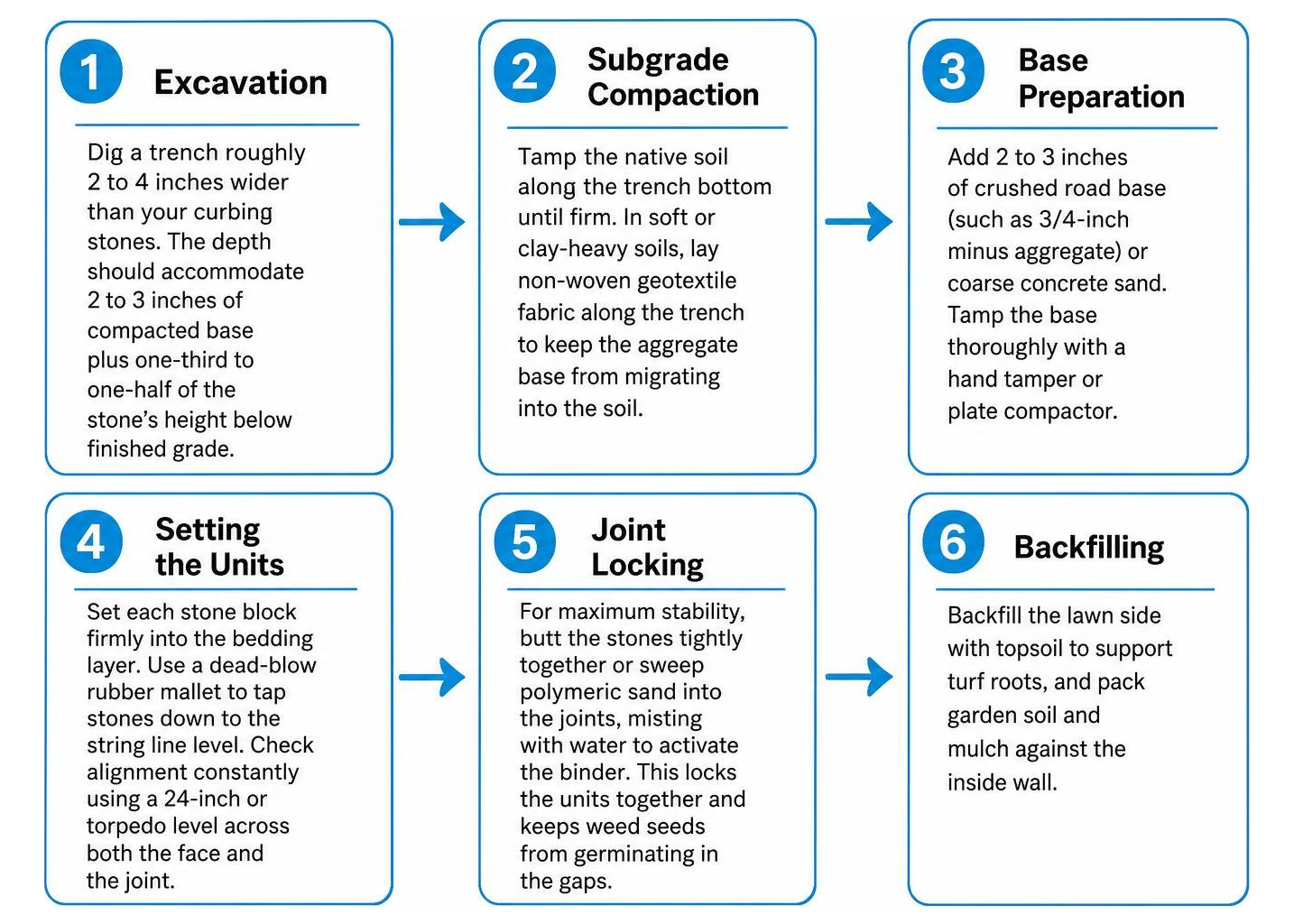
- Excavation: Dig a trench roughly 2 to 4 inches wider than your curbing stones. The depth should accommodate 2 to 3 inches of compacted base material plus one-third to one-half of the stone’s height below finished grade.
- Subgrade Compaction: Tamp the native soil along the trench bottom until firm. In soft or clay-heavy soils, lay non-woven geotextile fabric along the trench to keep the aggregate base from migrating into the soil.
- Base Preparation: Add 2 to 3 inches of crushed road base (such as 3/4-inch minus aggregate) or coarse concrete sand. Tamp the base thoroughly with a hand tamper or plate compactor.
- Setting the Units: Set each stone block firmly into the bedding layer. Use a dead-blow rubber mallet to tap stones down to the string line level. Check alignment constantly using a 24-inch or torpedo level across both the face and the joint.
- Joint Locking: For maximum stability, butt the stones tightly together or sweep polymeric sand into the joints, misting with water to activate the binder. This locks the units together and keeps weed seeds from germinating in the gaps.
- Backfilling: Backfill the lawn side with topsoil to support turf roots, and pack garden soil and mulch against the inside wall.
High-Impact Applications for Landscape Stone Curbing
Stone curbing brings clean visual lines and dependable containment to high-traffic landscape zones:
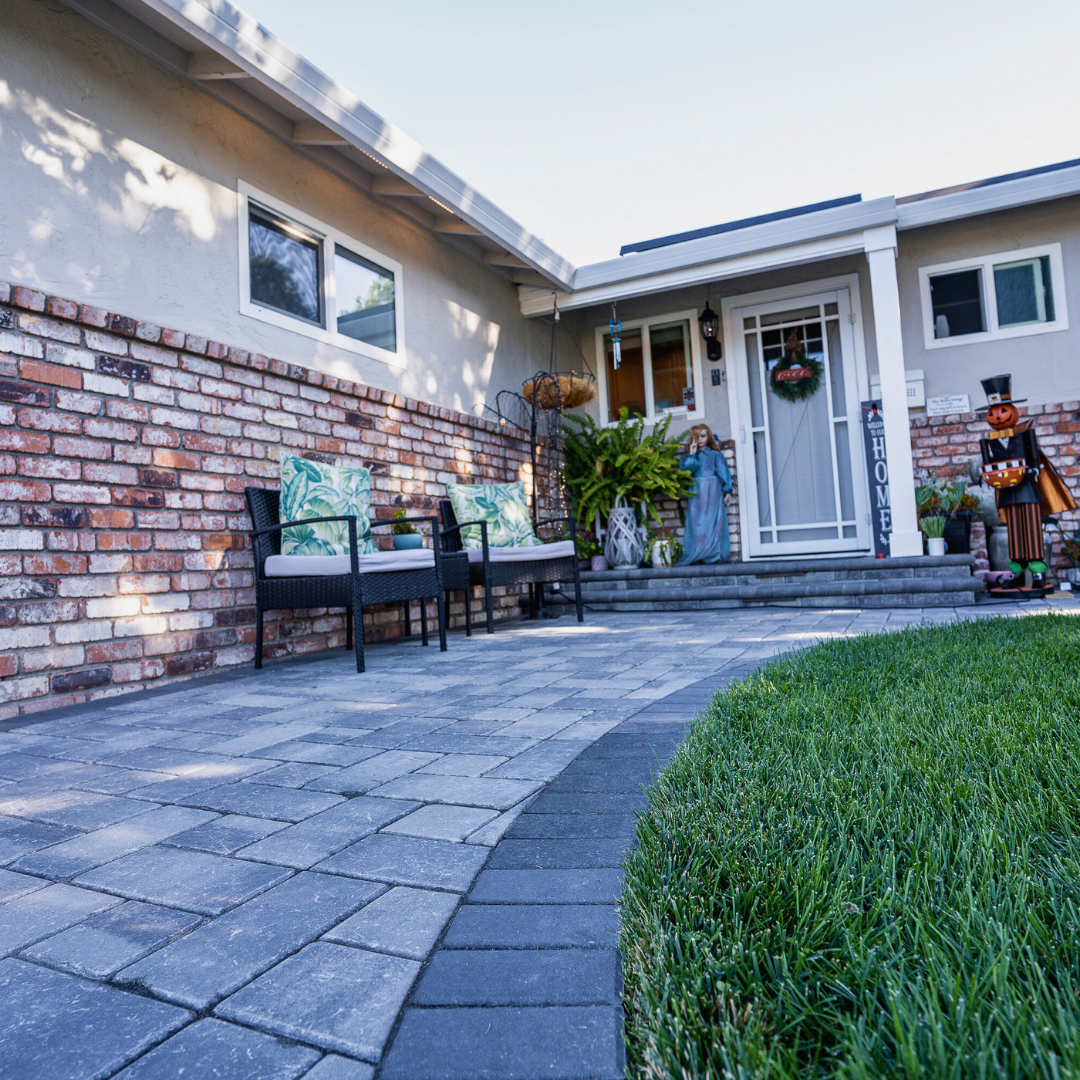
- Driveway Edging and Containment: Concrete pavers and asphalt driveways require solid edge restraints. Installing heavy concrete curbstones along driveway perimeters prevents vehicles from rolling off and chipping the edges while keeping adjoining gravel or turf neatly separated.
- Garden Bed and Mulch Retention: Raised stone curbs prevent bark nuggets and compost from washing onto the lawn during downpours, protecting root zones and saving you cleanup time.
- Tree Rings: Building circular stone curbs around mature trees protects shallow root zones from lawn equipment while giving you a clean, weed-free mulched ring.
- Walkways and Steps: Pairing stone curbs with custom walkways gives paths an upscale, finished appearance. For creative layouts and styling ideas, explore these paver walkway design ideas to see how raised borders elevate outdoor paths.
Linear Footage Calculations and Supplier Sourcing
Accurate material estimation prevents mid-project delays and minimizes leftover inventory.
To calculate your material needs:
- Measure the complete perimeter of the project area using a 100-foot measuring tape or rolling wheel.
- Add an extra 5% to 10% to your total linear footage to account for cutting waste around tight curves and end-run terminations.
- Divide your total adjusted footage by the individual unit length. For example, if you are installing 120 linear feet using 12-inch Pavestone Edgestone units (1.0 ft long each), you will need roughly 126 to 132 units including the waste allowance.
When sourcing materials, compare big-box modular units against specialized hardscape supply yards. Big-box options like the Dalen StoneWall 10-foot faux stone border kit ($89.99 sale price) offer quick, lightweight installations. However, solid concrete and natural quarried blocks provide vastly superior ballast, lifetime durability, and permanent edge restraint.
Frequently Asked Questions About Landscape Edging
How deep should stone curbing be set in the ground?
A reliable rule of thumb is the one-third burial rule: bury at least one-third (and up to one-half) of the stone’s total height below finished grade. For a standard 4-inch-tall edging stone, excavate a trench deep enough for a 2-inch compacted aggregate base and 1.5 inches of embedded stone. Setting stones slightly below the turf level also allows lawn mower wheels to glide over the top without catching the mower blade.
How does stone curbing handle frost heave and weed trimmers?
Dense concrete blocks and natural stone are virtually impervious to weed-whacker cords. While plastic edging quickly nicks, splits, and breaks under high-speed trimmer lines, stone simply deflects the impact. Furthermore, placing stone curbing on an aggregate base allows moisture to drain away, preventing water from pooling and freezing beneath the units—the primary cause of frost heave.
Can stone curbing be retrofitted into existing gardens?
Yes. Stone curbing can be installed along established flower beds and lawns with minimal root disruption. Cut cleanly through the existing sod using a flat spade or powered turf edger along your marked line. Carefully remove the turf ribbon, dig your narrow base trench, compact the aggregate foundation, and lay the stone units without disturbing established root systems nearby.
Conclusion
Choosing durable stone curbing turns an ongoing maintenance chore into a permanent landscape upgrade. By replacing fragile plastic, rubber, or thin metal strips with solid masonry units, you gain reliable weed suppression, clean mowing lines, and beautiful outdoor spaces that last for decades.
At BBP Pavers, we bring over 20 years of Bay Area hardscape expertise to every project, delivering quality installations backed by our safety-first process and 100% satisfaction guarantee. To choose the right materials and profiles for your yard, explore our comprehensive guide to edging stone options for landscaping and reach out to our expert team for a free quote on your next outdoor upgrade!


