Paver Driveway Benicia CA: 7 Rain-Ready Tips for 2026-27

Table of Contents
- Why Rain Matters for a Paver Driveway in Benicia
- How Should You Handle Drainage in Benicia?
- Can a Paver Driveway Benicia CA Homeowners Choose Be Permeable?
- What Should Happen Before Paver Installation?
- Which Pavers Work Best for a Benicia Driveway?
- The Benicia Driveway Problem Many Homeowners Miss
- Where Does a Paver Driveway Make Sense in Benicia?
- A Practical Benicia Driveway Example
- Pavers vs. Concrete for a Benicia Driveway
- How Do You Maintain a Paver Driveway Through the Rainy Season?
- Are paver driveways good for rainy weather in Benicia?
- Can permeable pavers be used for a Benicia driveway?
- Why do paver driveways sometimes sink or become uneven?
- Do pavers handle ground movement better than concrete?
- What affects the cost of a paver driveway in Benicia?
- What should I ask a paver contractor before installation?
Direct Answer: A paver driveway Benicia CA homeowners install before the 2026-27 rainy season should be designed around drainage, stable base preparation, surface grading, and the property’s existing runoff pattern rather than appearance alone.
Why Rain Matters for a Paver Driveway in Benicia
Rain itself is not the biggest threat to a driveway. Poor water management is.
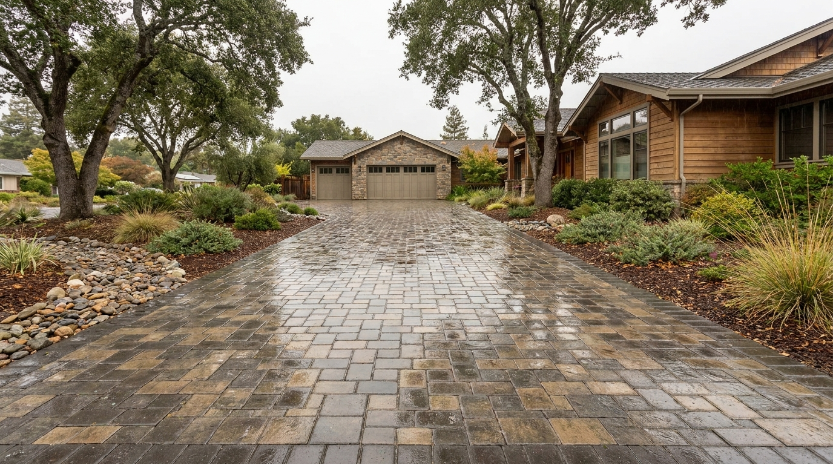
Benicia has a pronounced wet season, so a driveway installed or renovated before winter should be evaluated for how water moves across the property. The issue becomes even more important when an existing concrete or asphalt surface already sends runoff toward a low point, garage entrance, walkway, or landscaped area.
Benicia’s location along the Carquinez Strait makes stormwater planning an important local consideration. When you plan a paver driveway Benicia CA project, the finished surface should work with the property’s existing drainage rather than simply replacing one surface with another.
The most useful question is simple: where will the water go after the driveway is installed?
That question should influence the grading, base preparation, edge restraints, joint material, and overall driveway layout.
If you are ready to discuss your property, contact BBP Pavers to discuss your driveway project before the rainy season becomes the limiting factor.
How Should You Handle Drainage in Benicia?
A successful driveway drainage plan starts with the existing site, not with the pavers.
Before installation, your contractor should understand the property’s elevations, existing drainage points, garage location, landscape areas, and the direction water naturally wants to travel.
For a paver driveway Benicia CA homeowners are planning, this evaluation can influence the finished slope, garage transition, landscape edges, and drainage features throughout the driveway.
Five drainage points to check before installation
- Garage entrance: Water should not collect against the garage threshold.
- Low points: Existing depressions can become collection areas during heavy rain.
- Landscape areas: Properly planned drainage can direct water toward suitable landscaped areas.
- Property edges: Runoff should not simply be redirected toward a neighboring property.
- Existing drainage features: Their location should be considered when establishing the finished driveway grade.
Can a Paver Driveway Benicia CA Homeowners Choose Be Permeable?
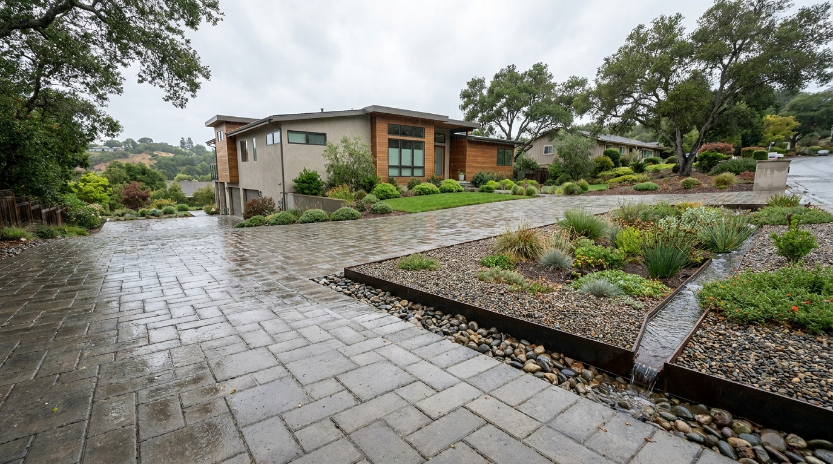
Permeable paving can be useful when the property and design support it, but it is not automatically the right solution for every driveway.
Benicia’s municipal guidance identifies pervious pavement as one possible low-impact development strategy. Local regulations also recognize permeable paving materials for applicable vehicle parking surfaces.
That does not mean every driveway should use a permeable system. Soil conditions, drainage design, available space, slope, existing utilities, and project requirements all matter.
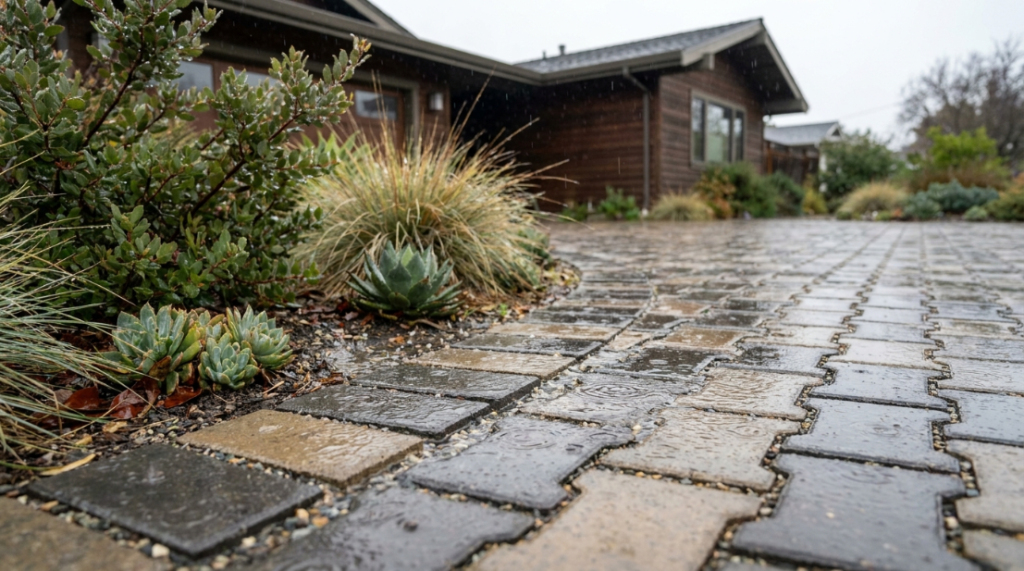
The key distinction is straightforward. Standard pavers manage water primarily through surface grading and drainage design. Permeable systems are designed to allow water to move through the pavement structure.
If your property may benefit from permeable paving, the system should be selected after evaluating the actual site rather than choosing it only because it sounds better for rain.
What Should Happen Before Paver Installation?
The most important part of a driveway is often underneath the pavers.
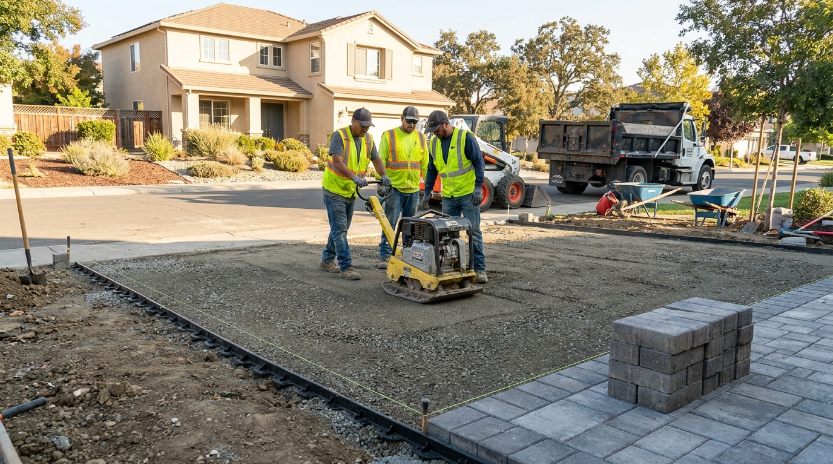
A professional installation typically begins by evaluating the existing surface and removing unsuitable material. The installation area then needs proper excavation, grading, base preparation, compaction, edge restraint, paver placement, and joint treatment.
For your paver driveway Benicia CA project, each layer should have a clear purpose. If the base is weak or drainage is poorly planned, attractive pavers can still become uneven later.
A practical installation sequence
- Site evaluation: Review grades, drainage, access, existing surfaces, and project boundaries.
- Removal and excavation: Remove unsuitable existing material and prepare the required depth.
- Subgrade preparation: Address soft or unstable areas before installing the structural base.
- Base installation: Place and compact the appropriate base material in controlled stages.
- Edge restraint: Secure the perimeter so the pavers remain properly aligned.
- Paver installation: Set the pavers according to the approved pattern and design.
- Joint finishing: Fill joints and compact the finished surface appropriately.
- Final drainage check: Confirm that finished grades direct water as intended.
BBP Pavers provides driveway paver installation and custom hardscape design services throughout the Bay Area. You can review the company’s driveway paver services to see how the service fits into your project planning.
Which Pavers Work Best for a Benicia Driveway?
The best driveway paver depends on vehicle use, structural requirements, drainage design, maintenance expectations, and the appearance of your home.
- Concrete pavers: A practical option for many residential driveways, with a wide range of shapes, colors, and patterns.
- Permeable pavers: Useful when the site supports a permeable pavement system and stormwater management is part of the design.
- Clay or brick-style pavers: Can provide a traditional appearance when the complete driveway system is designed for vehicle traffic.
- Natural stone: Can create a distinctive appearance, but the material and installation details need to match driveway conditions.
Do not choose a material based only on a showroom sample. The paver needs to work as part of the complete pavement system.
The Benicia Driveway Problem Many Homeowners Miss
The problem many homeowners discover too late is that the driveway was treated as an isolated feature instead of part of the property’s drainage system.
You can install excellent pavers and still have standing water if the underlying grade, transitions, or drainage strategy are wrong.
- Water collecting near the garage.
- Existing driveway areas remaining wet after surrounding areas have dried.
- Low sections where water naturally collects.
- Downspouts discharging directly onto the proposed driveway.
- Runoff moving toward a neighboring property.
- Existing pavers settling in isolated sections.
Before approving a design, ask your contractor one practical question: Where does the water go during a heavy winter rain?
A good answer should refer to actual grades and drainage features on your property, not just the paver product itself.
Where Does a Paver Driveway Make Sense in Benicia?
A paver driveway can make sense anywhere in Benicia where the property’s access, grading, and structural requirements support a properly installed pavement system.
That includes established residential areas where an aging driveway has become cracked or uneven, properties where the front entrance needs a coordinated driveway and walkway design, and homes where drainage improvements need to be considered as part of a larger hardscape renovation.
For example, a driveway renovation near central Benicia may need to respect an established walkway and landscape layout, while a property in the Southampton area may have different driveway geometry, slopes, or landscaping constraints.
The local context should influence the design, but the individual property should always determine the final installation approach.
There are also situations where pavers may not be the immediate answer. If the underlying drainage problem has not been identified, replacing the surface first can simply hide the real issue temporarily.
If your project includes a patio or outdoor living area, you can also explore BBP Pavers patio installations to coordinate the materials and transitions across your property.
A Practical Benicia Driveway Example
Consider a hypothetical Benicia homeowner with an older concrete driveway, a garage located at the top of a short approach, and a low landscape area along one side of the driveway.
The homeowner wants to replace the existing surface before the next rainy season. The obvious solution would be to remove the concrete and install new pavers using the same basic layout.
That is not necessarily the best approach.
A better design review would first examine the existing slope, identify where water currently travels, evaluate the garage transition, and determine whether the landscape area can play a useful role in the drainage plan.
The driveway could then be designed around those conditions instead of forcing the property into a generic installation template.
That distinction matters. A driveway should solve the problems of the property rather than simply cover them.
Pavers vs. Concrete for a Benicia Driveway
Both pavers and concrete can be suitable driveway surfaces. The better option depends on what you want the driveway to accomplish and how the property is likely to behave over time.
| Factor | Paver Driveway | Concrete Driveway |
|---|---|---|
| Design flexibility | High flexibility in patterns, shapes, and layouts | More dependent on slab design and finish options |
| Ground movement | Individual units can accommodate some movement within the pavement system | Movement can contribute to slab cracking |
| Localized repairs | Individual pavers can be removed and reset when appropriate | Repairs may involve patching or replacing larger sections |
| Drainage options | Can be designed as a permeable system where appropriate | Typically relies on grading and conventional drainage |
| Maintenance | Requires attention to joints, cleaning, and occasional resetting | Requires monitoring for cracking, staining, and surface deterioration |
Neither material eliminates the need for proper site preparation. The foundation and drainage strategy remain critical regardless of the surface you choose.
How Do You Maintain a Paver Driveway Through the Rainy Season?
Rainy-season maintenance starts with keeping drainage areas clear.
- Remove leaves and debris from drainage areas.
- Keep nearby landscape drains and inlets clear.
- Watch for new areas of standing water after heavy rain.
- Inspect paver joints for areas where material has washed out.
- Look for pavers that have become noticeably uneven.
- Check whether downspouts are directing concentrated water onto the driveway.
If you notice a new low spot, do not simply add joint material or place another paver on top. The underlying cause should be identified first.
Small changes in grade, base conditions, or drainage can create recurring problems if they are treated only at the surface.
Are paver driveways good for rainy weather in Benicia?
Yes, a properly designed and installed paver driveway can perform well during rainy weather in Benicia. Performance depends heavily on grading, base preparation, drainage, edge restraint, and joint construction. The paver itself is only one part of the complete driveway system.
Can permeable pavers be used for a Benicia driveway?
Permeable pavers can be appropriate for some Benicia properties. The city identifies pervious pavement as a possible low-impact development strategy and recognizes permeable paving materials in applicable vehicle parking regulations. The correct system still depends on site conditions, soil, drainage design, project scope, and applicable requirements.
Why do paver driveways sometimes sink or become uneven?
Uneven pavers can result from problems beneath the visible surface. Inadequate base preparation, poor compaction, drainage issues, unsuitable subgrade material, or localized ground movement can contribute to settlement. The correct repair depends on identifying the underlying cause rather than simply leveling the visible pavers.
Do pavers handle ground movement better than concrete?
Pavers can accommodate certain types of movement differently because the surface consists of individual units rather than one continuous slab. That does not mean pavers cannot settle or move. Proper excavation, base preparation, compaction, edge restraint, and drainage are still essential for long-term performance.
What affects the cost of a paver driveway in Benicia?
The main factors include driveway size, existing surface removal, excavation requirements, site access, base preparation, drainage work, paver selection, design complexity, edging, and site-specific grading conditions. A reliable contractor should evaluate the actual property rather than relying on a generic price based only on square footage.
What should I ask a paver contractor before installation?
Ask how the contractor will handle drainage, what preparation is required beneath the pavers, how the finished grade will be established, what happens if unsuitable soil is discovered, and how the driveway will transition into the garage, sidewalk, and landscape areas.
You should also ask who will be responsible for identifying applicable permitting or stormwater requirements for the project.
Ready to Plan Your Benicia Paver Driveway?
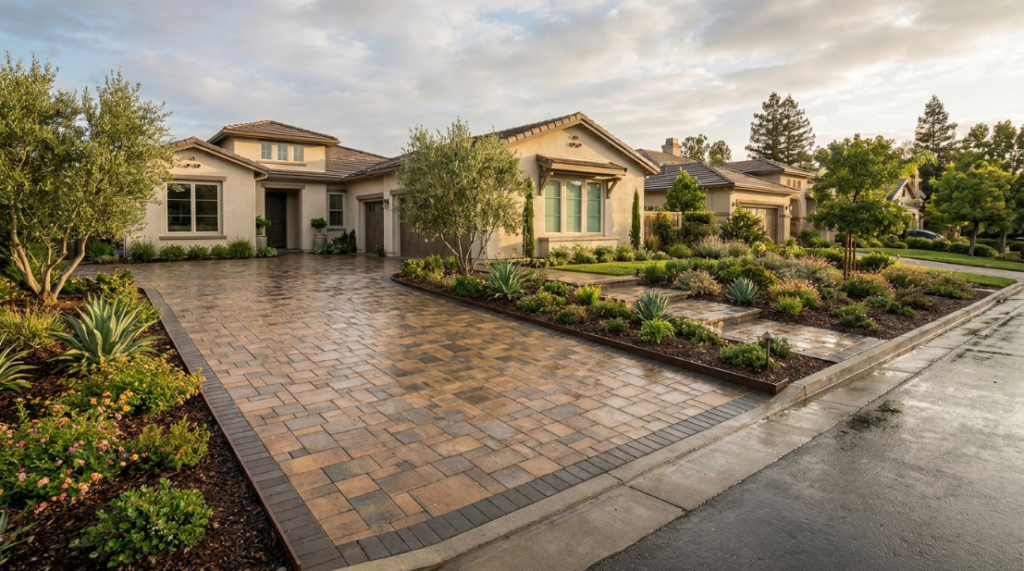
A successful paver driveway Benicia CA project starts before the first paver is installed. The most important decisions involve site preparation, drainage, grading, material selection, and how the new driveway connects with the rest of your property.
BBP Pavers serves Benicia and communities throughout the Bay Area, with driveway, patio, walkway, and hardscape installation services. The company provides consultations and custom design services to help homeowners plan outdoor projects.
If you are considering a driveway renovation before the 2026-27 rainy season, contact BBP Pavers to discuss your property and project goals.
You can also explore the company’s Bay Area service areas to see the communities BBP Pavers serves throughout the region.
BBP Pavers also maintains an official Yelp business profile where you can review the company’s local presence and customer feedback.
For another verified business profile, you can visit the company’s Yahoo Local listing.