
Why Retaining Walls Fail After the First Big Storm

Table of Contents
- Why Does a Wall Look Fine Until It Rains?
- What Actually Happens Behind a Retaining Wall When It Rains?
- Why Is the First Big Storm the Real Test?
- The Problem Nobody Mentions: Drainage Fails Where You Cannot See It
- What Does Good Retaining Wall Drainage Include?
- Is It a Drainage Problem or a Structural Problem?
- Do You Need a Permit or an Engineer for a Retaining Wall in California?
- When a Drainage Fix Makes Sense, and When It Does Not
- A Typical Scenario From a Bay Area Backyard
- Frequently Asked Questions
- Does every retaining wall need drainage?
- What happens if a retaining wall has no drainage?
- Are weep holes enough, or do I need a perforated drain pipe?
- How often should I check the drainage behind my retaining wall?
- What affects the cost of fixing retaining wall drainage?
- What should I ask a contractor before fixing or building a retaining wall?
- Final Thoughts
Direct Answer: Most retaining walls that fail after the first big storm fail because of poor retaining wall drainage: water collects in the soil behind the wall, adds weight and hydrostatic pressure, and pushes until the wall leans, bulges, cracks, or collapses.
Why Does a Wall Look Fine Until It Rains?
A retaining wall can look perfect for months. Then the first real storm of the season rolls through. By morning the cap is tilted, or a crack runs across the middle course. You did not see it coming, because the problem was never on the face of the wall. It was behind it.
Homeowners hear a lot of overlapping terms: weep holes, drain rock, French drain, filter fabric. Some people even say “the wall should drain itself.” Part of that is right, and part of it gets mixed up.
In this guide, we cover three things. First, what water does behind a wall during a storm. Second, what working retaining wall drainage actually includes. Third, how to tell a drainage problem from a structural one that needs an engineer.
Is your wall already moving? You do not need to finish reading first. Reach out to our team and we can talk through what you are seeing.
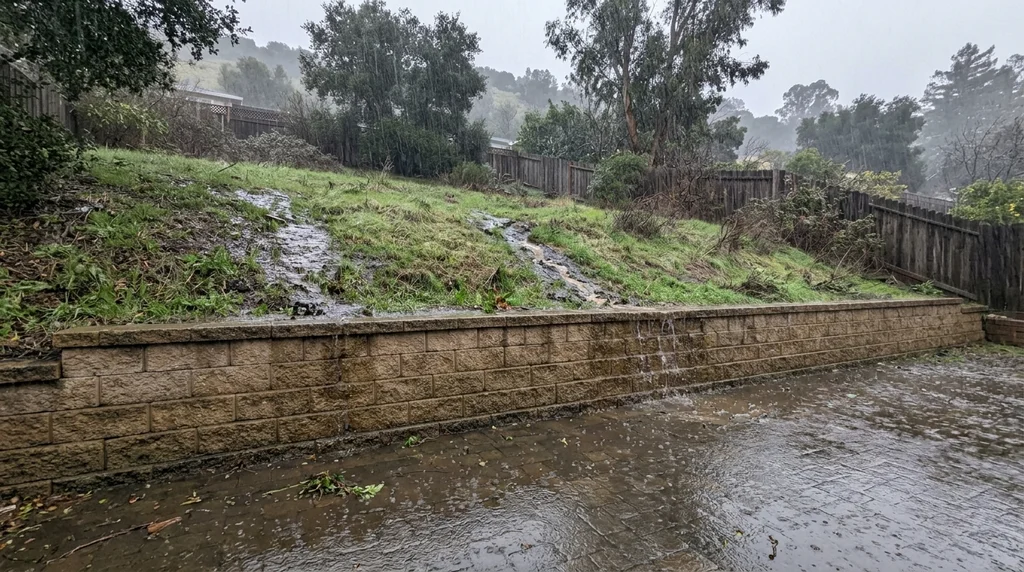
What Actually Happens Behind a Retaining Wall When It Rains?
When it rains, water soaks into the soil behind a retaining wall. If that water has no way out, the wall must hold back soil and water at the same time. Engineers call the extra push from trapped water hydrostatic pressure.
Saturated soil is also heavier than dry soil. It behaves less like a solid and more like a thick liquid. That is why poor retaining wall drainage is so often named as the leading cause of failure. Iowa State University researchers describe poor drainage as by far the most common reason retaining structures perform badly.
The failure is not always instant. A wall under constant water pressure can bow or lean slowly. Then it lets go after a later storm. That slow, quiet stage is your best chance to catch it.
Why Is the First Big Storm the Real Test?
The first big storm is the first time all season that enough water reaches the wall to test its retaining wall drainage. During a dry Bay Area summer and fall, a clogged pipe causes no symptoms. Nothing is flowing, so nothing backs up.
Then the rainy season starts. Dry soil takes in water, and back-to-back storms keep it saturated. Bay Area news coverage shows the pattern. In February 2025, San Francisco Public Works reported a storm-driven slide that broke through a retaining wall on Telegraph Hill.
Hillside streets in Orinda, Lafayette, and Moraga face the same risk. Runoff from the slopes above flows straight toward backyard walls.
So a wall that “survived last year” does not prove its retaining wall drainage works. Last year may have been drier. The pipe may have silted up since. The storm does not create the weakness. It reveals it.
The Problem Nobody Mentions: Drainage Fails Where You Cannot See It
The honest truth about retaining wall drainage is that it is buried. Buried systems fail silently. You can inspect the face of a wall in seconds. You cannot see whether the gravel behind it has filled with silt.
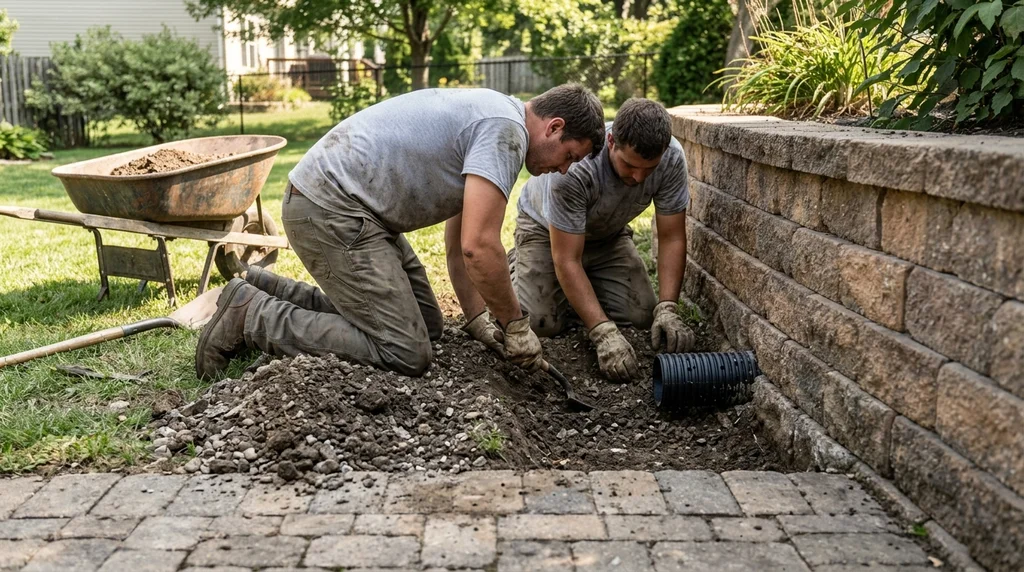
We regularly find the same hidden causes when we open up a struggling wall:
- No filter fabric between native soil and drain rock, so fine soil slowly clogs the gravel.
- Native clay used as backfill, which holds water right against the wall.
- A perforated pipe with no real exit, or an outlet buried by later landscaping.
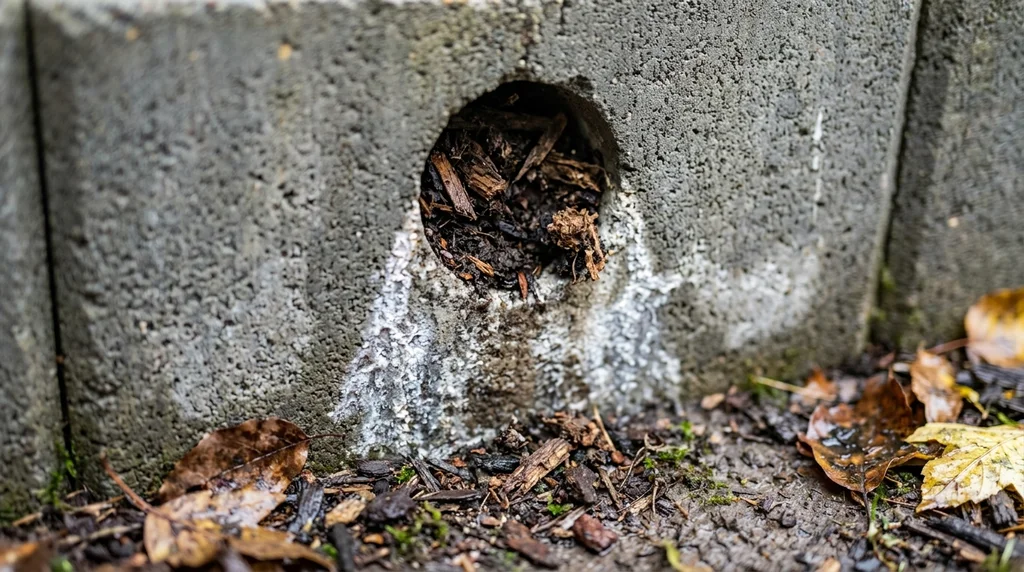
- Weep holes plugged with soil, roots, or mulch.
- Downspouts or a sloped patio sending water straight toward the top of the wall.
Protecting your retaining wall drainage starts with the visible pieces. Keep weep holes and pipe outlets clear. Point downspouts away from the wall. Grade the surface above so water moves away instead of pooling. The buried parts need a professional to evaluate.
Before you hire anyone, ask one question: “Where does the water behind this wall go, and can you show me the outlet?” A contractor who cannot answer clearly has not planned the drainage.
What Does Good Retaining Wall Drainage Include?
Good retaining wall drainage is a system of parts that work together. It collects water behind the wall and carries it somewhere safe. No single part does the job alone.
The Six Parts of a Working System
Here are the components you should expect to hear about, plus the mistake we see most often with each:
- Free-draining backfill (drain rock): clean gravel right behind the wall, so water drops down instead of pressing on the blocks. Common mistake: reusing excavated clay because it was already on site.
- Filter fabric (geotextile): a permeable fabric between native soil and drain rock. Common mistake: skipping it, so the gravel slowly clogs.
- Perforated drain pipe: a pipe at the base that collects water and carries it out. Common mistake: laying it flat, or never connecting it to an outlet.
- Weep holes, where the wall type uses them: openings near the base of solid walls. Common mistake: treating them as the whole system.
- Surface grading: shaping the ground above so water moves away. Common mistake: a new patio that slopes toward the wall.
- A free outlet: a safe exit for the collected water. Common mistake: dumping water onto a neighbor’s yard.
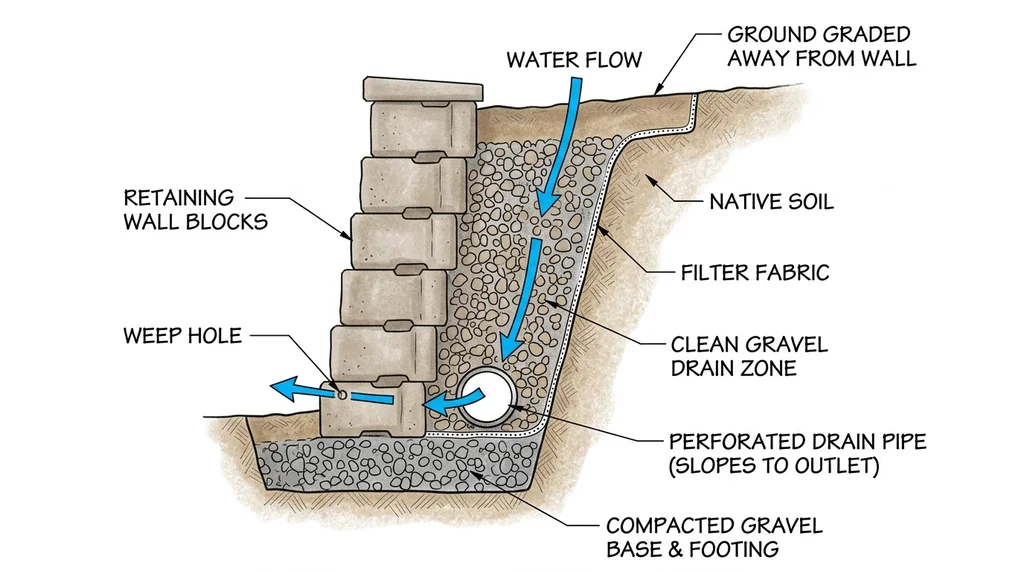
What Happens When Each Part Fails
Gravel depth, pipe size, and slope depend on the wall height, the soil, and the site. That is a design decision, not a rule of thumb. It is also why our retaining wall service starts with a site visit.
| Component | What it does | What happens when it is missing or clogged |
|---|---|---|
| Drain rock backfill | Gives water a fast path down | Water stays in the soil and presses on the wall |
| Filter fabric | Keeps fine soil out of the gravel | Gravel silts up over the years |
| Perforated pipe | Carries water out from the base | Water builds up at the footing |
| Weep holes | Relieve water through the wall face | Stay dry after rain while pressure builds |
| Surface grading | Sends runoff away before it soaks in | The slope funnels storm water to the wall |
| Free outlet | Releases collected water safely | The whole system backs up |
Is It a Drainage Problem or a Structural Problem?
A wall can fail for reasons that have nothing to do with water. Never assume better retaining wall drainage will solve every symptom. Water is the most common cause, but it is not the only one.
A weak footing or poor compaction can do it. So can a wall too tall for its design, or tree roots. Extra weight on top matters too, such as a driveway, a shed, or another wall.
Here are the warning signs worth watching after a storm:
- Weep holes that stay dry after heavy rain
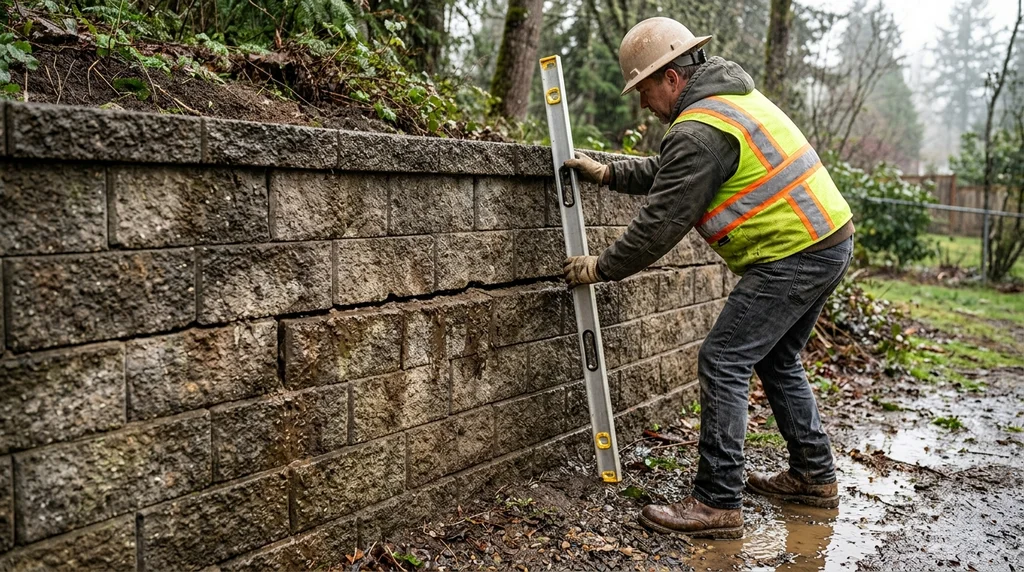
- A horizontal crack across the middle of the wall
- Bulging, leaning, or the top tilting outward
- Blocks shifting or separating at the joints
- Soil sinking just behind the top of the wall
- White mineral staining on the face
Safety alert: if your wall is leaning, bulging, cracked open, or losing soil, do not repair it yourself. Keep people and pets away from the base. Do not park or pile anything on top. Call a professional or a structural engineer, because a stressed wall can fail without warning.
Not sure which side of the line your wall is on? Our team can take a look and tell you honestly what it needs.
Do You Need a Permit or an Engineer for a Retaining Wall in California?
You may need a permit, and possibly an engineer, depending on height and load. The 2025 California Residential Code exempts walls up to 4 feet tall. That height is measured from the bottom of the footing to the top of the wall.
The exemption disappears if the wall supports a surcharge, such as a slope, driveway, or structure above it. Cities and counties can also set stricter rules, especially in hillside areas.
Before any work starts, ask your city or county building department whether your wall height and soil conditions need a permit or an engineer. Ask where drainage water is allowed to discharge, too.
When a Drainage Fix Makes Sense, and When It Does Not
A retaining wall drainage upgrade makes the most sense when the wall is still plumb and the trouble is clearly water. Think of a low garden wall in Concord with a downspout aimed at it. Or picture a terraced planter in Walnut Creek where mulch has buried the weep holes. Both are often fixable without rebuilding.
It is usually not just a drainage job when:
- The wall is tall or holds back a steep slope, as on many lots in Orinda and Moraga
- The wall is already leaning, bulging, or cracked through
- Soil above the wall is unstable or has moved before
- A driveway, pool, building, or second wall sits above it
- The wall is close to a foundation, a property line, or a public road
In those cases, get an engineering evaluation first. Sometimes the honest answer is a rebuild, not a patch. Good drainage protects a sound wall. It cannot rescue one that was built too weak to stand.
A Typical Scenario From a Bay Area Backyard
This is a hypothetical example, not a specific client. Picture a homeowner in Lafayette with a block wall behind a patio. The wall looked fine all summer. After the first heavy storm, the patio flooded and a small crack appeared on the bottom course.
On a visit like this, we would check the weep holes and look for the pipe outlet. A common finding is an outlet buried under a planter added years later. Water from the slope had nowhere to go.
Because the wall itself was still plumb, the fix would be simple in scope. Restore the outlet, clear the drainage path, and regrade the patio edge.
The lesson is clear. The storm did not break that wall. A small landscaping change quietly shut off its retaining wall drainage.
Want to see what homeowners say about working with us? Read our reviews on our Yelp page and our BBB profile. You can also browse recent projects on BBP Pavers’ Instagram.
Frequently Asked Questions
Does every retaining wall need drainage?
Almost every retaining wall that holds back soil benefits from drainage. Any wall that traps water behind it carries extra pressure during storms. Low garden edging carries far less risk than a wall on a slope. Still, even short walls last longer when water has a way out. A professional can tell you what level of retaining wall drainage your site needs.
What happens if a retaining wall has no drainage?
A retaining wall with no drainage lets water build up in the soil behind it. Every rain adds weight and hydrostatic pressure. Over time, that pressure can cause bowing, leaning, horizontal cracks, or blocks pushing out. Some walls deform slowly for years and then fail in a heavy storm. A wall that is already moving needs a professional evaluation first.
Are weep holes enough, or do I need a perforated drain pipe?
Weep holes alone are often not enough, because they clog easily with soil and roots. A perforated drain pipe in a gravel zone collects water along the full length of the wall. It then carries that water to an outlet. Many walls use both, plus filter fabric to keep the gravel clean. The right mix depends on wall type, height, and soil.
How often should I check the drainage behind my retaining wall?
Check your retaining wall before the rainy season and again after the first big storm. Make sure weep holes and pipe outlets are open. Confirm that downspouts point away from the wall. Look for new planters or mulch blocking the drainage path. Any new crack, lean, or bulge means you should call a professional.
What affects the cost of fixing retaining wall drainage?
The cost of fixing retaining wall drainage depends mostly on how much of the wall must be opened up. Wall height and length change the scope. So do equipment access, soil type, and the distance to a safe outlet. Permits or an engineer can add steps as well. A site visit is the only reliable way to define the work.
What should I ask a contractor before fixing or building a retaining wall?
Ask how the contractor plans the drainage and exactly where the water will exit. Ask what backfill material and filter fabric they use. Ask whether your wall needs a permit or an engineer. Ask how they compact the base, since compaction matters as much as drainage. Finally, ask what maintenance will keep the drainage working.
Final Thoughts
A retaining wall rarely fails out of nowhere. Most of the time, the storm simply exposes water with nowhere to go. Sometimes it exposes a wall asked to hold more than it was built for. Knowing the warning signs puts you ahead of the next big rain.
Want a clear answer before the rainy season gets serious? Contact BBP Pavers or call us at +1 844-497-3321. You can also browse our frequently asked questions. We serve homeowners across Concord and the wider Bay Area. We will tell you honestly whether your wall needs better retaining wall drainage or a deeper look.