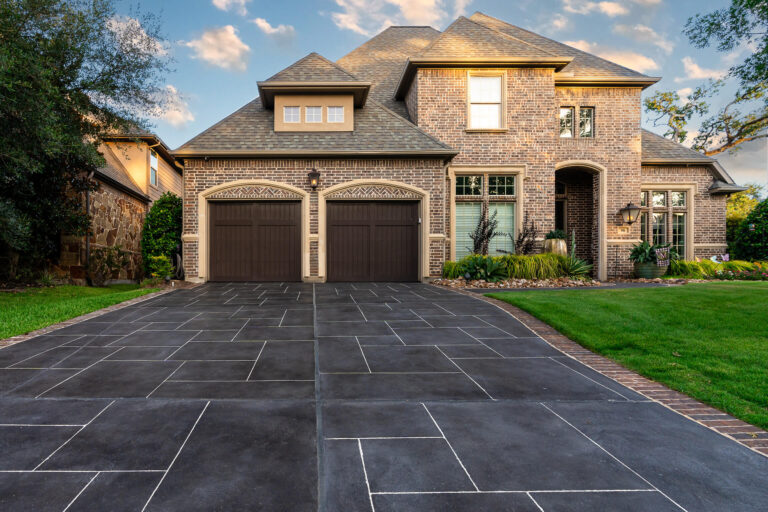
Standing Water After Rain? Driveway Drainage Solutions Start With the Real Cause

Table of Contents
- Why the Cause Matters More Than the Product
- Why Does Water Pool on My Driveway?
- How Do I Figure Out Where the Water Is Coming From?
- Causes, Signs, and Typical Fixes at a Glance
- The Problem Nobody Mentions: Sometimes It Isn’t Drainage at All
- Driveway Drainage Solutions Matched to the Cause
- When Pavers Shouldn’t Be the First Step
- A Typical Scenario: The Puddle in Front of the Garage
- How We Approach Standing Water at BBP Pavers
- Frequently Asked Questions
- Is a French drain or a trench drain better for a driveway?
- Can I put new pavers over a driveway that already floods?
- How often should I check my driveway drainage?
- Why do pavers sink after heavy rain?
- What affects the scope of fixing standing water on a driveway?
- What should I ask a contractor before fixing driveway drainage?
- Find the Cause First, Then Choose the Fix
Direct Answer: The right driveway drainage solutions depend on where the water comes from: fix slope or sunken pavers when the surface is the problem, redirect downspouts when it’s the roof, and bring in a drainage specialist when water arrives from uphill, a neighbor, or below ground.
Why the Cause Matters More Than the Product
You walk outside after the first real storm of the season. There it is: a puddle parked in front of the garage door. So most people start shopping right away. French drain, trench drain, channel drain, slot drain, ACO drain, permeable pavers. However, the names blur together fast.
Here’s what working on East Bay driveways has taught us. Driveway drainage solutions only work when they match the cause. A trench drain won’t fix a paver section that sank. Similarly, regrading won’t stop water pouring in from the lot next door. Same puddle, completely different jobs.
This guide covers three things. First, how to read the water on your driveway during the next rain. Second, which fix usually matches each cause. Third, when the job belongs to a drainage specialist instead of a paver crew. Prefer an in-person look? Then you can request an on-site visit from our team.
Why Does Water Pool on My Driveway?
Water pools on a driveway when the surface can’t shed it fast enough. It also pools when more water arrives than the surface was built to handle. The usual reasons fit on one hand. Either the slope is wrong, or part of the surface has sunk. Also, the roof or a higher lot may send water your way. Otherwise, the ground underneath may already be saturated.
The tricky part is that different problems look identical from your front window. A settled paver section and uphill runoff both create “standing water.” Still, their fixes have almost nothing in common. That’s why picking driveway drainage solutions before you know the source can waste a whole season.
Timing matters in the Bay Area too. The rainy season usually runs from about November through March. So the first fall storms are your best chance to watch the problem happen. After all, guessing about it in July is much harder.
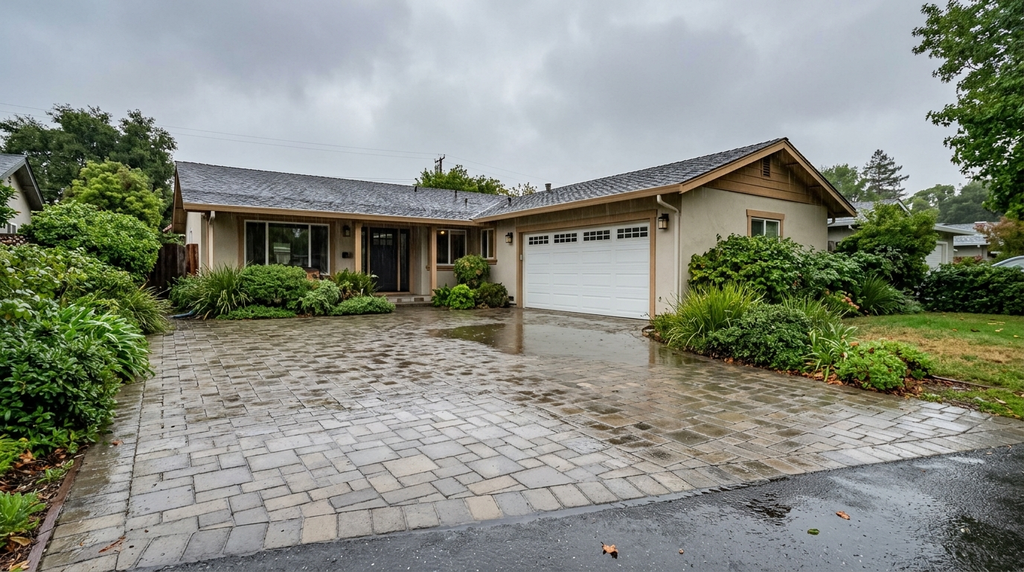
How Do I Figure Out Where the Water Is Coming From?
The fastest way to find the cause is to watch the water move. Go outside during or right after a steady rain. Then take photos and short videos, and note the time. A ten minute rain check beats an hour of reading about driveway drainage solutions online.
The Seven Questions to Answer During a Rain Check
- Where does the puddle form? Against the garage, in the middle, along one edge, or at the street end.
- Which way does the water run before it stops? Water moving toward the house or garage is a red flag.
- Is a downspout emptying onto the driveway? Check every roof corner near the paving.
- Is water coming in from somewhere higher? Look at slopes, a neighbor’s yard, planter beds, and the street.
- Does the low spot have a defined shape? Clear edges or tire grooves usually mean the surface moved.
- Are the joints between pavers full or empty? Run a finger along them. As a result, washed-out joints let water reach the layers underneath.
- How long does the water stay after the rain stops? Write it down. A puddle gone by evening tells a different story than one still there two days later.
Rule Out Sprinklers and Check for Safety Risks
Don’t forget the sprinklers. Then run your irrigation on a dry day and watch the driveway edges. Overspray can keep one corner of a driveway wet all summer. In fact, it’s one of the easiest driveway drainage problems to rule out.
Safety first: some standing water needs a professional right away. Watch for water against your foundation, flowing into the garage, or reaching outlets and electrical panels. Stop diagnosing on your own if you see any of these. Otherwise, they can damage the structure or create a shock hazard.
Causes, Signs, and Typical Fixes at a Glance
The table below links what you saw during your rain check to the most likely cause. It also shows the driveway drainage solutions that usually follow. Treat it as a starting point, not a final diagnosis. After all, many driveways have two causes at once.
Cause-by-Cause Reference Table
| Probable cause | What you see | Typical solution | When to call a specialist |
|---|---|---|---|
| Surface pitched wrong or laid too flat | Water spreads in a sheet and stops, or runs toward the garage | Re-pitching the paved surface and the base | If the whole lot slopes toward the house |
| Sunken or settled pavers | A dip with a clear outline, tire grooves, rocking pavers | Lifting the section, recompacting the base, resetting the pavers | If the base keeps washing out after a repair |
| Roof runoff | Puddle under a roof corner, heaviest flow below a downspout | Extending or redirecting the downspout | If there’s no safe or permitted place for the water |
| Runoff from higher ground | Water flows in from a slope, a neighbor’s yard, or the street | Intercepting the water before it reaches the driveway | Almost always, since this is drainage design work |
| Empty or washed-out joints | Missing sand, weeds, ant hills, water vanishing into joints | Refilling the joints, often with polymeric sand on standard pavers | If joints keep emptying, which can mean a base problem |
| Irrigation | Wet edges on dry days, spray hitting the paving | Adjusting sprinkler heads, timing, and spray patterns | Rarely needed |
| Saturated ground or water from below | Water lingers for days and nearby soil stays soggy | Subsurface drainage designed for the site | Always, before any paving work is planned |
Notice that only three of the seven rows are fixed by working on the pavers. That’s the honest picture, though. So the best driveway drainage solutions often start with a downspout or a drainage pro, not a new surface.
The Problem Nobody Mentions: Sometimes It Isn’t Drainage at All
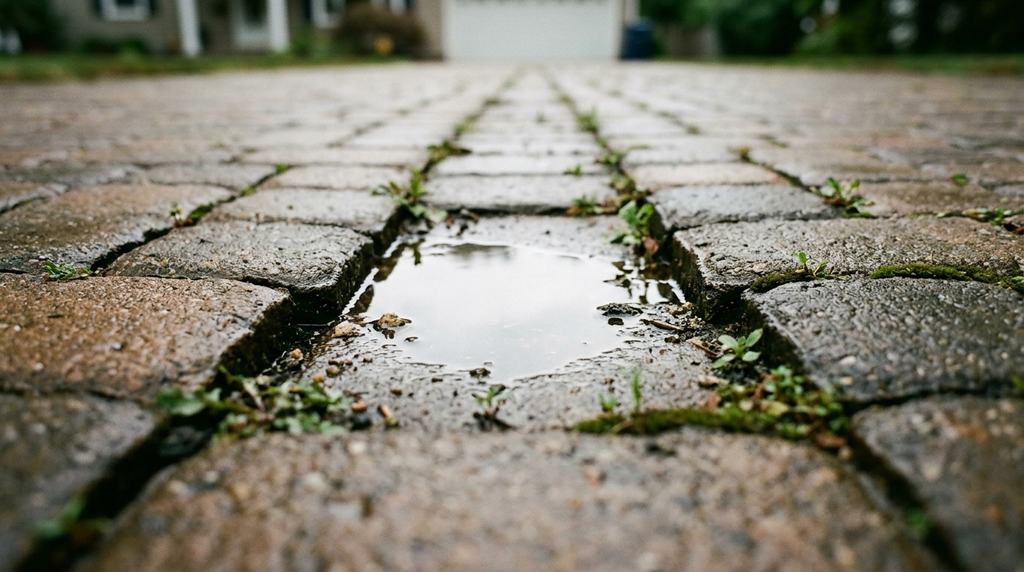
A lot of standing water on paver driveways is really an installation problem. That’s because pavers are a flexible system that follows whatever sits underneath them. When the base was too thin or poorly compacted, the surface slowly settles. Those low spots then collect water.
Cars make it worse. In particular, vehicle weight presses pavers down into weak areas of the base. That’s why grooves often appear exactly where the tires track. Once a dip holds water, the base softens further and bedding sand washes away. As a result, the dip gets deeper with every storm.
So the first question isn’t “which drain should I buy?” It’s “did the surface move?” If it did, a drain next to the sunken section only treats the symptom. In other words, no driveway drainage solution on the market fixes a failed base.
How to Tell If Your Pavers Settled
- Find the edge of the dip. Lay a long straight board across the low spot after rain. Then a sag with defined edges points to settlement.
- Check the edge restraint. Pavers spreading at the borders let the whole field shift and open the joints.
- Look closely at the joints. Empty joints let pavers move and let water into the base.
- Repair from the bottom up. A lasting fix lifts the pavers, rebuilds the base, and resets the same units. Instead, adding sand on top only hides the dip.
- Stop the water feeding the spot. If a downspout keeps soaking that area, even a good repair won’t last.
Before you approve any repair, ask the contractor one question. “What caused this section to sink, and how will the new base prevent it?” A clear, specific answer is a good sign. However, a vague one is your cue to keep looking.
Driveway Drainage Solutions Matched to the Cause
The right fix follows the source of the water. First, surface problems get surface fixes. Second, roof water gets redirected. Finally, water from outside the driveway gets intercepted before it reaches the paving. Here’s how the common driveway drainage solutions line up, with the mistake we see most for each.
Surface and Roof Water Fixes
- Re-pitching the surface. Best for driveways laid too flat or sloped toward the garage. Also, both the pavers and the base need the correct fall. Common mistake: thickening the sand layer to fake a slope. However, bedding sand only gives pavers an even seat.
- Lift-and-reset of a sunken section. Best for dips with clear edges and tire grooves. Common mistake: topping up the joints and calling it done.
- Downspout redirection. Best for puddles directly below a roof corner. This is one of the simplest driveway drainage solutions, and it often helps more than expected. Common mistake: sending the water back across the driveway or toward a neighbor.
- Joint restoration. Best for standard pavers with empty, weedy joints. It’s one of the least disruptive driveway drainage solutions on this list. Also, polymeric sand helps lock joints on conventional pavers. Common mistake: using it on permeable pavers, whose joints hold open-graded stone so water can pass.
Drainage Systems That Usually Need a Specialist
Who Handles Which Part of the Job
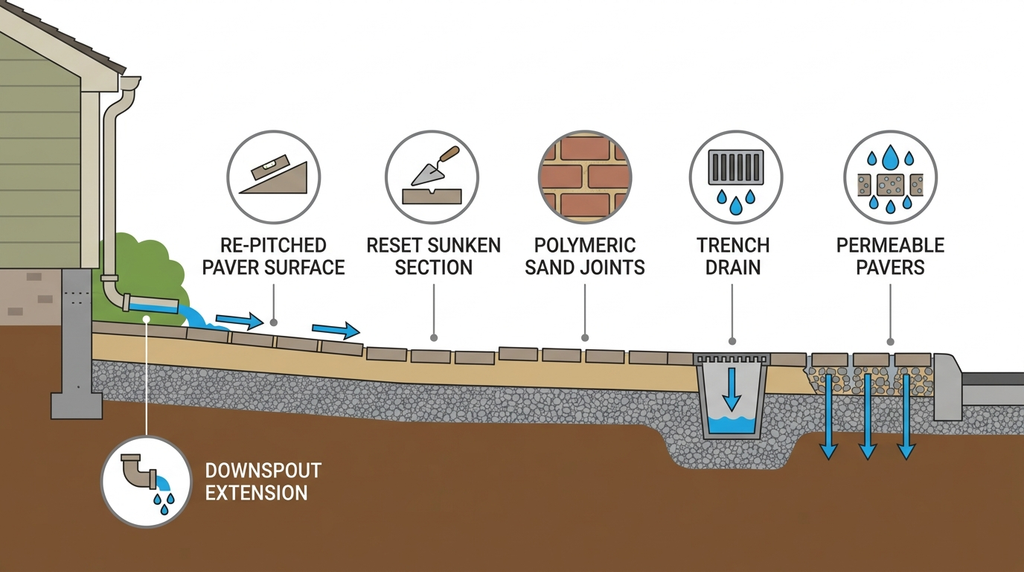
Our crews handle the paving side: slope, base, compaction, paver selection, and joints. However, subsurface drainage systems are their own specialty. When a driveway needs one, we’ll say so. We’ll recommend bringing a drainage professional in before the paver work is planned.
Homeowners ask us most about French drains and permeable pavers. Still, they solve different problems. A French drain collects water in a gravel trench and pipes it elsewhere. Meanwhile, permeable pavers let rain pass through the surface into a stone base. Our guide on French drains vs. permeable pavers compares how each one performs on a flooded East Bay driveway.
Whatever you choose, check the rules before you pick an outlet for the water. Specifically, look at your city or county requirements and your neighbor’s property line.
Not sure which row of the table fits your driveway? Reach out through our contact page and tell us what you saw. We’ll tell you if it’s a paving issue we can handle or a drainage job.
When Pavers Shouldn’t Be the First Step
Pavers are the right starting point when the problem lives in the paved surface. When water comes from somewhere else, new pavers just give it a nicer place to sit. Choosing driveway drainage solutions in the right order saves you from paving twice.
Talk to a drainage specialist or civil engineer first if:
- Your driveway sits below a hillside, like a steep lot in Orinda or Lafayette, and runoff pours across it.
- Water stays for days and the ground stays soggy, which can mean saturated soil or high groundwater.
- The water clearly comes from a neighbor’s property or the street.
- Water is reaching your foundation, crawlspace, or garage slab.
- You’re considering permeable pavers on clay soil or right next to the house.
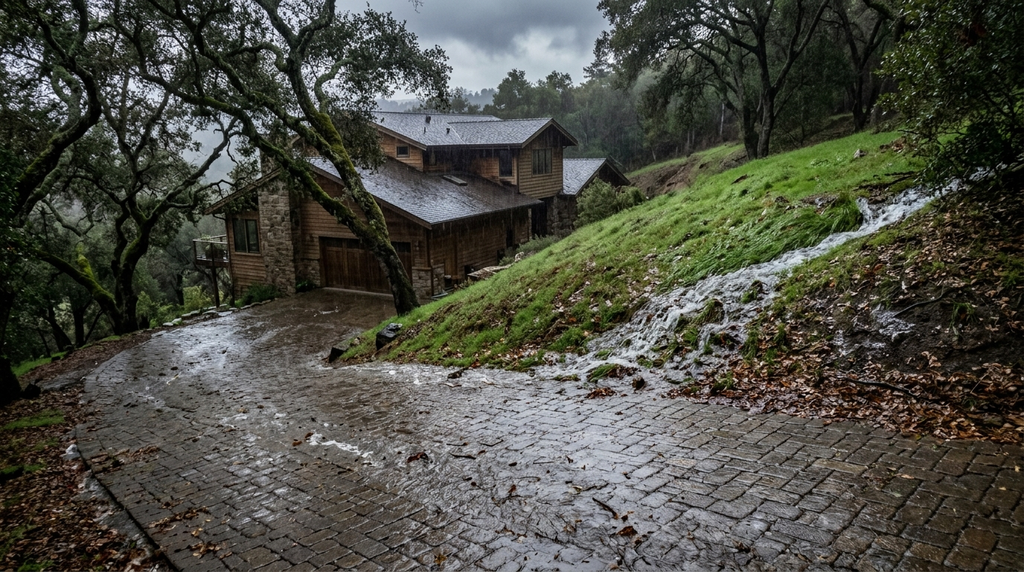
Once the water source is under control, a well-built paver driveway lasts. Above all, the right slope and a solid base make the difference. Our driveway pavers guide breaks down how we plan base depth and layout for vehicle loads.
A Typical Scenario: The Puddle in Front of the Garage
A homeowner in Concord sees water collecting in front of the garage after every storm. The paver driveway is about ten years old. Also, the puddle seems a little bigger each winter. Their first idea is a trench drain, the first of the driveway drainage solutions most people find online.
However, the rain check tells a different story. The puddle has a crisp outline. There’s a groove where the passenger side tire tracks. Also, a downspout on the garage corner empties straight onto the paving. That’s two causes from the table: a settled base and roof water feeding it.
The plan ends up simple. Redirect the downspout away from the paving. Next, lift the settled section and rebuild the base with the correct fall. Then reset the original pavers and refill the joints. As a result, no drain is needed here. Uphill runoff would have changed the answer, and a drainage specialist would have come first.
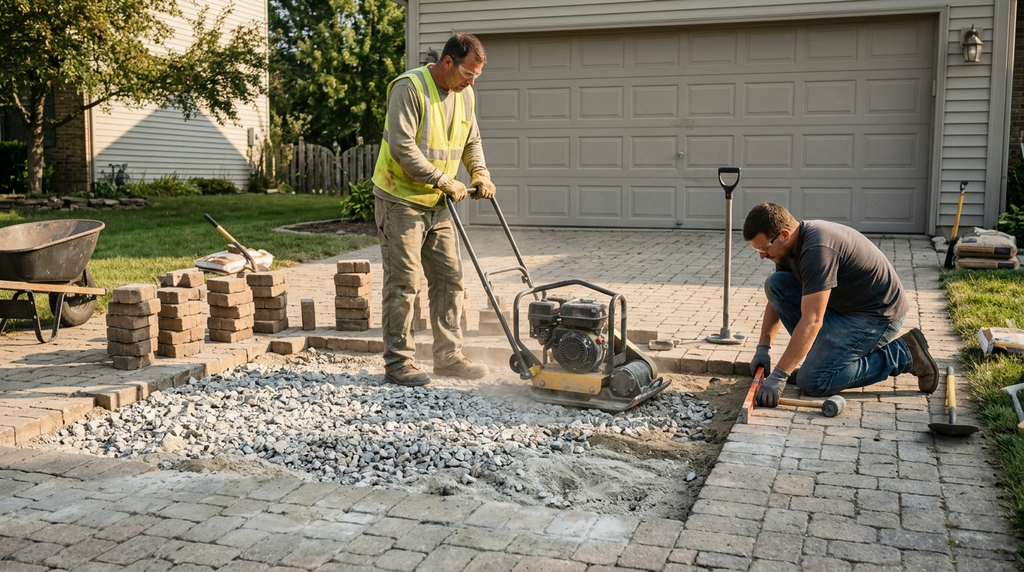
How We Approach Standing Water at BBP Pavers
Our process starts with the same questions in this guide, not with a product. First, we check the slope and look for settlement. Then our crew opens a joint or two and trace where the water comes from. Then we tell you which part we can fix and which part needs someone else.
Of course, you can check that approach for yourself. Our reviews on Yelp and our Better Business Bureau profile show how we work with Bay Area homeowners.
Have broader questions about materials or maintenance? Our FAQ page answers the ones we hear most often.
Frequently Asked Questions
Is a French drain or a trench drain better for a driveway?
French drains and trench drains handle different kinds of water, so neither wins every time. A trench drain sits flush with the surface and catches water running across the driveway. In contrast, a French drain is a buried gravel trench with a perforated pipe that collects water from the soil. Surface runoff at a garage often points to a trench drain. On the other hand, seepage from a slope may suit a French drain. Either way, a drainage specialist should confirm which one your site needs.
Can I put new pavers over a driveway that already floods?
New pavers alone won’t fix flooding caused by a slope, a neighbor’s lot, or saturated ground. If the surface itself is the cause, new pavers can help. That’s because correct pitch and a properly compacted base fix surface problems. When water comes from outside the driveway, that source has to be handled first.
How often should I check my driveway drainage?
Check your driveway drainage at least once a year, ideally before the Bay Area rainy season. Clear debris from any trench drain grates. Also look for empty joints, new low spots, and tire grooves. Check downspout extensions too, since they get bumped and disconnected.
Why do pavers sink after heavy rain?
Pavers usually sink because water reached a base that wasn’t built or compacted well. Then that water washes out bedding sand and softens weak spots in the base. Vehicle weight then pushes the pavers down into those spots. A lasting repair lifts the section and rebuilds the base instead of adding sand on top.
What affects the scope of fixing standing water on a driveway?
The scope of a standing water fix depends mostly on the cause and the site. Redirecting a downspout is a much smaller job than intercepting runoff from a slope. In addition, driveway size, equipment access, and how much base needs rebuilding all matter. So do soil type and where the water can safely go. An on-site visit is the only reliable way to define the scope of driveway drainage solutions for a property.
What should I ask a contractor before fixing driveway drainage?
Ask a contractor these questions before any driveway drainage work begins. Where is the water coming from, and how did you confirm it? Is this a surface problem, a drainage problem, or both? Where will the water go, and is that outlet allowed? What will you change in the base, and which part will someone else handle?
Find the Cause First, Then Choose the Fix
Standing water is a symptom. The cause might be a pitch problem, a sunken section, a downspout, or runoff from next door. It might also be wet ground below. So the best driveway drainage solutions are the ones that answer that cause directly.
Do the rain check, use the table, and bring your notes to whoever you hire. BBP Pavers can help from Concord and Walnut Creek to Palo Alto. Contact our team or call +1 844-497-3321, Monday to Friday, 7:00 AM to 5:00 PM. Then we’ll help you find the driveway drainage solutions that fit your property.